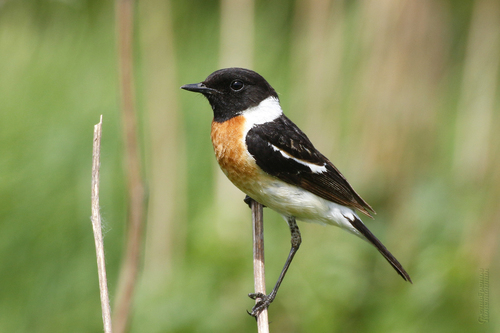
Blue Whistling-Thrush

Blue Whistling-Thrush

Myophonus caeruleus

Silhouette: Martin Bulla, based on François Desbordes' illustration · PhyloPic

LCLeast ConcernNTVUENCR
Daily sighting probability ~10% · With luck
at Royal Bardia National Park

In 3 days ~40% in a week ~70%

56 Verified sightings at Royal Bardia National Park From 2019 to 2026
6,758 In all 17 parks
February Best month
☀️ Diurnal When it's spotted

About the Blue Whistling-Thrush

The blue whistling thrush (Myophonus caeruleus) is a bird in the Old World flycatchers family Muscicapidae that is found in the mountains of Central Asia, South Asia, China and Southeast Asia. It is known for its loud human-like whistling song at dawn and dusk. The widely distributed populations show variations in size and plumage, with six subspecies accepted. Like others in the genus, they feed on the ground, often along streams and in damp places, foraging for snails, crabs, insects, and fruit.

The blue whistling thrush was formally described in 1786 by the Austrian naturalist Giovanni Antonio Scopoli under the binomial name Gracula caerulea. The specific epithet is from Latin caeruleus meaning "blue". Scopoli based his account on "Le Merle blue de la Chine" that had been described and illustrated in 1782 by the French naturalist Pierre Sonnerat in his book Voyage aux Indes orientales et a la Chine. The type locality has been restricted to Canton. The blue whistling thrush is now one of nine species placed in the genus Myophonus that was introduced in 1822 by the Dutch zoologist Coenraad Jacob Temminck.

Six subspecies are recognised: Wikipedia →

Sounds

Song0:33

China · 2025

© Bo Shunqi 薄顺奇 · XC1098732 · CC BY-NC-SA 4.0

Dawn song0:12

Kazakhstan · 2023

© Ding Li Yong · XC900568 · CC BY-NC-ND 4.0

Call0:59

China · 2021

© Geoff Carey · XC879330 · CC BY-NC-SA 4.0

Global Distribution

Parks Where Found

# Park Country Daily sighting probability
1 Langtang National Park 🇳🇵 Nepal
~70%
2 Doi Inthanon National Park 🇹🇭 Thailand
~60%
3 Royal Manas National Park 🇧🇹 Bhutan
~50%
4 Jim Corbett National Park 🇮🇳 India
~50%
5 Namdapha National Park 🇮🇳 India
~50%
6 Kerinci Seblat National Park 🇮🇩 Indonesia
~20%
7 Khao Yai National Park 🇹🇭 Thailand
~10%
8 Royal Bardia National Park 🇳🇵 Nepal
~10%
9 Hemis National Park 🇮🇳 India
~10%
10 Manas National Park 🇮🇳 India
~10%
11 Kaeng Krachan National Park 🇹🇭 Thailand
~10%
12 Gunung Leuser National Park 🇮🇩 Indonesia
<5%
13 Khao Luang National Park 🇹🇭 Thailand
<5%
14 Cuc Phuong National Park 🇻🇳 Vietnam
<5%
15 Kaziranga National Park 🇮🇳 India
<5%
16 Chitwan National Park 🇳🇵 Nepal
<5%
17 Khao Sok National Park 🇹🇭 Thailand
<5%

Cities Where Found

# City Country Daily sighting probability
1 Srinagar 🇮🇳 India
~30%
2 Hong Kong 🇨🇳 China
~30%
3 Nanjing 🇨🇳 China
~30%
4 Kathmandu 🇳🇵 Nepal
~20%
5 Guiyang 🇨🇳 China
~20%
6 Dehradun 🇮🇳 India
~20%
7 Changsha 🇨🇳 China
~20%
8 Almaty 🇰🇿 Kazakhstan
~20%
9 Jammu 🇮🇳 India
~10%
10 Chongqing 🇨🇳 China
~10%

Zoos & Centres Where Found

# Zoo / Centre Country
1 Disney's Animal Kingdom 🇺🇸 United States In captivity
2 Zürich Zoo 🇨🇭 Switzerland In captivity
3 Bronx Zoo 🇺🇸 United States In captivity
4 Hong Kong Zoological and Botanical Gardens 🇨🇳 China In captivity
5 Edward Youde Aviary 🇭🇰 Hong Kong SAR China In captivity

Before you go

What are the chances of seeing a Blue Whistling-Thrush in Royal Bardia National Park?

With luck

About 10% of wildlife watchers report a Blue Whistling-Thrush sighting in Royal Bardia National Park on a given day, based on 56 verified sightings from GBIF citizen-science data from 2019 to 2026. It is the 94th most-seen of the 233 birds we can rate there. Over three days the chance rises to about 40%, and over a week to about 70%, if each day is a fresh chance.

When is the best time to see a Blue Whistling-Thrush in Royal Bardia National Park?

February

In that month about 30% of wildlife watchers report a Blue Whistling-Thrush in Royal Bardia National Park on a given day, against about 10% in April–July and September–December, the lowest months. That is one of Royal Bardia National Park's driest months, with about 25 mm of rain against 590 mm in July. August has too few records to rate.

What time of day is best to see a Blue Whistling-Thrush?

Between noon and 3 pm

Across all the parks we cover, that three-hour window holds the most Blue Whistling-Thrush sightings with a recorded time, and about 9 in 10 of them come between 6 am and 6 pm: it is a daytime animal.

Which relatives of the Blue Whistling-Thrush live in Royal Bardia National Park?

Same family: Muscicapidae

The closest relatives of the Blue Whistling-Thrush that you can see in Royal Bardia National Park (family Muscicapidae, Old World Flycatchers, Robins, and Chats) are Pied Bushchat (about 50%), Oriental Magpie-Robin (about 40%) and Siberian Stonechat (about 30%), with each one's daily chance of a sighting.

Where does the Blue Whistling-Thrush sighting chance come from?

GBIF citizen-science records

It is estimated from how often the Blue Whistling-Thrush is recorded against all the birds logged in Royal Bardia National Park (56 verified sightings from 2019 to 2026), calibrated against known sighting rates. Figures are rounded to the nearest 10% because citizen-science data supports honest approximations, not decimals, and months with records from fewer than five people show "—". How it works.

← Back to Royal Bardia National Park