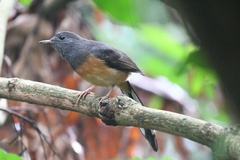
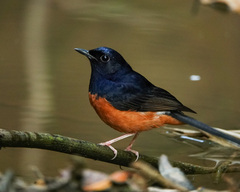
White-rumped Shama

White-rumped Shama

Copsychus malabaricus

Silhouette: Martin Bulla, based on François Desbordes' illustration · PhyloPic

LCLeast ConcernNTVUENCR
Daily sighting probability ~30% · Possible
at Royal Bardia National Park

In 3 days ~60% in a week ~90%

99 Verified sightings at Royal Bardia National Park From 2019 to 2026
13,141 In all 20 parks
May Best month
🌅 Crepuscular When it's spotted

About the White-rumped Shama

The white-rumped shama (Copsychus malabaricus) is a passerine bird in the Old World flycatcher family Muscicapidae. Native to densely vegetated habitats in the Indian subcontinent and Southeast Asia, its popularity as a cage-bird and songster has led to it being introduced elsewhere. The Larwo shama, the Kangean shama and the Sri Lanka shama were formerly considered to be conspecific with the white-rumped shama.

The white-rumped shama was formally described in 1786 by the Austrian naturalist Giovanni Antonio Scopoli under the binomial name Muscicapa malabarica. Scopoli based his account on "Le gobe-mouches à longue queue de Gingi" that had been described in 1782 by the French naturalist Pierre Sonnerat in the second volume of his book Voyage aux Indes orientales et à la Chine. Sonnerat mentioned that the bird was found on the Malabar Coast of India. The type locality is Mahé. The white-rumped shama is now one of 17 species placed in the genus Copsychus that was introduced in 1827 by the German naturalist Johann Georg Wagler.

Nine subspecies are recognised: Wikipedia →

Sounds

Recording0:06

Malaysia · 2025

© Lynette · iNaturalist · CC BY-NC 4.0

Recording0:32

Malaysia · 2019

© ivyesra · iNaturalist · CC BY-NC 4.0

Recording0:40

United States · 2024

© Susan Fawcett · iNaturalist · CC BY-NC 4.0

Global Distribution

Parks Where Found

# Park Country Daily sighting probability
1 Cat Tien National Park 🇻🇳 Vietnam
~70%
2 Kaeng Krachan National Park 🇹🇭 Thailand
~70%
3 Khao Luang National Park 🇹🇭 Thailand
~60%
4 Khao Sok National Park 🇹🇭 Thailand
~60%
5 Taman Negara National Park 🇲🇾 Malaysia
~40%
6 Cuc Phuong National Park 🇻🇳 Vietnam
~40%
7 Khao Yai National Park 🇹🇭 Thailand
~40%
8 Kanha National Park 🇮🇳 India
~30%
9 Manas National Park 🇮🇳 India
~30%
10 Royal Bardia National Park 🇳🇵 Nepal
~30%
11 Chitwan National Park 🇳🇵 Nepal
~20%
12 Kaziranga National Park 🇮🇳 India
~20%
13 Mudumalai National Park 🇮🇳 India
~20%
14 Doi Inthanon National Park 🇹🇭 Thailand
~10%
15 Bandhavgarh National Park 🇮🇳 India
~10%
16 Royal Manas National Park 🇧🇹 Bhutan
~10%
17 Jim Corbett National Park 🇮🇳 India
~10%
18 Nagarhole National Park 🇮🇳 India
~10%
19 Bandipur National Park 🇮🇳 India
<5%
20 Namdapha National Park 🇮🇳 India
<5%

Cities Where Found

# City Country Daily sighting probability
1 Kaohsiung 🇹🇼 Taiwan
~50%
2 Hanoi 🇻🇳 Vietnam
~30%
3 Taichung 🇹🇼 Taiwan
~20%
4 Guwahati 🇮🇳 India
~20%
5 Tainan 🇹🇼 Taiwan
~10%
6 Kuala Lumpur 🇲🇾 Malaysia
~10%
7 Ho Chi Minh City 🇻🇳 Vietnam
~10%
8 Taipei 🇹🇼 Taiwan
<5%
9 Dehradun 🇮🇳 India
<5%
10 Mumbai 🇮🇳 India
<5%

Zoos & Centres Where Found

# Zoo / Centre Country
1 Disney's Animal Kingdom 🇺🇸 United States In captivity
2 San Diego Zoo 🇺🇸 United States In captivity
3 Prague Zoo 🇨🇿 Czechia In captivity
4 Basel Zoo 🇨🇭 Switzerland In captivity
5 Copenhagen Zoo 🇩🇰 Denmark In captivity
6 Barcelona Zoo 🇪🇸 Spain In captivity
7 North Carolina Zoo 🇺🇸 United States In captivity
8 Zoo Miami 🇺🇸 United States In captivity
9 Songkhla Zoo 🇹🇭 Thailand In captivity
10 Marwell Zoo 🇬🇧 United Kingdom In captivity
11 Kyiv Zoo 🇺🇦 Ukraine In captivity
12 Woodland Park Zoo 🇺🇸 United States In captivity
13 Wrocław Zoological Garden 🇵🇱 Poland In captivity
14 Oregon Zoo 🇺🇸 United States In captivity
15 Taronga Zoo 🇦🇺 Australia In captivity
16 Gembira Loka Zoo 🇮🇩 Indonesia In captivity
17 Philadelphia Zoo 🇺🇸 United States In captivity
18 Surabaya Zoo 🇮🇩 Indonesia In captivity
19 London Zoo 🇬🇧 United Kingdom In captivity
20 Bandung Zoo 🇮🇩 Indonesia In captivity
21 Bird Paradise 🇸🇬 Singapore In captivity
22 Riverbanks Zoo 🇺🇸 United States In captivity
23 Aquarama Barcelona 🇪🇸 Spain In captivity
24 Lincoln Park Zoo 🇺🇸 United States In captivity
25 Rainforest Wild Asia 🇸🇬 Singapore In captivity
26 Vogelpark Avifauna 🇳🇱 Netherlands In captivity
27 Kebon Kewan Semarang 🇮🇩 Indonesia In captivity
28 Hong Kong Zoological and Botanical Gardens 🇨🇳 China In captivity
29 Tracy Aviary 🇺🇸 United States In captivity
30 Bioparc Fuengirola 🇪🇸 Spain In captivity
31 National Aviary 🇺🇸 United States In captivity
32 Africarium 🇵🇱 Poland In captivity
33 Oceanium 🇳🇱 Netherlands In captivity
34 Sea World Indonesia 🇮🇩 Indonesia In captivity
35 Edward Youde Aviary 🇭🇰 Hong Kong SAR China In captivity
36 Rákosův pavilon 🇨🇿 Czechia In captivity
37 Velemlokárium 🇨🇿 Czechia In captivity
38 BXSea Aquarium 🇮🇩 Indonesia In captivity
39 Jakarta Aquarium 🇮🇩 Indonesia In captivity
40 Lembang Park & Zoo 🇮🇩 Indonesia In captivity
41 Snakeroom Serpentarium 🇪🇸 Spain In captivity
42 terrarium ogrodu zoologicznego we Wrocławiu 🇵🇱 Poland In captivity
43 Vogelpark Bali 🇮🇩 Indonesia In captivity

Before you go

What are the chances of seeing a White-rumped Shama in Royal Bardia National Park?

Possible

About 30% of wildlife watchers report a White-rumped Shama sighting in Royal Bardia National Park on a given day, based on 99 verified sightings from GBIF citizen-science data from 2019 to 2026. It is the 51st most-seen of the 233 birds we can rate there. Over three days the chance rises to about 60%, and over a week to about 90%, if each day is a fresh chance.

When is the best time to see a White-rumped Shama in Royal Bardia National Park?

May

In that month about 50% of wildlife watchers report a White-rumped Shama in Royal Bardia National Park on a given day, against about 10% in December, the lowest month. That is one of Royal Bardia National Park's driest months, with about 75 mm of rain against 590 mm in July. August has too few records to rate.

What time of day is best to see a White-rumped Shama?

Between 3 and 6 am

Across all the parks we cover, that three-hour window holds the most White-rumped Shama sightings with a recorded time, and about 6 in 10 of them come between 6 pm and 6 am: it is most active around dawn and dusk.

Where does the White-rumped Shama sighting chance come from?

GBIF citizen-science records

It is estimated from how often the White-rumped Shama is recorded against all the birds logged in Royal Bardia National Park (99 verified sightings from 2019 to 2026), calibrated against known sighting rates. Figures are rounded to the nearest 10% because citizen-science data supports honest approximations, not decimals, and months with records from fewer than five people show "—". How it works.

← Back to Royal Bardia National Park