


Completed




African Bush Elephant
Loxodonta africana
Silhouette: Steven Traver · PhyloPic
- KingdomAnimalia (Animals)
- PhylumChordata (Chordates)
- ClassMammalia (Mammals)
- OrderProboscidea (Proboscideans)
- FamilyElephantidae (Elephants)
- GenusLoxodonta (African Elephants)
- SpeciesLoxodonta africana (African Bush Elephant)
In 3 days ~90% in a week >90%
18 Verified sightings at Selous Game Reserve From 2019 to 2026
12,035 In all 39 parks
December Best month
☀️ Diurnal When it's spotted



Completed
About the African Bush Elephant
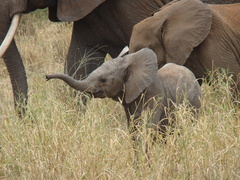
The African bush elephant (Loxodonta africana), also known as the African savanna elephant, is a species of elephant native to sub-Saharan Africa and the largest living terrestrial animal, with fully grown bulls reaching an average shoulder height of 3.04–3.36 m (10.0–11.0 ft) and a body mass of 5.2–6.9 t (5.7–7.6 short tons); the largest recorded specimen had a shoulder height of 3.96 m (13.0 ft) and an estimated body mass of 10.4 t (11.5 short tons). It is characterised by its long prehensile trunk with two finger-like processes; a concave back; large ears which help reduce body heat; and sturdy tusks that are noticeably curved. Its skin is grey with scanty hairs, and bending cracks which support thermoregulation by retaining water.
The African bush elephant inhabits a variety of habitats such as forests, grasslands, woodlands, wetlands and agricultural land. It is a mixed herbivore feeding mostly on grasses, creepers, herbs, leaves, and bark. The average adult consumes about 150 kg (330 lb) of vegetation and 230 L (51 imp gal; 61 US gal) of water each day. It is a social animal that lives in herds of cows and their offspring. Adult bulls usually live alone or in small bachelor groups. During the mating season, males undergo musth, a period of high testosterone levels and heightened aggression. The menstrual cycle of cows lasts three to four months, and gestation around 22 months, the longest of any mammal.
Since 2021, the African bush elephant has been listed as Endangered on the IUCN Red List. It is threatened foremost by habitat destruction, and in parts of its range also by poaching for meat and ivory. Between 2003 and 2015, the illegal killing of 14,606 African bush elephants was reported by rangers across 29 range countries. Chad is a major transit country for smuggling of ivory in West Africa, though this trend was curtailed by raising penalties for poaching and improving law enforcement. Poaching of the elephant in the 1970–1980s were considered the largest killings in history. In human culture, elephants have been extensively featured in literature, folklore and media, and are most valued for their large tusks. Wikipedia →
Sounds
Recording0:16
Botswana · 2020
© Dewald du Plessis · iNaturalist · CC BY-NC 4.0
Recording0:35
Kenya · 2018
© Tuoichen · iNaturalist · CC BY 4.0
Recording1:18
Mozambique · 2023
© nojinat · iNaturalist · CC BY-NC 4.0
Recent sightings of African Bush Elephant in Selous Game Reserve
LIVEiNaturalistGlobal Distribution
Parks Where Found
Zoos & Centres Where Found
Closest Relatives at Selous Game Reserve
No species of the same family or order lives in Selous Game Reserve, so these are its closest relatives here: other mammals.





Before you go
What are the chances of seeing an African Bush Elephant in Selous Game Reserve?
Likely
About 50% of wildlife watchers report an African Bush Elephant sighting in Selous Game Reserve on a given day, based on 18 verified sightings from GBIF citizen-science data from 2019 to 2026. It is the 6th most-seen of the 7 mammals we can rate there. Over three days the chance rises to about 90%, and over a week to over 90%, if each day is a fresh chance.
When is the best time to see an African Bush Elephant in Selous Game Reserve?
September and December
In those months about 70% of wildlife watchers report an African Bush Elephant in Selous Game Reserve on a given day, against about 10% in August, the lowest month. May has too few records to rate.
What time of day is best to see an African Bush Elephant?
Between 9 am and noon
Across all the parks we cover, that three-hour window holds the most African Bush Elephant sightings with a recorded time, and about 9 in 10 of them come between 6 am and 6 pm: it is a daytime animal.
Is Selous Game Reserve the best place to see an African Bush Elephant?
29th of 39
Of the 39 parks where we can rate African Bush Elephant sightings, Selous Game Reserve ranks 29th at about 50%. The best odds are in Tsavo East National Park (Kenya, about 90%), Lower Zambezi National Park (Zambia, about 80%) and Tarangire National Park (Tanzania, about 80%). All parks ranked.
Where does the African Bush Elephant sighting chance come from?
GBIF citizen-science records
It is estimated from how often the African Bush Elephant is recorded against all the mammals logged in Selous Game Reserve (18 verified sightings from 2019 to 2026), calibrated against known sighting rates. Figures are rounded to the nearest 10% because citizen-science data supports honest approximations, not decimals, and months with records from fewer than five people show "—". How it works.
