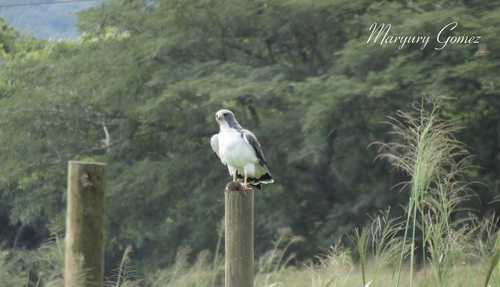
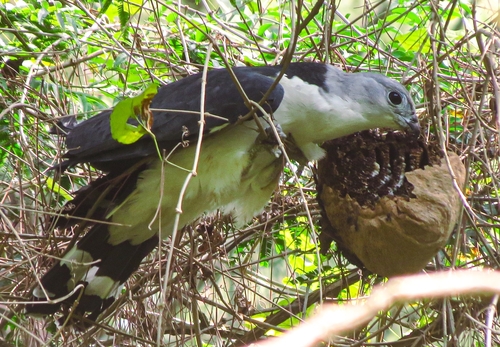
Black-chested Buzzard-Eagle

Black-chested Buzzard-Eagle

Geranoaetus melanoleucus

Silhouette: Sheatherius · PhyloPic

LCLeast ConcernNTVUENCR
Daily sighting probability ~10% · With luck
at Serra da Canastra National Park

In 3 days ~40% in a week ~70%

79 Verified sightings at Serra da Canastra National Park From 2019 to 2026
2,767 In all 13 parks
September Best month
☀️ Diurnal When it's spotted

About the Black-chested Buzzard-Eagle

The black-chested buzzard-eagle (Geranoaetus melanoleucus) is a bird of prey of the hawk and eagle family (Accipitridae). It lives in open regions of South America. This species is also known as the black buzzard-eagle, the gray buzzard-eagle, or analogously with "eagle" or "eagle-buzzard" replacing "buzzard-eagle", or as the Chilean blue eagle. It is sometimes placed in the genus Buteo.

Its scientific name is Latinized Ancient Greek and means "black-and-white crane-eagle" or (if called Buteo melanoleucos) "black-and-white buzzard": Geranoaetus comes from Ancient Greek géranos (γέρανoς), "crane" + aetós (ἆετός), "eagle". The "crane" reference is due to its grey upper wings and its loud cries. The alternative genus name Buteo is simply the Latin term used for these hawks in Ancient Rome, translating as "buzzard" (in the European sense). melanoleucus is from Ancient Greek mélan- (μέλαν-), "black-" + leukós (λευκός), "white". This refers to the contrasting coloration when seen from below.

When the black-chested buzzard-eagle was first described by Louis Pierre Vieillot in 1819, it was placed in the genus Spizaetus, as Spizaetus melanoleucus. Nowadays, however... Wikipedia →

Sounds

Flight call0:04

Ecuador · 2025

© Manuel Sánchez-Nivicela · XC1161738 · CC BY-NC-ND 4.0

Canto0:39

Brazil · 2016

© Caio Brito · XC427408 · CC BY-NC-SA 4.0

Begging call0:23

Brazil · 2017

© Nunes D'Acosta · XC396797 · CC BY-NC-SA 4.0

Global Distribution

Parks Where Found

# Park Country Daily sighting probability
1 Torres del Paine National Park 🇨🇱 Chile
~30%
2 Chingaza National Natural Park 🇨🇴 Colombia
~30%
3 Amboró National Park 🇧🇴 Bolivia
~20%
4 Los Nevados National Natural Park 🇨🇴 Colombia
~20%
5 Tierra del Fuego National Park 🇦🇷 Argentina
~20%
6 Serra da Canastra National Park 🇧🇷 Brazil
~10%
7 Nahuel Huapi National Park 🇦🇷 Argentina
~10%
8 Chapada Diamantina National Park 🇧🇷 Brazil
~10%
9 Península Valdés 🇦🇷 Argentina
<5%
10 Iberá National Park 🇦🇷 Argentina
<5%
11 Lauca National Park 🇨🇱 Chile
<5%
12 Podocarpus National Park 🇪🇨 Ecuador
<5%
13 Tijuca National Park 🇧🇷 Brazil
<5%

Cities Where Found

# City Country Daily sighting probability
1 Santiago 🇨🇱 Chile
~10%
2 Arequipa 🇵🇪 Peru
<5%
3 La Paz 🇧🇴 Bolivia
<5%
4 Quito 🇪🇨 Ecuador
<5%
5 Bogota 🇨🇴 Colombia
<5%
6 Rio de Janeiro 🇧🇷 Brazil
<5%
7 Buenos Aires 🇦🇷 Argentina
<5%

Zoos & Centres Where Found

# Zoo / Centre Country
1 Pairi Daiza 🇧🇪 Belgium In captivity
2 ZooParc de Beauval 🇫🇷 France In captivity
3 Cabarceno Natural Park 🇪🇸 Spain In captivity
4 African Lion Safari 🇨🇦 Canada In captivity
5 Parque Zoológico 🇧🇷 Brazil In captivity
6 Zoológico de Brasília 🇧🇷 Brazil In captivity
7 Safari Madrid 🇪🇸 Spain In captivity
8 Wildpark Poing 🇩🇪 Germany In captivity
9 São Paulo Zoo 🇧🇷 Brazil In captivity
10 Wildgehege Hellenthal 🇩🇪 Germany In captivity
11 Parque Zoologico Guátika 🇨🇴 Colombia In captivity
12 Temaikén 🇦🇷 Argentina In captivity
13 Lisbon Zoo 🇵🇹 Portugal In captivity
14 Parque Zoobotânico Arruda Câmara (BICA) 🇧🇷 Brazil In captivity
15 Zoológico Dois Irmãos 🇧🇷 Brazil In captivity
16 Bioparque Municipal Vesty Pakos 🇧🇴 Bolivia In captivity
17 Ecopark 🇦🇷 Argentina In captivity
18 Zoom di Cumiana 🇮🇹 Italy In captivity
19 Faunia 🇪🇸 Spain In captivity
20 Parque Safari 🇨🇱 Chile In captivity
21 Leśny Park Niespodzianek 🇵🇱 Poland In captivity
22 Amaru 🇪🇨 Ecuador In captivity
23 Parque de las Leyendas 🇵🇪 Peru In captivity
24 Parc animalier de Courzieu 🇫🇷 France In captivity
25 Aviario Nacional de Colombia 🇨🇴 Colombia In captivity
26 Buin Zoo 🇨🇱 Chile In captivity
27 Bioparque Wakatá 🇨🇴 Colombia In captivity
28 Reserva de Fauna y Flora Pan de Azúcar 🇺🇾 Uruguay In captivity
29 Zoológico Villa Dolores 🇺🇾 Uruguay In captivity
30 Zoo Park da Montanha 🇧🇷 Brazil In captivity
31 Zoo. La Isla del Tapir 🇪🇨 Ecuador In captivity
32 Palmitos Park 🇪🇸 Spain In captivity
33 Chilean National Zoo 🇨🇱 Chile In captivity
34 The Raptor Foundation 🇬🇧 United Kingdom In captivity
35 Santacruz zoo 🇨🇴 Colombia In captivity
36 Cim d'Àligues 🇪🇸 Spain In captivity
37 Ecozoológico San Martín 🇪🇨 Ecuador In captivity
38 Granja los Pibes 🇦🇷 Argentina In captivity
39 Le Domaine des Fauves 🇫🇷 France In captivity
40 Zoo Criadero Tarqui 🇪🇨 Ecuador In captivity
41 Zoologico Mundo Andino - Tipon 🇵🇪 Peru In captivity
42 Zoológico de Concepción 🇨🇱 Chile In captivity
43 Arequipa zoo 🇵🇪 Peru In captivity
44 Zoocriadero Vida Salvaje 🇵🇪 Peru In captivity
45 Adlerwarte Berlebeck 🇩🇪 Germany In captivity
46 Agroflori Parque de las Aves 🇧🇴 Bolivia In captivity
47 Gauntlet Birds of Prey 🇬🇧 United Kingdom In captivity
48 Liberty's Owl, Raptor and Reptile Centre 🇬🇧 United Kingdom In captivity
49 Parque dos Falcões 🇧🇷 Brazil In captivity
50 Thirsk Birds of Prey Centre 🇬🇧 United Kingdom In captivity

Before you go

What are the chances of seeing a Black-chested Buzzard-Eagle in Serra da Canastra National Park?

With luck

About 10% of wildlife watchers report a Black-chested Buzzard-Eagle sighting in Serra da Canastra National Park on a given day, based on 79 verified sightings from GBIF citizen-science data from 2019 to 2026. It is the 124th most-seen of the 294 birds we can rate there. Over three days the chance rises to about 40%, and over a week to about 70%, if each day is a fresh chance.

When is the best time to see a Black-chested Buzzard-Eagle in Serra da Canastra National Park?

September

In that month about 30% of wildlife watchers report a Black-chested Buzzard-Eagle in Serra da Canastra National Park on a given day, against under 5% in April, the lowest month. That is one of Serra da Canastra National Park's driest months, with about 45 mm of rain against 280 mm in January.

What time of day is best to see a Black-chested Buzzard-Eagle?

Between noon and 3 pm

Across all the parks we cover, that three-hour window holds the most Black-chested Buzzard-Eagle sightings with a recorded time, and about 9 in 10 of them come between 6 am and 6 pm: it is a daytime animal.

Which relatives of the Black-chested Buzzard-Eagle live in Serra da Canastra National Park?

Same family: Accipitridae

The closest relatives of the Black-chested Buzzard-Eagle that you can see in Serra da Canastra National Park (family Accipitridae, Hawks, Eagles, and Kites) are White-tailed Hawk (about 30%), Roadside Hawk (about 30%) and Savanna Hawk (about 10%), with each one's daily chance of a sighting.

Where does the Black-chested Buzzard-Eagle sighting chance come from?

GBIF citizen-science records

It is estimated from how often the Black-chested Buzzard-Eagle is recorded against all the birds logged in Serra da Canastra National Park (79 verified sightings from 2019 to 2026), calibrated against known sighting rates. Figures are rounded to the nearest 10% because citizen-science data supports honest approximations, not decimals, and months with records from fewer than five people show "—". How it works.

← Back to Serra da Canastra National Park