Black-tailed Trogon

Black-tailed Trogon

Trogon melanurus

Silhouette: Edwin Price · PhyloPic

LCLeast ConcernNTVUENCR
Daily sighting probability <5% · Rare
at Sierra de la Macarena National Park

In 3 days <5% in a week ~10%

12 Verified sightings at Sierra de la Macarena National Park From 2019 to 2026
6,097 In all 12 parks
July Best month
☀️ Diurnal When it's spotted

About the Black-tailed Trogon

The black-tailed trogon (Trogon melanurus) is a species of bird in the family Trogonidae, the quetzals and trogons. It is found Panama and northern South America. The Clements taxonomy adds a fourth subspecies, T. m. occidentalis. What is now the Ecuadorian trogon (T. mesurus) was until the early 2000s considered another subspecies. A subspecies of slaty-tailed trogon (T. massena australis) is sometimes treated as a subspecies of black-tailed trogon, and T. m. macroura has been suggested as a separate species.

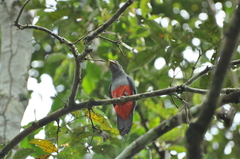
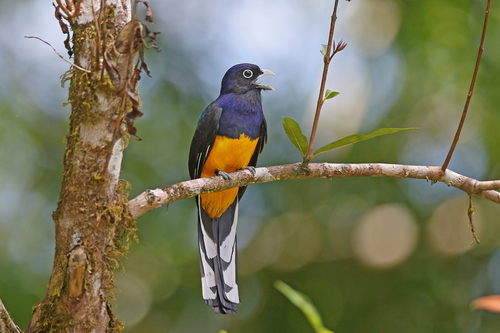
The black-tailed trogon is 28 to 30 cm (11 to 12 in) long and weighs 52 to 122 g (1.8 to 4.3 oz). The male of the nominate subspecies has a yellow bill and a blackish face and throat with an orange-red ring around the eye. The crown, nape, upperparts, and breast are green. A white band separates the breast from the red belly and vent. The upperside of the tail is deep blue and the underside is slaty gray. The folded wing has fine vermiculation that looks gray... Wikipedia →

Sounds

Song0:08

Ecuador · 2010

© Manuel Sánchez-Nivicela · XC1154475 · CC BY-NC-ND 4.0

Call0:41

Brazil · 2025

© Joost van Bruggen · XC1050437 · CC BY-NC-ND 4.0

Duet0:26

Brazil · 2025

© JAYRSON ARAUJO DE OLIVEIRA · XC1035172 · CC BY-NC-SA 4.0

Global Distribution

Parks Where Found

# Park Country Daily sighting probability
1 Manu National Park 🇵🇪 Peru
~30%
2 Tambopata National Reserve 🇵🇪 Peru
~30%
3 Soberanía National Park 🇵🇦 Panama
~30%
4 Amacayacu National Natural Park 🇨🇴 Colombia
~20%
5 Darién National Park 🇵🇦 Panama
~20%
6 Cuyabeno Wildlife Reserve 🇪🇨 Ecuador
~20%
7 Yasuní National Park 🇪🇨 Ecuador
~10%
8 Anavilhanas National Park 🇧🇷 Brazil
<5%
9 Chagres National Park 🇵🇦 Panama
<5%
10 San Lorenzo Protected Forest 🇵🇦 Panama
<5%
11 Sierra de la Macarena National Park 🇨🇴 Colombia
<5%
12 Parque Natural Metropolitano 🇵🇦 Panama
<5%

Zoos & Centres Where Found

# Zoo / Centre Country
1 Dallas World Aquarium 🇺🇸 United States In captivity

Before you go

What are the chances of seeing a Black-tailed Trogon in Sierra de la Macarena National Park?

Rare

Under 5% of wildlife watchers report a Black-tailed Trogon sighting in Sierra de la Macarena National Park on a given day, based on 12 verified sightings from GBIF citizen-science data from 2019 to 2026. It is the 331st most-seen of the 418 birds we can rate there. Over three days the chance rises to under 5%, and over a week to about 10%, if each day is a fresh chance.

When is the best time to see a Black-tailed Trogon in Sierra de la Macarena National Park?

Any time of year

In every month with enough records, under 5% of wildlife watchers report a Black-tailed Trogon in Sierra de la Macarena National Park on a given day, so our monthly data shows no clear season.

What time of day is best to see a Black-tailed Trogon?

Between 8 and 11 am

Across all the parks we cover, that three-hour window holds the most Black-tailed Trogon sightings with a recorded time, and about 9 in 10 of them come between 6 am and 6 pm: it is a daytime animal.

Is Sierra de la Macarena National Park the best place to see a Black-tailed Trogon?

11th of 12

Of the 12 parks where we can rate Black-tailed Trogon sightings, Sierra de la Macarena National Park ranks 11th at under 5%. The best odds are in Manu National Park (Peru, about 30%), Tambopata National Reserve (Peru, about 30%) and Soberanía National Park (Panama, about 30%).

Where does the Black-tailed Trogon sighting chance come from?

GBIF citizen-science records

It is estimated from how often the Black-tailed Trogon is recorded against all the birds logged in Sierra de la Macarena National Park (12 verified sightings from 2019 to 2026), calibrated against known sighting rates. Figures are rounded to the nearest 10% because citizen-science data supports honest approximations, not decimals, and months with records from fewer than five people show "—". How it works.

← Back to Sierra de la Macarena National Park