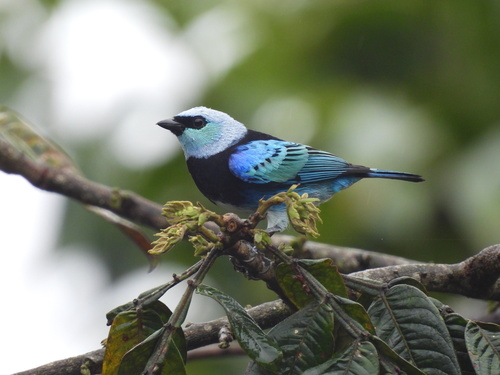
Blue-necked Tanager

Blue-necked Tanager

Stilpnia cyanicollis

Silhouette: Sheatherius · PhyloPic

Daily sighting probability <5% · Rare
at Sierra de la Macarena National Park

In 3 days <5% in a week ~10%

8 Verified sightings at Sierra de la Macarena National Park From 2019 to 2026
2,185 In all 10 parks
April Best month
☀️ Diurnal When it's spotted

About the Blue-necked Tanager

The blue-necked tanager (Stilpnia cyanicollis) is a species of bird in the family Thraupidae. It is found in South America from Colombia to Bolivia. Its natural habitats are subtropical or tropical moist lowland forest, subtropical or tropical moist montane forest, and heavily degraded former forest. The blue-necked tanager averages 12 cm (4.7 in) in length and weighs approximately 17 g (5⁄8 oz). They have a blue hood and throat. The wing coverts, wing edges, and rump are turquoise to a greenish straw color. The posterior underparts are black, violet, or blue. The juveniles are brownish gray, with a hint of adult coloration. Coloration of adults varies slightly by region. The beaks, legs, and feet are black. The diet of the blue-necked tanager consists of fruits, berries, flower blossoms and insects. Tanagers will pick insects from leaves, or sometimes in flight, but fruit is the major dietary item.

The female builds a cup nest of moss, usually well concealed, and lays an average of 2 white eggs with brown spotting. Incubation is 13–14 days and the chicks fledge after 15–16 days. The male and female feed the nestlings on insects and fruit, and may be assisted by helpers. Wikipedia →

Sounds

Song0:17

Ecuador · 2026

© Jonas Nilsson · XC1097218 · CC BY-NC-SA 4.0

Call0:37

Ecuador · 2023

© Manuel Sánchez-Nivicela · XC1022036 · CC BY-NC-ND 4.0

Call0:15

Ecuador · 2023

© rudy gelis · XC828925 · CC BY-NC-SA 4.0

Global Distribution

Parks Where Found

# Park Country Daily sighting probability
1 Podocarpus National Park 🇪🇨 Ecuador
~30%
2 Henri Pittier National Park 🇻🇪 Venezuela
~20%
3 Farallones de Cali National Natural Park 🇨🇴 Colombia
~20%
4 Manu National Park 🇵🇪 Peru
~10%
5 Chingaza National Natural Park 🇨🇴 Colombia
<5%
6 Los Nevados National Natural Park 🇨🇴 Colombia
<5%
7 Machalilla National Park 🇪🇨 Ecuador
<5%
8 Chapada dos Guimarães National Park 🇧🇷 Brazil
<5%
9 Sierra de la Macarena National Park 🇨🇴 Colombia
<5%
10 Yasuní National Park 🇪🇨 Ecuador
<5%

Cities Where Found

# City Country Daily sighting probability
1 Medellín 🇨🇴 Colombia
~10%
2 Cali 🇨🇴 Colombia
<5%
3 Valencia 🇻🇪 Venezuela
<5%
4 Bogota 🇨🇴 Colombia
<5%

Zoos & Centres Where Found

# Zoo / Centre Country
1 San Diego Zoo 🇺🇸 United States In captivity
2 Basel Zoo 🇨🇭 Switzerland In captivity
3 California Academy of Sciences 🇺🇸 United States In captivity
4 Zoo Miami 🇺🇸 United States In captivity
5 San Diego Zoo Safari Park 🇺🇸 United States In captivity
6 Memphis Zoo 🇺🇸 United States In captivity
7 Aviario Nacional de Colombia 🇨🇴 Colombia In captivity
8 The Living Planet Aquarium 🇺🇸 United States In captivity
9 Universeum 🇸🇪 Sweden In captivity

Before you go

What are the chances of seeing a Blue-necked Tanager in Sierra de la Macarena National Park?

Rare

Under 5% of wildlife watchers report a Blue-necked Tanager sighting in Sierra de la Macarena National Park on a given day, based on 8 verified sightings from GBIF citizen-science data from 2019 to 2026. It is the 362nd most-seen of the 418 birds we can rate there. Over three days the chance rises to under 5%, and over a week to about 10%, if each day is a fresh chance.

When is the best time to see a Blue-necked Tanager in Sierra de la Macarena National Park?

Any time of year

In every month with enough records, under 5% of wildlife watchers report a Blue-necked Tanager in Sierra de la Macarena National Park on a given day, so our monthly data shows no clear season.

What time of day is best to see a Blue-necked Tanager?

Between 3 and 6 pm

Across all the parks we cover, that three-hour window holds the most Blue-necked Tanager sightings with a recorded time, and about 9 in 10 of them come between 6 am and 6 pm: it is a daytime animal.

Which relatives of the Blue-necked Tanager live in Sierra de la Macarena National Park?

Same genus: Stilpnia

The closest relatives of the Blue-necked Tanager that you can see in Sierra de la Macarena National Park (genus Stilpnia, Stilpnia Tanagers) are Burnished-buff Tanager (about 30%) and Masked Tanager (about 20%), with each one's daily chance of a sighting.

Where does the Blue-necked Tanager sighting chance come from?

GBIF citizen-science records

It is estimated from how often the Blue-necked Tanager is recorded against all the birds logged in Sierra de la Macarena National Park (8 verified sightings from 2019 to 2026), calibrated against known sighting rates. Figures are rounded to the nearest 10% because citizen-science data supports honest approximations, not decimals, and months with records from fewer than five people show "—". How it works.

← Back to Sierra de la Macarena National Park