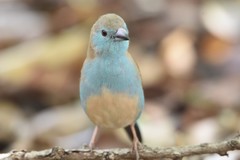
Blue-breasted Cordonbleu

Blue-breasted Cordonbleu

Uraeginthus angolensis

Silhouette: Sheatherius · PhyloPic

LCLeast ConcernNTVUENCR
Daily sighting probability ~60% · Likely
at South Luangwa National Park

In 3 days ~90% in a week >90%

385 Verified sightings at South Luangwa National Park From 2019 to 2026
9,462 In all 20 parks
August Best month
☀️ Diurnal When it's spotted

About the Blue-breasted Cordonbleu

The blue waxbill (Uraeginthus angolensis), also called southern blue waxbill, blue-breasted waxbill, southern cordon-bleu, blue-cheeked cordon-bleu, blue-breasted cordon-bleu and Angola cordon-bleu, is a common species of estrildid finch found in Southern Africa. It is also relatively commonly kept as an aviary bird.

The blue waxbill was formally described by the Swedish naturalist Carl Linnaeus in 1758 in the tenth edition of his Systema Naturae under the binomial name Fringilla angolensis. Linnaeus based his description on the "Blue-Belly'd Finch" that had been described and illustrated in 1750 by the English naturalist George Edwards in his A Natural History of Uncommon Birds. Edwards had viewed a caged bird in London that had come from Angola. This species is now placed in the genus Uraeginthus that was introduced by the German ornithologist Jean Cabanis in 1851.

Three subspecies are recognized: The blue waxbill has powder-blue face, breast, rump, and flanks with pale brown upperparts. The female is paler than the male and the blue is confined to the rump, tail, head, and upper breast, with the rest of the underparts being buffy brown. They measure... Wikipedia →

Sounds

Call1:15

Botswana · 2023

© Marc Anderson · XC1080584 · CC BY-NC-ND 4.0

Alarm call0:10

Zambia · 2021

© Hans Matheve · XC699503 · CC BY-NC-ND 4.0

Song1:14

South Africa · 2020

© Derek Solomon · XC538794 · CC BY-NC-SA 4.0

Global Distribution

Parks Where Found

# Park Country Daily sighting probability
1 Gonarezhou National Park 🇿🇼 Zimbabwe
~70%
2 uMkhuze Game Reserve 🇿🇦 South Africa
~60%
3 South Luangwa National Park 🇿🇲 Zambia
~60%
4 Mana Pools National Park 🇿🇼 Zimbabwe
~50%
5 Liwonde National Park 🇲🇼 Malawi
~50%
6 Kruger National Park 🇿🇦 South Africa
~50%
7 Lower Zambezi National Park 🇿🇲 Zambia
~50%
8 Hluhluwe-Imfolozi Park 🇿🇦 South Africa
~40%
9 Kafue National Park 🇿🇲 Zambia
~40%
10 Mikumi National Park 🇹🇿 Tanzania
~40%
11 Pilanesberg National Park 🇿🇦 South Africa
~40%
12 Gorongosa National Park 🇲🇿 Mozambique
~40%
13 Hwange National Park 🇿🇼 Zimbabwe
~30%
14 Chobe National Park 🇧🇼 Botswana
~30%
15 Moremi Game Reserve 🇧🇼 Botswana
~30%
16 Waterberg Plateau Park 🇳🇦 Namibia
~30%
17 Etosha National Park 🇳🇦 Namibia
~20%
18 Ruaha National Park 🇹🇿 Tanzania
~10%
19 iSimangaliso Wetland Park 🇿🇦 South Africa
<5%
20 Tarangire National Park 🇹🇿 Tanzania
<5%

Cities Where Found

# City Country Daily sighting probability
1 Harare 🇿🇼 Zimbabwe
~70%
2 Lusaka 🇿🇲 Zambia
~60%
3 Brazzaville 🇨🇬 Republic of the Congo
~60%
4 Dar es-Salaam 🇹🇿 Tanzania
~40%
5 Lilongwe 🇲🇼 Malawi
~30%
6 Luanda 🇦🇴 Angola
~30%
7 Lubango 🇦🇴 Angola
~20%
8 Pretoria 🇿🇦 South Africa
~10%
9 Maputo 🇲🇿 Mozambique
<5%
10 Johannesburg 🇿🇦 South Africa
<5%

Before you go

What are the chances of seeing a Blue-breasted Cordonbleu in South Luangwa National Park?

Likely

About 60% of wildlife watchers report a Blue-breasted Cordonbleu sighting in South Luangwa National Park on a given day, based on 385 verified sightings from GBIF citizen-science data from 2019 to 2026. It is the 17th most-seen of the 257 birds we can rate there. Over three days the chance rises to about 90%, and over a week to over 90%, if each day is a fresh chance.

When is the best time to see a Blue-breasted Cordonbleu in South Luangwa National Park?

August and November

In those months about 70% of wildlife watchers report a Blue-breasted Cordonbleu in South Luangwa National Park on a given day, against about 40% in June, the lowest month. Those are among South Luangwa National Park's driest months, with about 30 mm of rain a month against 310 mm in January.

What time of day is best to see a Blue-breasted Cordonbleu?

Between 9 am and noon

Across all the parks we cover, that three-hour window holds the most Blue-breasted Cordonbleu sightings with a recorded time, and about 9 in 10 of them come between 6 am and 6 pm: it is a daytime animal.

Is South Luangwa National Park the best place to see a Blue-breasted Cordonbleu?

3rd of 20

Of the 20 parks where we can rate Blue-breasted Cordonbleu sightings, South Luangwa National Park ranks 3rd at about 60%. The best odds are in Gonarezhou National Park (Zimbabwe, about 70%) and uMkhuze Game Reserve (South Africa, about 60%). All parks ranked.

Which relatives of the Blue-breasted Cordonbleu live in South Luangwa National Park?

Same family: Estrildidae

The closest relatives of the Blue-breasted Cordonbleu that you can see in South Luangwa National Park (family Estrildidae, Waxbills and Allies) are Red-billed Firefinch (about 30%), Green-winged Pytilia (about 20%) and Jameson's Firefinch (about 10%), with each one's daily chance of a sighting.

Where does the Blue-breasted Cordonbleu sighting chance come from?

GBIF citizen-science records

It is estimated from how often the Blue-breasted Cordonbleu is recorded against all the birds logged in South Luangwa National Park (385 verified sightings from 2019 to 2026), calibrated against known sighting rates. Figures are rounded to the nearest 10% because citizen-science data supports honest approximations, not decimals, and months with records from fewer than five people show "—". How it works.

← Back to South Luangwa National Park