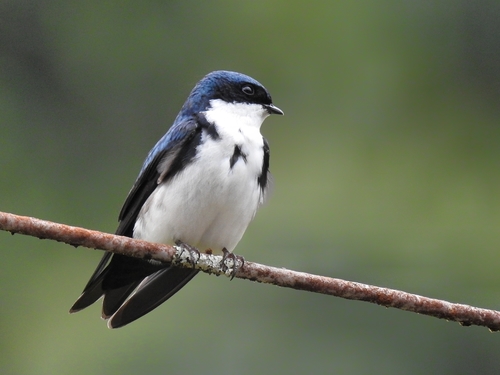
White-ruffed Manakin

White-ruffed Manakin

Corapipo altera

Silhouette: Edwin Price · PhyloPic

Daily sighting probability ~10% · With luck
at Tapantí-Macizo de la Muerte National Park

In 3 days ~30% in a week ~60%

1,156 Verified sightings at Tapantí-Macizo de la Muerte National Park From 2019 to 2026
6,668 In all 15 parks
October Best month
☀️ Diurnal When it's spotted

About the White-ruffed Manakin

The white-ruffed manakin (Corapipo altera) is a sub-oscine (Tyranni), passerine bird in the manakin family. It is a resident breeder in the tropical New World from eastern Honduras to northwestern Colombia. Its typical habitat is wet forest, adjacent clearings and tall secondary growth. It is a small, plump bird about 10 centimetres (4 in) long. Males have glossy blue-black plumage with a white erectile ruff on the throat and females are green. At breeding time, males are involved in lekking behaviour on the forest floor during which they puff out their neck feathers. This is a fairly common species with a wide range.

The white-ruffed manakin is, like its relatives, a compact short-tailed bird with a flat, wide bill, dark legs and striking male plumage. It is typically 10 cm long and weighs ~11 g (9–14 g; males are smaller than females).

The adult male is mostly glossy blue-black with a white erectile ruff on the throat and sides of the neck. His wings are modified, with a very short outer primary. Females and birds in their first year of life are olive-green with a greyish throat. In their second year, males molt into a mostly-green plumage but with a black mask and... Wikipedia →

Sounds

Recording0:42

Costa Rica · 2024

© Scott Olmstead · XC949653 · CC BY-NC-SA 4.0

Uncertain0:48

Costa Rica · 2022

© Finca Cántaros · XC715197 · CC BY-NC-SA 4.0

Song0:05

Costa Rica · 2020

© Johan Chaves · XC557137 · CC BY-NC-SA 4.0

Global Distribution

Parks Where Found

# Park Country Daily sighting probability
1 Chagres National Park 🇵🇦 Panama
~40%
2 Darién National Park 🇵🇦 Panama
~30%
3 Tenorio Volcano National Park 🇨🇷 Costa Rica
~20%
4 Arenal Volcano National Park 🇨🇷 Costa Rica
~20%
5 Braulio Carrillo National Park 🇨🇷 Costa Rica
~10%
6 Tapantí-Macizo de la Muerte National Park 🇨🇷 Costa Rica
~10%
7 Rincón de la Vieja National Park 🇨🇷 Costa Rica
<5%
8 La Amistad International Park (Panama) 🇵🇦 Panama
<5%
9 Chirripó National Park 🇨🇷 Costa Rica
<5%
10 Marino Ballena National Park 🇨🇷 Costa Rica
<5%
11 Carara National Park 🇨🇷 Costa Rica
<5%
12 Poás Volcano National Park 🇨🇷 Costa Rica
<5%
13 Piedras Blancas National Park 🇨🇷 Costa Rica
<5%
14 Manuel Antonio National Park 🇨🇷 Costa Rica
<5%
15 Corcovado National Park 🇨🇷 Costa Rica
<5%

Before you go

What are the chances of seeing a White-ruffed Manakin in Tapantí-Macizo de la Muerte National Park?

With luck

About 10% of wildlife watchers report a White-ruffed Manakin sighting in Tapantí-Macizo de la Muerte National Park on a given day, based on 1,156 verified sightings from GBIF citizen-science data from 2019 to 2026. It is the 87th most-seen of the 467 birds we can rate there. Over three days the chance rises to about 30%, and over a week to about 60%, if each day is a fresh chance.

When is the best time to see a White-ruffed Manakin in Tapantí-Macizo de la Muerte National Park?

October

In that month about 30% of wildlife watchers report a White-ruffed Manakin in Tapantí-Macizo de la Muerte National Park on a given day, against about 10% in August–September and November–June, the lowest months. That is one of Tapantí-Macizo de la Muerte National Park's wettest months, with about 570 mm of rain against 160 mm in February.

What time of day is best to see a White-ruffed Manakin?

Between 9 am and noon

Across all the parks we cover, that three-hour window holds the most White-ruffed Manakin sightings with a recorded time, and nearly all of them come between 6 am and 6 pm: it is a daytime animal.

Where does the White-ruffed Manakin sighting chance come from?

GBIF citizen-science records

It is estimated from how often the White-ruffed Manakin is recorded against all the birds logged in Tapantí-Macizo de la Muerte National Park (1,156 verified sightings from 2019 to 2026), calibrated against known sighting rates. Figures are rounded to the nearest 10% because citizen-science data supports honest approximations, not decimals, and months with records from fewer than five people show "—". How it works.

← Back to Tapantí-Macizo de la Muerte National Park