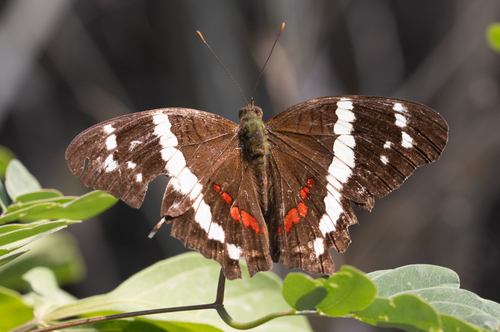
Belted Orchid Bee

Belted Orchid Bee

Eulaema cingulata

Daily sighting probability ~10% · With luck
at Tortuguero National Park

In 3 days ~20% in a week ~40%

5 Verified sightings at Tortuguero National Park From 2019 to 2026
123 In all 11 parks
November Best month
☀️ Diurnal When it's spotted

About the Belted Orchid Bee

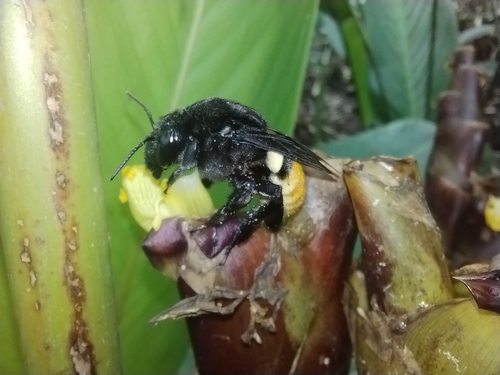
Eulaema cingulata is a large-bodied black and orange corbiculate bee in the genus Eulaema. It is characterized by its size and flashy orange segments of its metastoma. Unlike other Eulaema, E. cingulata has white markings on its face. Specifically, T1 andT3 are black while T2 and T4 through T7 are cream or slightly orange in color. These bees are easily mistaken for bumblebees (Bombus spp.). However, they are actually members of the Euglossini, or orchid bees. Wikipedia →

Global Distribution

Parks Where Found

# Park Country Daily sighting probability
1 Cerro Azul Meámbar National Park 🇭🇳 Honduras
~20%
2 Piedras Blancas National Park 🇨🇷 Costa Rica
~10%
3 Manu National Park 🇵🇪 Peru
~10%
4 Farallones de Cali National Natural Park 🇨🇴 Colombia
~10%
5 Tijuca National Park 🇧🇷 Brazil
~10%
6 Chirripó National Park 🇨🇷 Costa Rica
~10%
7 Tortuguero National Park 🇨🇷 Costa Rica
~10%
8 Arenal Volcano National Park 🇨🇷 Costa Rica
~10%
9 Braulio Carrillo National Park 🇨🇷 Costa Rica
~10%
10 Manuel Antonio National Park 🇨🇷 Costa Rica
~10%
11 Monteverde Cloud Forest Reserve 🇨🇷 Costa Rica
~10%

Cities Where Found

# City Country Daily sighting probability
1 Cali 🇨🇴 Colombia
~10%
2 São Luís 🇧🇷 Brazil
~10%
3 San José 🇨🇷 Costa Rica
~10%
4 Medellín 🇨🇴 Colombia
~10%
5 Niterói 🇧🇷 Brazil
~10%
6 Rio de Janeiro 🇧🇷 Brazil
~10%
7 San Salvador 🇸🇻 El Salvador
~10%
8 Belo Horizonte 🇧🇷 Brazil
<5%
9 São Paulo 🇧🇷 Brazil
<5%

Before you go

What are the chances of seeing a Belted Orchid Bee in Tortuguero National Park?

With luck

About 10% of wildlife watchers report a Belted Orchid Bee sighting in Tortuguero National Park on a given day, based on 5 verified sightings from GBIF citizen-science data from 2019 to 2026. It is the 71st most-seen of the 80 insects we can rate there. Over three days the chance rises to about 20%, and over a week to about 40%, if each day is a fresh chance.

When is the best time to see a Belted Orchid Bee in Tortuguero National Park?

November

In that month about 20% of wildlife watchers report a Belted Orchid Bee in Tortuguero National Park on a given day, against under 5% in February–March, May–August, October and December, the lowest months. That is one of Tortuguero National Park's wettest months, with about 530 mm of rain against 160 mm in March.

What time of day is best to see a Belted Orchid Bee?

Between 8 and 11 am

Across all the parks we cover, that three-hour window holds the most Belted Orchid Bee sightings with a recorded time, and about 9 in 10 of them come between 6 am and 6 pm: it is a daytime animal.

Which relatives of the Belted Orchid Bee live in Tortuguero National Park?

Same family: Apidae

The closest relatives of the Belted Orchid Bee that you can see in Tortuguero National Park (family Apidae, Honey Bees, Bumble Bees, and Allies) are Red-Tailed Stingless Bee (about 20%) and Narrow Stingless Bee (about 10%), with each one's daily chance of a sighting.

Where does the Belted Orchid Bee sighting chance come from?

GBIF citizen-science records

It is estimated from how often the Belted Orchid Bee is recorded against all the insects logged in Tortuguero National Park (5 verified sightings from 2019 to 2026), calibrated against known sighting rates. Figures are rounded to the nearest 10% because citizen-science data supports honest approximations, not decimals, and months with records from fewer than five people show "—". How it works.

← Back to Tortuguero National Park