Grosbeak Weaver

Grosbeak Weaver

Amblyospiza albifrons

Silhouette: Sheatherius · PhyloPic

LCLeast ConcernNTVUENCR
Daily sighting probability <5% · Rare
at Virunga National Park

In 3 days <5% in a week ~10%

5 Verified sightings at Virunga National Park From 2019 to 2026
2,749 In all 28 parks
May Best month
☀️ Diurnal When it's spotted

About the Grosbeak Weaver

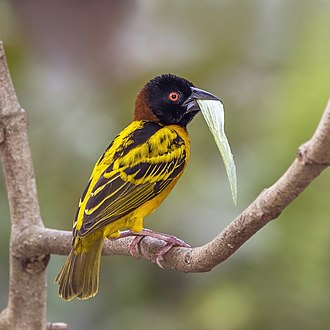
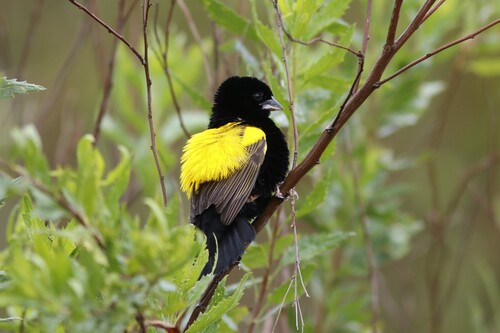
The thick-billed weaver (Amblyospiza albifrons), or grosbeak weaver, is a distinctive and bold species of weaver bird that is native to the Afrotropics. It belongs to the monotypic genus Amblyospiza and subfamily Amblyospizinae.

They have particularly strong mandibles, which are employed to extricate the seeds in nutlets and drupes, and their songs are comparatively unmusical and harsh. Their colonial nests are readily distinguishable from those of other weavers, due to their form and placement, and the fine strands used in their construction.

They habitually fan and flick their tails. The generic name Amblyospiza was coined by Carl Jakob Sundevall in 1850 and means "blunt, finch", referencing the very large bill, while the specific name albifrons refers white forehead of the males. The thick-billed weaver was formally described as Pyrrhula albifrons in 1831 by the Irish zoologist and politician Nicholas Aylward Vigors from the collection of Henry Ellis, the specimens of which were attributed to Algoa Bay and environs in the Eastern Cape. Wikipedia →

Sounds

Song1:20

Kenya · 2020

© Bram Piot · XC523322 · CC BY-NC-SA 4.0

Call0:16

Zambia · 2023

© Dries Van de Loock · XC791507 · CC BY-NC-ND 4.0

Flight call0:06

Uganda · 2015

© Martin St-Michel · XC259514 · CC BY-NC-SA 4.0

Global Distribution

Parks Where Found

# Park Country Daily sighting probability
1 Kibale National Park 🇺🇬 Uganda
~40%
2 iSimangaliso Wetland Park 🇿🇦 South Africa
~30%
3 Semuliki National Park 🇺🇬 Uganda
~30%
4 uMkhuze Game Reserve 🇿🇦 South Africa
~20%
5 Arusha National Park 🇹🇿 Tanzania
~20%
6 Nairobi National Park 🇰🇪 Kenya
~10%
7 Lake Manyara National Park 🇹🇿 Tanzania
~10%
8 Mkomazi National Park 🇹🇿 Tanzania
~10%
9 Akagera National Park 🇷🇼 Rwanda
~10%
10 Queen Elizabeth National Park 🇺🇬 Uganda
~10%
11 Lake Nakuru National Park 🇰🇪 Kenya
~10%
12 Meru National Park 🇰🇪 Kenya
~10%
13 Lake Mburo National Park 🇺🇬 Uganda
<5%
14 Kruger National Park 🇿🇦 South Africa
<5%
15 Hluhluwe-Imfolozi Park 🇿🇦 South Africa
<5%
16 Ngorongoro Conservation Area 🇹🇿 Tanzania
<5%
17 Murchison Falls National Park 🇺🇬 Uganda
<5%
18 Pilanesberg National Park 🇿🇦 South Africa
<5%
19 Tsavo East National Park 🇰🇪 Kenya
<5%
20 Tsavo West National Park 🇰🇪 Kenya
<5%
21 Chobe National Park 🇧🇼 Botswana
<5%
22 Addo Elephant National Park 🇿🇦 South Africa
<5%
23 Bwindi Impenetrable National Park 🇺🇬 Uganda
<5%
24 Virunga National Park 🇨🇩 Democratic Republic of the Congo
<5%
25 Masai Mara National Reserve 🇰🇪 Kenya
<5%
26 Tarangire National Park 🇹🇿 Tanzania
<5%
27 Nyungwe National Park 🇷🇼 Rwanda
<5%
28 Moremi Game Reserve 🇧🇼 Botswana
<5%

Cities Where Found

# City Country Daily sighting probability
1 Mombasa 🇰🇪 Kenya
~50%
2 Pretoria 🇿🇦 South Africa
~40%
3 Kigali 🇷🇼 Rwanda
~30%
4 Johannesburg 🇿🇦 South Africa
~30%
5 Zanzibar City 🇹🇿 Tanzania
~30%
6 Yaoundé 🇨🇲 Cameroon
~20%
7 Durban 🇿🇦 South Africa
~20%
8 Harare 🇿🇼 Zimbabwe
~20%
9 Nairobi 🇰🇪 Kenya
~10%
10 Dar es-Salaam 🇹🇿 Tanzania
~10%

Before you go

What are the chances of seeing a Grosbeak Weaver in Virunga National Park?

Rare

Under 5% of wildlife watchers report a Grosbeak Weaver sighting in Virunga National Park on a given day, based on 5 verified sightings from GBIF citizen-science data from 2019 to 2026. It is the 301st most-seen of the 316 birds we can rate there. Over three days the chance rises to under 5%, and over a week to about 10%, if each day is a fresh chance.

When is the best time to see a Grosbeak Weaver in Virunga National Park?

Any time of year

In every month with enough records, under 5% of wildlife watchers report a Grosbeak Weaver in Virunga National Park on a given day, so our monthly data shows no clear season.

What time of day is best to see a Grosbeak Weaver?

Between 8 and 11 am

Across all the parks we cover, that three-hour window holds the most Grosbeak Weaver sightings with a recorded time, and about 9 in 10 of them come between 6 am and 6 pm: it is a daytime animal.

Is Virunga National Park the best place to see a Grosbeak Weaver?

24th of 28

Of the 28 parks where we can rate Grosbeak Weaver sightings, Virunga National Park ranks 24th at under 5%. The best odds are in Kibale National Park (Uganda, about 40%), iSimangaliso Wetland Park (South Africa, about 30%) and Semuliki National Park (Uganda, about 30%).

Which relatives of the Grosbeak Weaver live in Virunga National Park?

Same family: Ploceidae

The closest relatives of the Grosbeak Weaver that you can see in Virunga National Park (family Ploceidae, Weavers and Allies) are Village Weaver (about 20%), Baglafecht Weaver (about 20%) and Black-headed Weaver (about 10%), with each one's daily chance of a sighting.

Where does the Grosbeak Weaver sighting chance come from?

GBIF citizen-science records

It is estimated from how often the Grosbeak Weaver is recorded against all the birds logged in Virunga National Park (5 verified sightings from 2019 to 2026), calibrated against known sighting rates. Figures are rounded to the nearest 10% because citizen-science data supports honest approximations, not decimals, and months with records from fewer than five people show "—". How it works.

← Back to Virunga National Park