


Completed

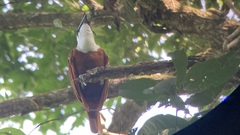
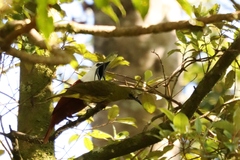


Three-wattled Bellbird
Procnias tricarunculatus
Silhouette: Kai Caspar · PhyloPic
- KingdomAnimalia (Animals)
- PhylumChordata (Chordates)
- ClassAves (Birds)
- OrderPasseriformes (Perching Birds)
- FamilyCotingidae (Cotingas)
- GenusProcnias (Neotropical Bellbirds)
- SpeciesProcnias tricarunculatus (Three-wattled Bellbird)
In 3 days ~30% in a week ~60%
250 Verified sightings at Volcán Barú National Park From 2019 to 2026
5,616 In all 13 parks
March Best month
☀️ Diurnal When it's spotted
About the Three-wattled Bellbird
The three-wattled bellbird (Procnias tricarunculatus) is a Central American migratory bird of the cotinga family. The sexes are very dissimilar in appearance. The male has a white head and throat and the remaining plumage is chestnut brown. From the base of his beak dangle three long, slender, black wattles that he uses in display. The female has olive plumage with yellowish streaked underparts and a yellow vent area.
The three-wattled bellbird breeds in mountainous regions of Costa Rica and migrates to western Honduras, Nicaragua and Panama. The male bird has a loud, distinctive, bell-like call, and as these birds are secretive and shy, they are more often heard than seen. The International Union for Conservation of Nature has assessed their conservation status as "vulnerable".
One of four species of bellbird that live in Central and South America, the three-wattled bellbird is between 25 cm (9.8 in) and 30 cm (12 in) long. The body, tail, and wings of the male are uniformly chestnut-brown; its head, neck, and upper breast are white; and it has a black eye-ring, eye-stripe, and bill. Its name comes from the three worm-like wattles of skin that hang from the base... Wikipedia →
Recent sightings of Three-wattled Bellbird in Volcán Barú National Park
LIVEiNaturalistGlobal Distribution
Parks Where Found
| # | Park | Country | Daily sighting probability |
|---|---|---|---|
| 1 | Monteverde Cloud Forest Reserve | 🇨🇷 Costa Rica | |
| 2 | Volcán Barú National Park | 🇵🇦 Panama | |
| 3 | La Amistad International Park (Panama) | 🇵🇦 Panama | |
| 4 | Bastimentos Island National Marine Park | 🇵🇦 Panama | |
| 5 | Rincón de la Vieja National Park | 🇨🇷 Costa Rica | |
| 6 | Cabo Blanco Absolute Nature Reserve | 🇨🇷 Costa Rica | |
| 7 | Arenal Volcano National Park | 🇨🇷 Costa Rica | |
| 8 | Piedras Blancas National Park | 🇨🇷 Costa Rica | |
| 9 | Braulio Carrillo National Park | 🇨🇷 Costa Rica | |
| 10 | Tenorio Volcano National Park | 🇨🇷 Costa Rica | |
| 11 | Corcovado National Park | 🇨🇷 Costa Rica | |
| 12 | Los Quetzales National Park | 🇨🇷 Costa Rica | |
| 13 | Tapantí-Macizo de la Muerte National Park | 🇨🇷 Costa Rica |
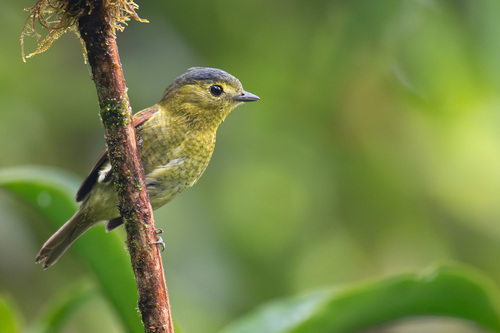
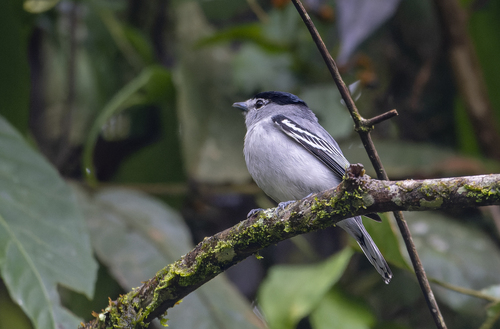
Closest Relatives at Volcán Barú National Park



Before you go
What are the chances of seeing a Three-wattled Bellbird in Volcán Barú National Park?
With luck
About 10% of wildlife watchers report a Three-wattled Bellbird sighting in Volcán Barú National Park on a given day, based on 250 verified sightings from GBIF citizen-science data from 2019 to 2026. It is the 97th most-seen of the 296 birds we can rate there. Over three days the chance rises to about 30%, and over a week to about 60%, if each day is a fresh chance.
When is the best time to see a Three-wattled Bellbird in Volcán Barú National Park?
January–April and June
In those months about 20% of wildlife watchers report a Three-wattled Bellbird in Volcán Barú National Park on a given day, against under 5% in August to December, the lowest months. Those are among Volcán Barú National Park's driest months, with about 150 mm of rain a month against 460 mm in October.
What time of day is best to see a Three-wattled Bellbird?
Between 8 and 11 am
Across all the parks we cover, that three-hour window holds the most Three-wattled Bellbird sightings with a recorded time, and about 9 in 10 of them come between 6 am and 6 pm: it is a daytime animal.
Is Volcán Barú National Park the best place to see a Three-wattled Bellbird?
2nd of 13
Of the 13 parks where we can rate Three-wattled Bellbird sightings, Volcán Barú National Park ranks 2nd at about 10%. The best odds are in Monteverde Cloud Forest Reserve (Costa Rica, about 20%).
Where does the Three-wattled Bellbird sighting chance come from?
GBIF citizen-science records
It is estimated from how often the Three-wattled Bellbird is recorded against all the birds logged in Volcán Barú National Park (250 verified sightings from 2019 to 2026), calibrated against known sighting rates. Figures are rounded to the nearest 10% because citizen-science data supports honest approximations, not decimals, and months with records from fewer than five people show "—". How it works.
