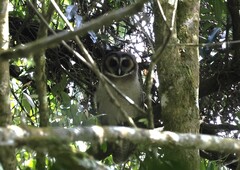
Brown Wood Owl

Brown Wood Owl

Strix leptogrammica

Silhouette: Sharon Wegner-Larsen · PhyloPic

LCLeast ConcernNTVUENCR
Daily sighting probability ~10% · With luck
at Way Kambas National Park

In 3 days ~20% in a week ~40%

23 Verified sightings at Way Kambas National Park From 2019 to 2026
888 In all 23 parks
May Best month
☀️🌙 Day & Night When it's spotted

About the Brown Wood Owl

The brown wood owl (Strix leptogrammica) is found in India, Bangladesh, Sri Lanka, Indonesia, Taiwan, and south China. The brown wood owl is a resident breeder in south Asia. This species is a part of the family of owls known as typical owls (Strigidae), which contains most species of owl. It belongs to the earless owl genus Strix.

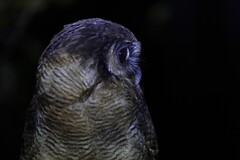
The brown wood owl is medium large (45–57 cm), with upperparts uniformly dark brown, with faint white spotting on the shoulders. The underparts are buff with brown streaking. The facial disc is brown or rufous, edged with white and without concentric barring, and the eyes are dark brown. There is a white neckband. The sexes are similar in appearance.

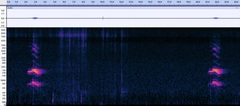
Their call is a (hoo) hoo hoo HOO, or a deep goke-goke-ga-LOOO, or a loud scream. Their alarm call is a bark, wow-wow. Some subspecies are known to produce distinct vocalizations; they are also different in appearance and parapatric, and might be distinct species: The northern Strix (leptogrammica) newarensis group (Himalayan wood-owl; present subspecies newarensis, ticehursti, laotiana and caligata) which occur from the Himalayan foothills of Kashmir east to Taiwan have a soft low to-hooh not unlike a rock dove cooing. S. (l.) bartelsi (Bartels's wood-owl), Javan wood-owl from Java, the southeasternmost taxon, has a loud, forceful, single HOOH! with long pauses between calls.

This species is highly nocturnal and is commonly found in dense forests. It can often be located by the small birds that mob it while it is roosting in a tree. The diet of the brown wood owl consists mainly of small mammals, birds, and reptiles. Wikipedia →

Sounds

Call1:08

Malaysia · 2024

© Lim Ying Hien · XC941923 · CC BY-NC-ND 4.0

Call0:09

Nepal · 2023

© Marc Anderson · XC813112 · CC BY-NC-ND 4.0

Call0:11

India · 2018

© Tejaswini Limaye · XC436746 · CC BY-NC-SA 4.0

Global Distribution

Parks Where Found

# Park Country Daily sighting probability
1 Danum Valley Conservation Area 🇲🇾 Malaysia
~10%
2 Way Kambas National Park 🇮🇩 Indonesia
~10%
3 Kinabatangan Wildlife Sanctuary 🇲🇾 Malaysia
~10%
4 Mudumalai National Park 🇮🇳 India
~10%
5 Kinabalu Park 🇲🇾 Malaysia
<5%
6 Cuc Phuong National Park 🇻🇳 Vietnam
<5%
7 Khao Sok National Park 🇹🇭 Thailand
<5%
8 Gunung Leuser National Park 🇮🇩 Indonesia
<5%
9 Khao Luang National Park 🇹🇭 Thailand
<5%
10 Khao Yai National Park 🇹🇭 Thailand
<5%
11 Wilpattu National Park 🇱🇰 Sri Lanka
<5%
12 Royal Bardia National Park 🇳🇵 Nepal
<5%
13 Kaeng Krachan National Park 🇹🇭 Thailand
<5%
14 Doi Inthanon National Park 🇹🇭 Thailand
<5%
15 Horton Plains National Park 🇱🇰 Sri Lanka
<5%
16 Minneriya National Park 🇱🇰 Sri Lanka
<5%
17 Nagarhole National Park 🇮🇳 India
<5%
18 Bandipur National Park 🇮🇳 India
<5%
19 Royal Manas National Park 🇧🇹 Bhutan
<5%
20 Taman Negara National Park 🇲🇾 Malaysia
<5%
21 Namdapha National Park 🇮🇳 India
<5%
22 Sepilok 🇲🇾 Malaysia
<5%
23 Kanha National Park 🇮🇳 India
<5%

Cities Where Found

# City Country Daily sighting probability
1 Dehradun 🇮🇳 India
<5%
2 Kathmandu 🇳🇵 Nepal
<5%

Zoos & Centres Where Found

# Zoo / Centre Country
1 Walsrode World Bird Park 🇩🇪 Germany In captivity
2 Parc des oiseaux 🇫🇷 France In captivity
3 Espace Rambouillet 🇫🇷 France In captivity
4 Taipei Zoo 🇹🇼 Taiwan In captivity
5 Kadoorie Farm and Botanic Garden 🇭🇰 Hong Kong SAR China In captivity
6 Chester Zoo 🇬🇧 United Kingdom In captivity
7 Fonghuanggu Bird and Ecology Park 🇹🇼 Taiwan In captivity
8 Wrocław Zoological Garden 🇵🇱 Poland In captivity
9 Zoo de La Flèche 🇫🇷 France In captivity
10 Hamerton Zoo Park 🇬🇧 United Kingdom In captivity
11 Leśny Park Niespodzianek 🇵🇱 Poland In captivity
12 Kuala Lumpur Bird Park 🇲🇾 Malaysia In captivity
13 Zoo d'Upie 🇫🇷 France In captivity
14 Bird Park Steinen 🇩🇪 Germany In captivity
15 Small Breeds Farm Park 🇬🇧 United Kingdom In captivity
16 Bali Bird Park 🇮🇩 Indonesia In captivity
17 Africarium 🇵🇱 Poland In captivity
18 Eureka Orchideeën en Vogelbush 🇳🇱 Netherlands In captivity
19 Millets Wildside Falconry and Wildlife Centre 🇬🇧 United Kingdom In captivity
20 The Green Planet 🇦🇪 United Arab Emirates In captivity
21 Aquaria KLCC 🇲🇾 Malaysia In captivity
22 Le centre de soins des rapaces Espace Rambouillet 🇫🇷 France In captivity
23 terrarium ogrodu zoologicznego we Wrocławiu 🇵🇱 Poland In captivity

Before you go

What are the chances of seeing a Brown Wood Owl in Way Kambas National Park?

With luck

About 10% of wildlife watchers report a Brown Wood Owl sighting in Way Kambas National Park on a given day, based on 23 verified sightings from GBIF citizen-science data from 2019 to 2026. It is the 165th most-seen of the 205 birds we can rate there. Over three days the chance rises to about 20%, and over a week to about 40%, if each day is a fresh chance.

When is the best time to see a Brown Wood Owl in Way Kambas National Park?

May

In that month about 30% of wildlife watchers report a Brown Wood Owl in Way Kambas National Park on a given day, against under 5% in March and August–October, the lowest months. November to February have too few records to rate.

What time of day is best to see a Brown Wood Owl?

Between 7 and 10 pm

Across all the parks we cover, that three-hour window holds the most Brown Wood Owl sightings with a recorded time, and about 6 in 10 of them come between 6 pm and 6 am: it is seen both by day and at night.

Is Way Kambas National Park the best place to see a Brown Wood Owl?

Among the best

Of the 23 parks where we can rate Brown Wood Owl sightings, Way Kambas National Park ranks 2nd at about 10%, level with the leaders once rounded. The best odds are in Danum Valley Conservation Area (Malaysia, about 10%).

Which relatives of the Brown Wood Owl live in Way Kambas National Park?

Same family: Strigidae

The closest relatives of the Brown Wood Owl that you can see in Way Kambas National Park (family Strigidae, Typical Owls) are Buffy Fish-Owl (about 40%), Sunda Scops-Owl (about 40%) and Brown Boobook (about 30%), with each one's daily chance of a sighting.

Where does the Brown Wood Owl sighting chance come from?

GBIF citizen-science records

It is estimated from how often the Brown Wood Owl is recorded against all the birds logged in Way Kambas National Park (23 verified sightings from 2019 to 2026), calibrated against known sighting rates. Figures are rounded to the nearest 10% because citizen-science data supports honest approximations, not decimals, and months with records from fewer than five people show "—". How it works.

← Back to Way Kambas National Park