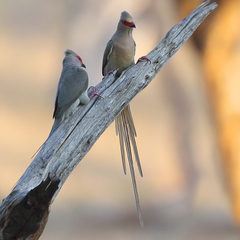
Red-faced Mousebird

Red-faced Mousebird

Urocolius indicus

Silhouette: Enoch Joseph Wetsy (photo), John E. McCormack, Michael G. Harvey, Brant C. Faircloth, Nicholas G. Crawford, Travis C. Glenn, Robb T. Brumfield & T. Michael Keesey · PhyloPic

LCLeast ConcernNTVUENCR
Daily sighting probability ~10% · With luck
at West Coast National Park

In 3 days ~30% in a week ~60%

128 Verified sightings at West Coast National Park From 2019 to 2026
4,972 In all 23 parks
October Best month
☀️ Diurnal When it's spotted

About the Red-faced Mousebird

The red-faced mousebird (Urocolius indicus) is a species of mousebird or coly. It is a common in southern Africa from the Democratic Republic of Congo (formerly Zaire), Zambia and Tanzania south to the Cape. Its habitat is savanna with thickets, fynbos scrub, other open woodland, gardens and orchards.

There are a total of five recognized subspecies: Urocolius indicus mossambicus (Distribution: east Angola to southwest Tanzania and Malawi) Urocolius indicus lacteifrons (Distribution: western Angola, north & central Namibia and western Botswana)

Urocolius indicus pallidus (Distribution: southeast Tanzania and northeast Mozambique) Urocolius indicus transvaalensis (Distribution: Central and eastern Botswana and southwest Zambia to Mozambique and South Africa) Urocolius indicus indicus (Distribution: south and central South Africa)

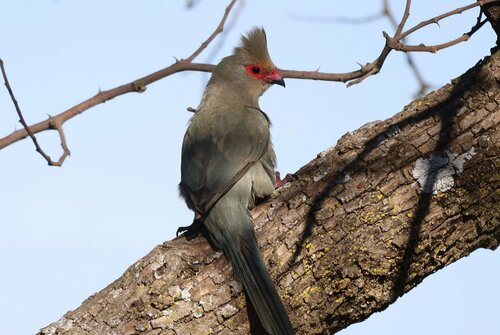
This bird is about 34 cm (13 in) long, with the tail comprising approximately half the length. The crested head and breast are pale cinnamon with a red bill and eye mask. The rest of the upperparts and tail are blue-grey apart from a paler grey rump. The belly is whitish. The sexes are similar, but juveniles lack the crest and have a green mask. Their call is tree-ree-ree whistle, and regularly called in multiple repetitions. Red-faced mousebirds make the same call whether in-flight or perched.

The red-faced mousebird is a frugivore which subsists on fruits, berries, leaves, seeds and nectar. Its flight is typically fast, strong and direct from one feeding area to another. This is a social bird outside the breeding season, feeding together in small groups, normally of about half a dozen birds, but sometimes up to 15 or more. They fly and interact in tight collections. It engages in mutual preening and roosts in groups at night. It is more wary than other mousebirds.

These sedentary birds breed between June and February. The nest is a large untidy cup of plant material lined with material such as sheep wool. The clutch is 2–6 eggs, creamy white with reddish brown spots and hatch in about two weeks. Wikipedia →
Sounds

Song0:39

Botswana · 2023

© Marc Anderson · XC1071006 · CC BY-NC-ND 4.0

Call0:30

South Africa · 2021

© Tony Archer · XC662468 · CC BY-NC-SA 4.0

Song0:38

South Africa · 2022

© Lynette Rudman · XC731718 · CC BY-NC-SA 4.0

Global Distribution

Parks Where Found

# Park Country Daily sighting probability
1 uMkhuze Game Reserve 🇿🇦 South Africa
~50%
2 Pilanesberg National Park 🇿🇦 South Africa
~40%
3 Lower Zambezi National Park 🇿🇲 Zambia
~30%
4 Gonarezhou National Park 🇿🇼 Zimbabwe
~30%
5 Mana Pools National Park 🇿🇼 Zimbabwe
~30%
6 Hluhluwe-Imfolozi Park 🇿🇦 South Africa
~30%
7 Addo Elephant National Park 🇿🇦 South Africa
~20%
8 Kruger National Park 🇿🇦 South Africa
~20%
9 South Luangwa National Park 🇿🇲 Zambia
~20%
10 Namib-Naukluft National Park 🇳🇦 Namibia
~20%
11 Moremi Game Reserve 🇧🇼 Botswana
~10%
12 Gorongosa National Park 🇲🇿 Mozambique
~10%
13 Table Mountain National Park 🇿🇦 South Africa
~10%
14 West Coast National Park 🇿🇦 South Africa
~10%
15 Kafue National Park 🇿🇲 Zambia
~10%
16 Chobe National Park 🇧🇼 Botswana
~10%
17 De Hoop Nature Reserve 🇿🇦 South Africa
~10%
18 Liwonde National Park 🇲🇼 Malawi
~10%
19 iSimangaliso Wetland Park 🇿🇦 South Africa
~10%
20 Garden Route National Park 🇿🇦 South Africa
<5%
21 Hwange National Park 🇿🇼 Zimbabwe
<5%
22 Etosha National Park 🇳🇦 Namibia
<5%
23 Kgalagadi Transfrontier Park 🇿🇦 South Africa
<5%

Cities Where Found

# City Country Daily sighting probability
1 Lusaka 🇿🇲 Zambia
~60%
2 Johannesburg 🇿🇦 South Africa
~40%
3 Pretoria 🇿🇦 South Africa
~30%
4 Cape Town 🇿🇦 South Africa
~20%
5 Luanda 🇦🇴 Angola
<5%
6 Harare 🇿🇼 Zimbabwe
<5%

Before you go

What are the chances of seeing a Red-faced Mousebird in West Coast National Park?

With luck

About 10% of wildlife watchers report a Red-faced Mousebird sighting in West Coast National Park on a given day, based on 128 verified sightings from GBIF citizen-science data from 2019 to 2026. It is the 107th most-seen of the 192 birds we can rate there. Over three days the chance rises to about 30%, and over a week to about 60%, if each day is a fresh chance.

When is the best time to see a Red-faced Mousebird in West Coast National Park?

July and September–October

In those months about 20% of wildlife watchers report a Red-faced Mousebird in West Coast National Park on a given day, against under 5% in January–April and June, the lowest months.

What time of day is best to see a Red-faced Mousebird?

Between 7 and 10 am

Across all the parks we cover, that three-hour window holds the most Red-faced Mousebird sightings with a recorded time, and about 9 in 10 of them come between 6 am and 6 pm: it is a daytime animal.

Which relatives of the Red-faced Mousebird live in West Coast National Park?

Same family: Coliidae

The closest relatives of the Red-faced Mousebird that you can see in West Coast National Park (family Coliidae, Mousebirds) are White-backed Mousebird (about 60%) and Speckled Mousebird (about 10%), with each one's daily chance of a sighting.

Where does the Red-faced Mousebird sighting chance come from?

GBIF citizen-science records

It is estimated from how often the Red-faced Mousebird is recorded against all the birds logged in West Coast National Park (128 verified sightings from 2019 to 2026), calibrated against known sighting rates. Figures are rounded to the nearest 10% because citizen-science data supports honest approximations, not decimals, and months with records from fewer than five people show "—". How it works.

← Back to West Coast National Park