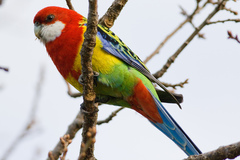
Eastern Rosella

Eastern Rosella

Platycercus eximius

Silhouette: Farelli (photo), John E. McCormack, Michael G. Harvey, Brant C. Faircloth, Nicholas G. Crawford, Travis C. Glenn, Robb T. Brumfield & T. Michael Keesey · PhyloPic

LCLeast ConcernNTVUENCR
Daily sighting probability ~10% · With luck
at Wilsons Promontory National Park

In 3 days ~20% in a week ~50%

51 Verified sightings at Wilsons Promontory National Park From 2019 to 2026
1,062 In all 11 parks
March Best month
☀️ Diurnal When it's spotted

About the Eastern Rosella

The eastern rosella (Platycercus eximius) is a parrot native and endemic to south-eastern Australia. It was first introduced to New Zealand in cages, and individuals were subsequently intentionally released or accidentally escaped into the wild. In New Zealand, it is now established in the North Island (notably in the northern half of the island, Taranaki, Waikato and in the Hutt Valley) and in the hills around Dunedin in the South Island.

The eastern rosella belongs to the genus Platycercus and subgenus Violania along with other three species members: northern rosella (P. venustus), pale-headed rosella (P. adscitus) and western rosella (P. icterotis). An early analysis of rosella phylogeny stated that the eastern rosella and pale-headed rosella are most closely related to each other, compared to the other two rosella species. However, a more recent mitochondrial study found that the eastern rosella was the earlier offshoot of the lineage that split into the pale-headed and northern rosella, and those non-sister taxa were hence able to hybridize.

The three subspecies of eastern rosella are: P. e. eximius, mainly found in Victoria and southern New South Wales, Australia... Wikipedia →

Sounds

Call0:26

Australia · 2024

© Romuald Mikusek · XC1173636 · CC BY-NC-SA 4.0

Recording0:08

Australia · 2024

© Harvey L · XC981053 · CC BY-NC-SA 4.0

Uncertain0:31

Australia · 2021

© nick talbot · XC698757 · CC BY-NC-SA 4.0

Global Distribution

Parks Where Found

# Park Country Daily sighting probability
1 Egmont National Park 🇳🇿 New Zealand
~30%
2 Grampians National Park 🇦🇺 Australia
~20%
3 Wilsons Promontory National Park 🇦🇺 Australia
~10%
4 Blue Mountains National Park 🇦🇺 Australia
~10%
5 Kosciuszko National Park 🇦🇺 Australia
<5%
6 Great Otway National Park 🇦🇺 Australia
<5%
7 Springbrook National Park 🇦🇺 Australia
<5%
8 Royal National Park 🇦🇺 Australia
<5%
9 Maria Island National Park 🇦🇺 Australia
<5%
10 Hattah-Kulkyne National Park 🇦🇺 Australia
<5%
11 Lamington National Park 🇦🇺 Australia
<5%

Cities Where Found

# City Country Daily sighting probability
1 Auckland 🇳🇿 New Zealand
~40%
2 Melbourne 🇦🇺 Australia
~30%
3 Hobart 🇦🇺 Australia
~20%
4 Sydney 🇦🇺 Australia
~10%

Zoos & Centres Where Found

# Zoo / Centre Country
1 ZooParc de Beauval 🇫🇷 France In captivity
2 Nandankanan Zoological Park 🇮🇳 India In captivity
3 Zoo Miami 🇺🇸 United States In captivity
4 Safari Madrid 🇪🇸 Spain In captivity
5 Sedgwick County Zoo 🇺🇸 United States In captivity
6 Cheyenne Mountain Zoo 🇺🇸 United States In captivity
7 Africam Safari 🇲🇽 Mexico In captivity
8 Novosibirsk Zoo 🇷🇺 Russia In captivity
9 Kyiv Zoo 🇺🇦 Ukraine In captivity
10 Woodland Park Zoo 🇺🇸 United States In captivity
11 Tanganyika Wildlife Park 🇺🇸 United States In captivity
12 Fort Worth Zoo 🇺🇸 United States In captivity
13 Wilhelma 🇩🇪 Germany In captivity
14 Tashkent Zoo 🇺🇿 Uzbekistan In captivity
15 La Palmyre Zoo 🇫🇷 France In captivity
16 Budapest Zoo & Botanical Garden 🇭🇺 Hungary In captivity
17 Bioparque Educativo Quillón 🇨🇱 Chile In captivity
18 Loro Parque 🇪🇸 Spain In captivity
19 Discovery Cove 🇺🇸 United States In captivity
20 Buin Zoo 🇨🇱 Chile In captivity
21 Staglands Wildlife Reserve 🇳🇿 New Zealand In captivity
22 L'Oceanogràfic 🇪🇸 Spain In captivity
23 Bird Park Steinen 🇩🇪 Germany In captivity
24 Santillana Zoo 🇪🇸 Spain In captivity
25 Chilean National Zoo 🇨🇱 Chile In captivity
26 Zoo Lagos 🇵🇹 Portugal In captivity
27 Millcreek Bird Park 🇳🇿 New Zealand In captivity
28 The Valley of Turtles 🇫🇷 France In captivity
29 Agroflori Parque de las Aves 🇧🇴 Bolivia In captivity
30 Castellar Zoo 🇪🇸 Spain In captivity
31 Parque Loro Sexi 🇪🇸 Spain In captivity
32 Zoo Samara 🇷🇺 Russia In captivity
33 Flying High Bird Sanctuary 🇦🇺 Australia In captivity
34 Haus des Meeres 🇦🇹 Austria In captivity
35 National Aquarium 🇺🇸 United States In captivity
36 Bird Kingdom 🇨🇦 Canada In captivity
37 Bloedel Conservatory 🇨🇦 Canada In captivity
38 The Green Planet 🇦🇪 United Arab Emirates In captivity
39 Acuario de Almuñécar 🇪🇸 Spain In captivity
40 Campbelltown Forest of Wild Birds 🇯🇵 Japan In captivity
41 Ogród zoologiczny w Spiskiej Nowej Wsi 🇸🇰 Slovakia In captivity
42 Tierpark Bad Kösen 🇩🇪 Germany In captivity
43 Ульяновский зоопарк 🇷🇺 Russia In captivity

Before you go

What are the chances of seeing an Eastern Rosella in Wilsons Promontory National Park?

With luck

About 10% of wildlife watchers report an Eastern Rosella sighting in Wilsons Promontory National Park on a given day, based on 51 verified sightings from GBIF citizen-science data from 2019 to 2026. It is the 62nd most-seen of the 138 birds we can rate there. Over three days the chance rises to about 20%, and over a week to about 50%, if each day is a fresh chance.

When is the best time to see an Eastern Rosella in Wilsons Promontory National Park?

March

In that month about 20% of wildlife watchers report an Eastern Rosella in Wilsons Promontory National Park on a given day, against under 5% in January–February and July, the lowest months.

What time of day is best to see an Eastern Rosella?

Between 10 am and 1 pm

Across all the parks we cover, that three-hour window holds the most Eastern Rosella sightings with a recorded time, and about 9 in 10 of them come between 6 am and 6 pm: it is a daytime animal.

Is Wilsons Promontory National Park the best place to see an Eastern Rosella?

3rd of 11

Of the 11 parks where we can rate Eastern Rosella sightings, Wilsons Promontory National Park ranks 3rd at about 10%. The best odds are in Egmont National Park (New Zealand, about 30%) and Grampians National Park (Australia, about 20%).

Where does the Eastern Rosella sighting chance come from?

GBIF citizen-science records

It is estimated from how often the Eastern Rosella is recorded against all the birds logged in Wilsons Promontory National Park (51 verified sightings from 2019 to 2026), calibrated against known sighting rates. Figures are rounded to the nearest 10% because citizen-science data supports honest approximations, not decimals, and months with records from fewer than five people show "—". How it works.

← Back to Wilsons Promontory National Park