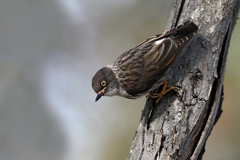
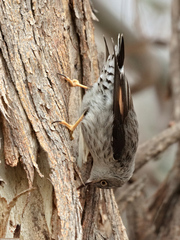
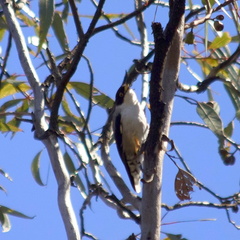
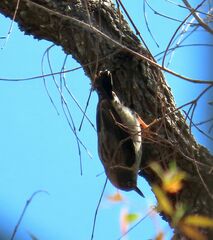

Varied Sittella

Varied Sittella

Daphoenositta chrysoptera

Silhouette: Sheatherius · PhyloPic

LCLeast ConcernNTVUENCR Endemic
Daily sighting probability <5% · Rare
at Wilsons Promontory National Park

In 3 days <5% in a week ~10%

9 Verified sightings at Wilsons Promontory National Park From 2019 to 2026
507 In all 10 parks
May Best month
☀️ Diurnal When it's spotted

About the Varied Sittella

The varied sittella (Daphoenositta chrysoptera) is a small songbird native to Australia. About 10–11 cm long, it is also known as the Australian nuthatch, orange-winged sittella and the barkpecker. The varied sittella was first described by the English ornithologist John Latham in 1801 under the binomial name Sitta chrysoptera. The generic name Daphoenositta is derived from Greek daphoinos/δαφοινός, 'blood-red, tawny' and sittē, a bird like a woodpecker mentioned by Aristotle. The specific name chrysoptera is from Greek khrusopteros/χρυσό-πτερος, 'golden-winged'.

The species inhabits a broad range, and its appearance changes depending on its location, hence the name varied sittella. There are five subspecies: Its crown and head can... Wikipedia →

Sounds

Call0:45

Australia · 2023

© Peter Boesman · XC859840 · CC BY-NC-ND 4.0

Song1:01

Australia · 2022

© James Lambert · XC759723 · CC BY-NC-ND 4.0

Song0:38

Australia · 2021

© Eddy Smith · XC673813 · CC BY-NC-SA 4.0

Global Distribution

Parks Where Found

# Park Country Daily sighting probability
1 Springbrook National Park 🇦🇺 Australia
~10%
2 Booderee National Park 🇦🇺 Australia
~10%
3 Great Otway National Park 🇦🇺 Australia
~10%
4 Kosciuszko National Park 🇦🇺 Australia
<5%
5 Grampians National Park 🇦🇺 Australia
<5%
6 Lamington National Park 🇦🇺 Australia
<5%
7 Blue Mountains National Park 🇦🇺 Australia
<5%
8 Royal National Park 🇦🇺 Australia
<5%
9 Wilsons Promontory National Park 🇦🇺 Australia
<5%
10 Hattah-Kulkyne National Park 🇦🇺 Australia
<5%

Cities Where Found

# City Country Daily sighting probability
1 Perth 🇦🇺 Australia
<5%
2 Brisbane 🇦🇺 Australia
<5%
3 Sydney 🇦🇺 Australia
<5%
4 Melbourne 🇦🇺 Australia
<5%

Before you go

What are the chances of seeing a Varied Sittella in Wilsons Promontory National Park?

Rare

Under 5% of wildlife watchers report a Varied Sittella sighting in Wilsons Promontory National Park on a given day, based on 9 verified sightings from GBIF citizen-science data from 2019 to 2026. It is the 121st most-seen of the 138 birds we can rate there. Over three days the chance rises to under 5%, and over a week to about 10%, if each day is a fresh chance.

When is the best time to see a Varied Sittella in Wilsons Promontory National Park?

May

In that month about 10% of wildlife watchers report a Varied Sittella in Wilsons Promontory National Park on a given day, against under 5% in June to April, the lowest months.

What time of day is best to see a Varied Sittella?

Between 11 am and 2 pm

Across all the parks we cover, that three-hour window holds the most Varied Sittella sightings with a recorded time, and nearly all of them come between 6 am and 6 pm: it is a daytime animal.

Is Wilsons Promontory National Park the best place to see a Varied Sittella?

9th of 10

Of the 10 parks where we can rate Varied Sittella sightings, Wilsons Promontory National Park ranks 9th at under 5%. The best odds are in Springbrook National Park (Australia, about 10%), Booderee National Park (Australia, about 10%) and Great Otway National Park (Australia, about 10%).

Which relatives of the Varied Sittella live in Wilsons Promontory National Park?

Same order: Passeriformes

The closest relatives of the Varied Sittella that you can see in Wilsons Promontory National Park (order Passeriformes, Perching Birds) are Superb Fairywren (about 80%), Australian Magpie (about 70%) and Red Wattlebird (about 70%), with each one's daily chance of a sighting.

Where does the Varied Sittella sighting chance come from?

GBIF citizen-science records

It is estimated from how often the Varied Sittella is recorded against all the birds logged in Wilsons Promontory National Park (9 verified sightings from 2019 to 2026), calibrated against known sighting rates. Figures are rounded to the nearest 10% because citizen-science data supports honest approximations, not decimals, and months with records from fewer than five people show "—". How it works.

← Back to Wilsons Promontory National Park