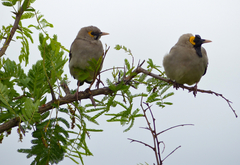

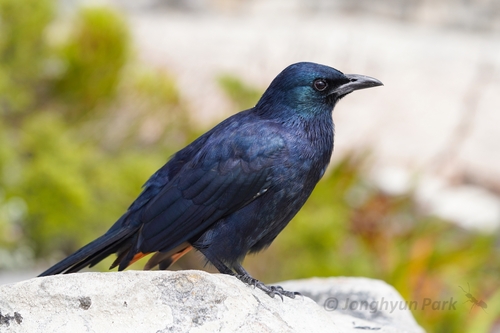
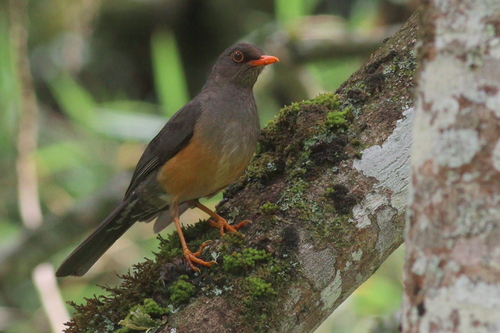
Wattled Starling

Wattled Starling

Creatophora cinerea

Silhouette: Rafael Maia · PhyloPic

LCLeast ConcernNTVUENCR
Daily sighting probability <5% · Rare
at Aberdare National Park

In 3 days ~10%

7 Verified sightings at Aberdare National Park From 2019 to 2026
9,363 In all 42 parks
August Best month
☀️ Diurnal When it's spotted

About the Wattled Starling

The wattled starling (Creatophora cinerea) is a nomadic resident bird in eastern and southern Africa. It is a species of grassland, open woodland, and cultivation. This is the only African starling that appears to show affinities with the Asian starlings, particularly the genus Sturnus. Its bare face patches and ability to open-bill feed in grassland are unique amongst African starlings. It is the only member of the genus Creatophora.

This common species appears to be extending its range into West Africa and has also occurred in Arabia, Madagascar, and Seychelles. The wattled starling is 21 cm long, with a short tail and pointed wings. It has mainly grey plumage except for a white rump, and black flight feathers and tail. The breeding male has a white shoulder patch and a distinctive head pattern, with unfeathered yellow skin, and black forehead and throat wattles. The extent to which these seasonal features develop increases with the age of the bird and some old females may show a weaker version of this plumage.

The non-breeding male has a feathered head except for a small yellow patch behind the eye. There are no wattles, but there is a black moustachial stripe... Wikipedia →

Sounds

Call0:25

Tanzania · 2023

© isaac kilusu · XC774794 · CC BY-NC-SA 4.0

Song0:41

Zambia · 2021

© Hans Matheve · XC699841 · CC BY-NC-ND 4.0

Call0:46

Kenya · 2022

© Oliver Fowler · XC755827 · CC BY-NC-SA 4.0

Global Distribution

Parks Where Found

# Park Country Daily sighting probability
1 Amboseli National Park 🇰🇪 Kenya
~40%
2 Tsavo East National Park 🇰🇪 Kenya
~40%
3 Serengeti National Park 🇹🇿 Tanzania
~40%
4 Tarangire National Park 🇹🇿 Tanzania
~40%
5 Samburu National Reserve 🇰🇪 Kenya
~40%
6 Tsavo West National Park 🇰🇪 Kenya
~30%
7 Ngorongoro Conservation Area 🇹🇿 Tanzania
~30%
8 Awash National Park 🇪🇹 Ethiopia
~30%
9 Masai Mara National Reserve 🇰🇪 Kenya
~30%
10 Nairobi National Park 🇰🇪 Kenya
~30%
11 Meru National Park 🇰🇪 Kenya
~30%
12 Mkomazi National Park 🇹🇿 Tanzania
~20%
13 Moremi Game Reserve 🇧🇼 Botswana
~20%
14 Kruger National Park 🇿🇦 South Africa
~20%
15 Queen Elizabeth National Park 🇺🇬 Uganda
~20%
16 Lake Nakuru National Park 🇰🇪 Kenya
~20%
17 Kgalagadi Transfrontier Park 🇿🇦 South Africa
~10%
18 Lower Zambezi National Park 🇿🇲 Zambia
~10%
19 Gorongosa National Park 🇲🇿 Mozambique
~10%
20 Addo Elephant National Park 🇿🇦 South Africa
~10%
21 Gonarezhou National Park 🇿🇼 Zimbabwe
~10%
22 West Coast National Park 🇿🇦 South Africa
~10%
23 Lake Mburo National Park 🇺🇬 Uganda
~10%
24 Chobe National Park 🇧🇼 Botswana
~10%
25 Akagera National Park 🇷🇼 Rwanda
~10%
26 Mana Pools National Park 🇿🇼 Zimbabwe
~10%
27 Virunga National Park 🇨🇩 Democratic Republic of the Congo
~10%
28 Ruaha National Park 🇹🇿 Tanzania
~10%
29 Kafue National Park 🇿🇲 Zambia
~10%
30 South Luangwa National Park 🇿🇲 Zambia
~10%
31 Mikumi National Park 🇹🇿 Tanzania
~10%
32 Lake Manyara National Park 🇹🇿 Tanzania
~10%
33 De Hoop Nature Reserve 🇿🇦 South Africa
~10%
34 Etosha National Park 🇳🇦 Namibia
~10%
35 Hwange National Park 🇿🇼 Zimbabwe
~10%
36 Liwonde National Park 🇲🇼 Malawi
~10%
37 Kidepo Valley National Park 🇺🇬 Uganda
<5%
38 Arusha National Park 🇹🇿 Tanzania
<5%
39 Aberdare National Park 🇰🇪 Kenya
<5%
40 Murchison Falls National Park 🇺🇬 Uganda
<5%
41 uMkhuze Game Reserve 🇿🇦 South Africa
<5%
42 iSimangaliso Wetland Park 🇿🇦 South Africa
<5%

Cities Where Found

# City Country Daily sighting probability
1 Durban 🇿🇦 South Africa
<5%
2 Kigali 🇷🇼 Rwanda
<5%
3 Kampala 🇺🇬 Uganda
<5%
4 Nairobi 🇰🇪 Kenya
<5%
5 Johannesburg 🇿🇦 South Africa
<5%

Zoos & Centres Where Found

# Zoo / Centre Country
1 Wilhelma 🇩🇪 Germany In captivity
2 Vogelpark Avifauna 🇳🇱 Netherlands In captivity
3 Zoo Lagos 🇵🇹 Portugal In captivity

Before you go

What are the chances of seeing a Wattled Starling in Aberdare National Park?

Rare

Under 5% of wildlife watchers report a Wattled Starling sighting in Aberdare National Park on a given day, based on 7 verified sightings from GBIF citizen-science data from 2019 to 2026. It is the 183rd most-seen of the 217 birds we can rate there. Over three days the chance rises to about 10%, if each day is a fresh chance.

When is the best time to see a Wattled Starling in Aberdare National Park?

August

In that month about 10% of wildlife watchers report a Wattled Starling in Aberdare National Park on a given day, against under 5% in September to July, the lowest months.

What time of day is best to see a Wattled Starling?

Between 8 and 11 am

Across all the parks we cover, that three-hour window holds the most Wattled Starling sightings with a recorded time, and about 9 in 10 of them come between 6 am and 6 pm: it is a daytime animal.

Which relatives of the Wattled Starling live in Aberdare National Park?

Same family: Sturnidae

The closest relatives of the Wattled Starling that you can see in Aberdare National Park (family Sturnidae, Starlings) are Slender-billed Starling (about 10%) and Sharpe's Starling (about 10%), with each one's daily chance of a sighting.

Where does the Wattled Starling sighting chance come from?

GBIF citizen-science records

It is estimated from how often the Wattled Starling is recorded against all the birds logged in Aberdare National Park (7 verified sightings from 2019 to 2026), calibrated against known sighting rates. Figures are rounded to the nearest 10% because citizen-science data supports honest approximations, not decimals, and months with records from fewer than five people show "—". How it works.

← Back to Aberdare National Park