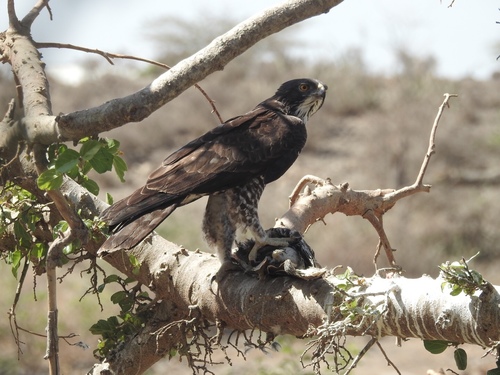
Greater Spotted Eagle

Greater Spotted Eagle

Aquila clanga

Silhouette: Andy Wilson · PhyloPic

Daily sighting probability <5% · Rare
at Bale Mountains National Park

In 3 days ~10% in a week ~30%

6 Verified sightings at Bale Mountains National Park From 2019 to 2026
2,032 In all 18 parks
December Best month
☀️ Diurnal When it's spotted

About the Greater Spotted Eagle

The greater spotted eagle (Clanga clanga), also called the spotted eagle, is a large migratory bird of prey in the family Accipitridae. It is a member of the subfamily Aquilinae, commonly known as "booted eagles". It was once classified as a member of the genus Aquila, but has been reclassified to the distinct genus Clanga, along with the two other species of spotted eagle.

During breeding season, greater spotted eagles are widely distributed across Eastern Europe, parts of Central Europe, central Russia, central Asia and parts of China, along with other isolated areas. During winter, they migrate, primarily to South Asia, Southeast Asia, the Middle East, the upper Mediterranean Basin, and parts of East Africa. Greater spotted eagles favor wetter habitats than most other booted eagles, preferring riparian zones as well as bogs, lakes, ponds, and other bodies of water surrounded by woodland. They breed primarily on floodplains, especially ones that experience high water levels. During winter and migration, they often seek out similar wetland habitats, but have also been observed in dry upland areas such as savanna plateaus.

The eagle is an opportunistic forager, especially during the winter. It will readily scavenge a variety of food sources, including carrion, as well as small mammals (principally rodents), frogs, and a variety of smaller birds (especially water birds), and occasionally reptiles and insects. The eagle is primarily an aerial hunter, gliding from concealed perches over marshes or wet fields to catch prey.

This species builds stick nests in large trees, laying a clutch of one to three eggs. The female of a pair incubates and broods the young while the male hunts and delivers prey. Parents rarely raise more than one fledgling per year. As is common among a few species of raptors, the oldest chick is much larger than its younger siblings, and will often attack and kill the younger siblings.

The greater spotted eagle's range overlaps with the closely related lesser spotted eagle (Clanga pomarina). The two species are known to breed together frequently, forming hybrid offspring, which is detrimental to the population of the rarer greater spotted eagles. The greater spotted eagle is classified as a vulnerable species by the International Union for Conservation of Nature. Its populations are threatened by habitat destruction, collisions with objects, and hybridization with lesser spotted eagles. Wikipedia →

Sounds

Recording0:14

Russia · 2025

© Константин Селивёрстов · iNaturalist · CC BY 4.0

Recording0:18

Russia · 2026

© Евгений Маринкин · iNaturalist · CC BY 4.0

Global Distribution

Parks Where Found

# Park Country Daily sighting probability
1 Keoladeo National Park 🇮🇳 India
~50%
2 Kaziranga National Park 🇮🇳 India
~20%
3 Mudumalai National Park 🇮🇳 India
~10%
4 Bale Mountains National Park 🇪🇹 Ethiopia
<5%
5 Gir National Park 🇮🇳 India
<5%
6 Białowieża National Park 🇵🇱 Poland
<5%
7 Chitwan National Park 🇳🇵 Nepal
<5%
8 Nagarhole National Park 🇮🇳 India
<5%
9 Periyar National Park 🇮🇳 India
<5%
10 Bandipur National Park 🇮🇳 India
<5%
11 Manas National Park 🇮🇳 India
<5%
12 Hortobágy National Park 🇭🇺 Hungary
<5%
13 Lake Nakuru National Park 🇰🇪 Kenya
<5%
14 Doñana National Park 🇪🇸 Spain
<5%
15 Ranthambore National Park 🇮🇳 India
<5%
16 Biebrza National Park 🇵🇱 Poland
<5%
17 Camargue 🇫🇷 France
<5%
18 Kanha National Park 🇮🇳 India
<5%

Cities Where Found

# City Country Daily sighting probability
1 Vasai-Virar 🇮🇳 India
~10%
2 Riyadh 🇸🇦 Saudi Arabia
~10%
3 Surat 🇮🇳 India
<5%
4 Chennai 🇮🇳 India
<5%
5 Mumbai 🇮🇳 India
<5%
6 Kuwait City 🇰🇼 Kuwait
<5%
7 Dubai 🇦🇪 United Arab Emirates
<5%
8 Ponnani 🇮🇳 India
<5%
9 Thrissur 🇮🇳 India
<5%
10 Kalyan-Dombivli 🇮🇳 India
<5%

Zoos & Centres Where Found

# Zoo / Centre Country
1 Kadoorie Farm and Botanic Garden 🇭🇰 Hong Kong SAR China In captivity
2 Nakhon Ratchasima Zoo 🇹🇭 Thailand In captivity
3 Castellar Zoo 🇪🇸 Spain In captivity
4 The National Aquarium Abu Dhabi 🇦🇪 United Arab Emirates In captivity
5 مركز كلباء للطيور الجارحة 🇦🇪 United Arab Emirates In captivity

Before you go

What are the chances of seeing a Greater Spotted Eagle in Bale Mountains National Park?

Rare

Under 5% of wildlife watchers report a Greater Spotted Eagle sighting in Bale Mountains National Park on a given day, based on 6 verified sightings from GBIF citizen-science data from 2019 to 2026. It is the 101st most-seen of the 117 birds we can rate there. Over three days the chance rises to about 10%, and over a week to about 30%, if each day is a fresh chance.

When is the best time to see a Greater Spotted Eagle in Bale Mountains National Park?

December

In that month about 20% of wildlife watchers report a Greater Spotted Eagle in Bale Mountains National Park on a given day, against under 5% in January–February, April–August and October–November, the lowest months. That is one of Bale Mountains National Park's driest months, with about 35 mm of rain against 230 mm in April. March and September have too few records to rate.

What time of day is best to see a Greater Spotted Eagle?

Between 10 am and 1 pm

Across all the parks we cover, that three-hour window holds the most Greater Spotted Eagle sightings with a recorded time, and about 9 in 10 of them come between 6 am and 6 pm: it is a daytime animal.

Is Bale Mountains National Park the best place to see a Greater Spotted Eagle?

4th of 18

Of the 18 parks where we can rate Greater Spotted Eagle sightings, Bale Mountains National Park ranks 4th at under 5%. The best odds are in Keoladeo National Park (India, about 50%), Kaziranga National Park (India, about 20%) and Mudumalai National Park (India, about 10%).

Which relatives of the Greater Spotted Eagle live in Bale Mountains National Park?

Same genus: Aquila

The closest relatives of the Greater Spotted Eagle that you can see in Bale Mountains National Park (genus Aquila, True Eagles) are Steppe Eagle (about 30%), Tawny Eagle (about 30%) and Verreaux's Eagle (about 10%), with each one's daily chance of a sighting.

Where does the Greater Spotted Eagle sighting chance come from?

GBIF citizen-science records

It is estimated from how often the Greater Spotted Eagle is recorded against all the birds logged in Bale Mountains National Park (6 verified sightings from 2019 to 2026), calibrated against known sighting rates. Figures are rounded to the nearest 10% because citizen-science data supports honest approximations, not decimals, and months with records from fewer than five people show "—". How it works.

← Back to Bale Mountains National Park