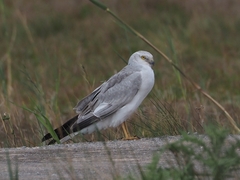
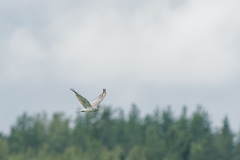
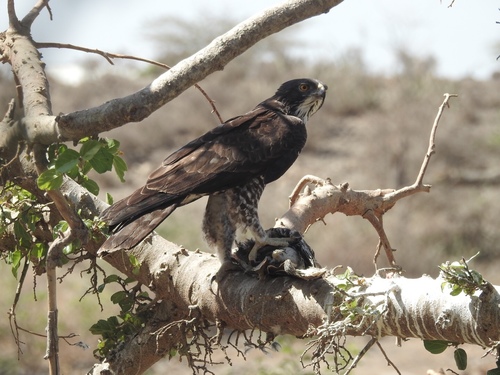
Pale Harrier

Pale Harrier

Circus macrourus

Silhouette: Andy Wilson · PhyloPic

LCNTNear ThreatenedVUENCR
Daily sighting probability ~10% · With luck
at Bale Mountains National Park

In 3 days ~20% in a week ~50%

16 Verified sightings at Bale Mountains National Park From 2019 to 2026
1,352 In all 29 parks
November Best month
☀️ Diurnal When it's spotted

About the Pale Harrier

The pallid harrier (Circus macrourus) is a species of harrier, a bird of prey in the family Accipitridae. It breeds in southern parts of eastern Europe and central Asia and Iran and winters mainly in India and southeast Asia. It is a rare but increasing vagrant to Great Britain and western Europe. In 2017 a pair of pallid harriers nested in a barley field in the Netherlands; they raised four chicks, the first recorded breeding of the species in the country. In 2019, a pair bred in Spain for the first time.

This medium-sized raptor breeds on open plains, bogs and heathland. In winter it is a bird of open country. The scientific name is Ancient Greek. Circus is from kirkos (circle), referring to a bird of prey named for its circling flight ('probably the hen harrier), and macrourus is "long-tailed", from makros (long) and -ouros (-tailed).

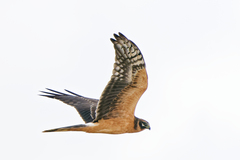
This is a typical harrier, with long wings held in a shallow V in its low flight. It also resembles other harriers in having distinct male and female plumages. Adults measure 40–48 cm (16–19 in) long with a wingspan of 95–120 cm (37–47 in). Males weigh 315 g (11.1 oz) while the slightly larger females weigh 445 g... Wikipedia →

Sounds

Flight call0:18

Belgium · 2012

© Hans Matheve · XC643655 · CC BY-NC-ND 4.0

Alarm call0:53

Czech Republic · 2020

© Jan Studecky · XC571877 · CC BY-NC-SA 4.0

Call1:07

Kazakhstan · 2013

© Thijs Fijen · XC145150 · CC BY-NC-SA 3.0

Global Distribution

Parks Where Found

# Park Country Daily sighting probability
1 Masai Mara National Reserve 🇰🇪 Kenya
~10%
2 Bale Mountains National Park 🇪🇹 Ethiopia
~10%
3 Serengeti National Park 🇹🇿 Tanzania
~10%
4 Awash National Park 🇪🇹 Ethiopia
~10%
5 Tsavo East National Park 🇰🇪 Kenya
~10%
6 Kidepo Valley National Park 🇺🇬 Uganda
~10%
7 Ngorongoro Conservation Area 🇹🇿 Tanzania
~10%
8 Murchison Falls National Park 🇺🇬 Uganda
~10%
9 Samburu National Reserve 🇰🇪 Kenya
<5%
10 Amboseli National Park 🇰🇪 Kenya
<5%
11 Queen Elizabeth National Park 🇺🇬 Uganda
<5%
12 Tarangire National Park 🇹🇿 Tanzania
<5%
13 Lake Nakuru National Park 🇰🇪 Kenya
<5%
14 Ruaha National Park 🇹🇿 Tanzania
<5%
15 Kiskunság National Park 🇭🇺 Hungary
<5%
16 Hortobágy National Park 🇭🇺 Hungary
<5%
17 Tsavo West National Park 🇰🇪 Kenya
<5%
18 Nairobi National Park 🇰🇪 Kenya
<5%
19 Lake Mburo National Park 🇺🇬 Uganda
<5%
20 Biebrza National Park 🇵🇱 Poland
<5%
21 Periyar National Park 🇮🇳 India
<5%
22 Doñana National Park 🇪🇸 Spain
<5%
23 Chobe National Park 🇧🇼 Botswana
<5%
24 Fertő-Hanság National Park 🇭🇺 Hungary
<5%
25 Keoladeo National Park 🇮🇳 India
<5%
26 Ranthambore National Park 🇮🇳 India
<5%
27 Wadden Sea National Park 🇩🇪 Germany
<5%
28 Kruger National Park 🇿🇦 South Africa
<5%
29 Kanha National Park 🇮🇳 India
<5%

Cities Where Found

# City Country Daily sighting probability
1 Vasai-Virar 🇮🇳 India
<5%
2 Abu Dhabi 🇦🇪 United Arab Emirates
<5%
3 Helsinki 🇫🇮 Finland
<5%
4 Tel Aviv 🇮🇱 Israel
<5%
5 Hyderabad 🇮🇳 India
<5%
6 Jerusalem 🇮🇱 Israel
<5%
7 Chennai 🇮🇳 India
<5%
8 Pune 🇮🇳 India
<5%

Before you go

What are the chances of seeing a Pale Harrier in Bale Mountains National Park?

With luck

About 10% of wildlife watchers report a Pale Harrier sighting in Bale Mountains National Park on a given day, based on 16 verified sightings from GBIF citizen-science data from 2019 to 2026. It is the 74th most-seen of the 117 birds we can rate there. Over three days the chance rises to about 20%, and over a week to about 50%, if each day is a fresh chance.

When is the best time to see a Pale Harrier in Bale Mountains National Park?

November

In that month about 20% of wildlife watchers report a Pale Harrier in Bale Mountains National Park on a given day, against under 5% in May and December–January, the lowest months. March and September have too few records to rate.

What time of day is best to see a Pale Harrier?

Between 1 and 4 pm

Across all the parks we cover, that three-hour window holds the most Pale Harrier sightings with a recorded time, and about 9 in 10 of them come between 6 am and 6 pm: it is a daytime animal.

Is Bale Mountains National Park the best place to see a Pale Harrier?

Among the best

Of the 29 parks where we can rate Pale Harrier sightings, Bale Mountains National Park ranks 2nd at about 10%, level with the leaders once rounded. The best odds are in Masai Mara National Reserve (Kenya, about 10%).

Which relatives of the Pale Harrier live in Bale Mountains National Park?

Same family: Accipitridae

The closest relatives of the Pale Harrier that you can see in Bale Mountains National Park (family Accipitridae, Hawks, Eagles, and Kites) are Augur Buzzard (about 80%), Black Kite (about 30%) and Steppe Eagle (about 30%), with each one's daily chance of a sighting.

Where does the Pale Harrier sighting chance come from?

GBIF citizen-science records

It is estimated from how often the Pale Harrier is recorded against all the birds logged in Bale Mountains National Park (16 verified sightings from 2019 to 2026), calibrated against known sighting rates. Figures are rounded to the nearest 10% because citizen-science data supports honest approximations, not decimals, and months with records from fewer than five people show "—". How it works.

← Back to Bale Mountains National Park