European Serin

European Serin

Serinus serinus

Silhouette: Sheatherius · PhyloPic

LCLeast ConcernNTVUENCR
Daily sighting probability <5% · Rare
at Bavarian Forest National Park

In 3 days ~10% in a week ~20%

37 Verified sightings at Bavarian Forest National Park From 2019 to 2026
9,754 In all 25 parks
April Best month
🌅 Crepuscular When it's spotted

About the European Serin

The European serin, or simply the serin (Serinus serinus), is the smallest species of the family of finches (Fringillidae) and is closely related to the Atlantic canary. Its diet consists mainly of a combination of buds and seeds.

The European serin was described by Carl Linnaeus in 1766 in the 12th edition of his Systema Naturae under the binomial name Fringilla serinus. The Latin serinus comes from the French word serin for a canary. The French word may be a corruption of the Latin word citrinus meaning "lemon-coloured".

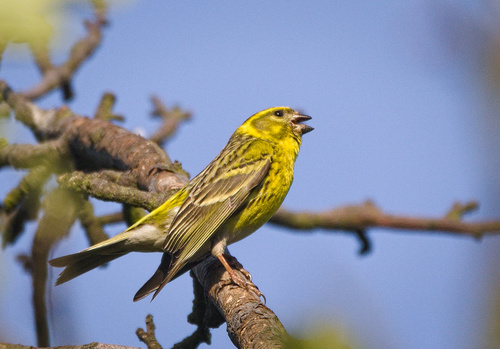
The European serin is a small short-tailed bird, 11–12 cm in length. The upper parts are dark-streaked greyish green, with a yellow rump. The yellow breast and white belly are also heavily streaked. The male has a brighter yellow face and breast, yellow wing bars and yellow tail sides. The song of this bird is a buzzing trill, very familiar in Mediterranean countries.

It breeds across southern and central Europe and North Africa. Southern and Atlantic coast populations are largely resident, but the northern breeders migrate further south in Europe for the winter. Open woodland and cultivation, often with some conifers, is favoured... Wikipedia →
Sounds

Call0:38

Spain · 2024

© Jacobo Ramil Millarengo · XC897458 · CC BY-NC-SA 4.0

Song0:45

Poland · 2023

© Romuald Mikusek · XC812474 · CC BY-NC-SA 4.0

Flight call0:18

Spain · 2020

© Sean Ronayne · XC524575 · CC BY-NC-SA 4.0

Global Distribution

Parks Where Found

# Park Country Daily sighting probability
1 Sierra Nevada National Park 🇪🇸 Spain
~60%
2 Monfragüe National Park 🇪🇸 Spain
~50%
3 Sierra de Guadarrama National Park 🇪🇸 Spain
~40%
4 Picos de Europa National Park 🇪🇸 Spain
~40%
5 Ecrins National Park 🇫🇷 France
~40%
6 Doñana National Park 🇪🇸 Spain
~30%
7 Cévennes National Park 🇫🇷 France
~30%
8 Mercantour National Park 🇫🇷 France
~30%
9 Vanoise National Park 🇫🇷 France
~30%
10 Pyrénées National Park 🇫🇷 France
~20%
11 Aigüestortes National Park 🇪🇸 Spain
~20%
12 Białowieża National Park 🇵🇱 Poland
~20%
13 Hohe Tauern National Park 🇦🇹 Austria
~20%
14 Ordesa y Monte Perdido National Park 🇪🇸 Spain
~20%
15 Plitvice Lakes National Park 🇭🇷 Croatia
~20%
16 Triglav National Park 🇸🇮 Slovenia
~20%
17 Biebrza National Park 🇵🇱 Poland
~10%
18 Fertő-Hanság National Park 🇭🇺 Hungary
~10%
19 Tatra National Park 🇸🇰 Slovakia
~10%
20 Hortobágy National Park 🇭🇺 Hungary
~10%
21 Kiskunság National Park 🇭🇺 Hungary
<5%
22 Bavarian Forest National Park 🇩🇪 Germany
<5%
23 Camargue 🇫🇷 France
<5%
24 Gauja National Park 🇱🇻 Latvia
<5%
25 Wadden Sea National Park 🇩🇪 Germany
<5%

Cities Where Found

# City Country Daily sighting probability
1 Barcelona 🇪🇸 Spain
~60%
2 Valencia 🇪🇸 Spain
~60%
3 Lisbon 🇵🇹 Portugal
~60%
4 Madrid 🇪🇸 Spain
~60%
5 Naples 🇮🇹 Italy
~50%
6 Porto 🇵🇹 Portugal
~50%
7 Tunis 🇹🇳 Tunisia
~40%
8 Rome 🇮🇹 Italy
~30%
9 Marrakesh 🇲🇦 Morocco
~20%
10 Rabat 🇲🇦 Morocco
~20%

Before you go

What are the chances of seeing a European Serin in Bavarian Forest National Park?

Rare

Under 5% of wildlife watchers report a European Serin sighting in Bavarian Forest National Park on a given day, based on 37 verified sightings from GBIF citizen-science data from 2019 to 2026. It is the 113th most-seen of the 170 birds we can rate there. Over three days the chance rises to about 10%, and over a week to about 20%, if each day is a fresh chance.

When is the best time to see a European Serin in Bavarian Forest National Park?

April and June–July

In those months about 10% of wildlife watchers report a European Serin in Bavarian Forest National Park on a given day, against under 5% in May and August–March, the lowest months.

What time of day is best to see a European Serin?

Between 9 am and noon

Across all the parks we cover, that three-hour window holds the most European Serin sightings with a recorded time, and about 7 in 10 of them come between 6 am and 6 pm: it is most active around dawn and dusk.

Which relatives of the European Serin live in Bavarian Forest National Park?

Same family: Fringillidae

The closest relatives of the European Serin that you can see in Bavarian Forest National Park (family Fringillidae, Finches, Euphonias, and Allies) are Chaffinch (about 60%), Eurasian Goldfinch (about 30%) and European Greenfinch (about 20%), with each one's daily chance of a sighting.

Where does the European Serin sighting chance come from?

GBIF citizen-science records

It is estimated from how often the European Serin is recorded against all the birds logged in Bavarian Forest National Park (37 verified sightings from 2019 to 2026), calibrated against known sighting rates. Figures are rounded to the nearest 10% because citizen-science data supports honest approximations, not decimals, and months with records from fewer than five people show "—". How it works.

← Back to Bavarian Forest National Park