
Eurasian Siskin

Eurasian Siskin

Spinus spinus

Silhouette: Andy Wilson · PhyloPic

LCLeast ConcernNTVUENCR
Daily sighting probability ~20% · Possible
at Bavarian Forest National Park

In 3 days ~50% in a week ~80%

198 Verified sightings at Bavarian Forest National Park From 2019 to 2026
5,654 In all 30 parks
October Best month
🌅 Crepuscular When it's spotted

About the Eurasian Siskin

The Eurasian siskin (Spinus spinus) is a small passerine bird in the finch family Fringillidae. It is also called the European siskin, common siskin or just siskin. Other (archaic) names include black-headed goldfinch, barley bird and aberdevine. It is very common throughout Europe and Eurosiberia. It is found in forested areas, both coniferous and mixed woodland where it feeds on seeds of all kinds, especially of alder and conifers.

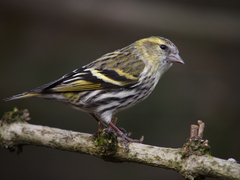
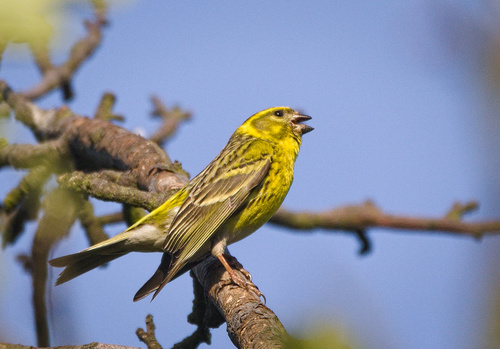
It can be distinguished from similar finches by its plumage colour. Its upperparts are greyish green and its underparts are grey-streaked white. Its wings are black with a striking yellow wing bar and its tail is black with yellow sides. The male has a predominantly yellow face and breast with a neat black cap. The female and young birds have a greyish-green head and no cap. It is a trusting, sociable and active bird. Its song is a pleasant mix of tweets and trills.

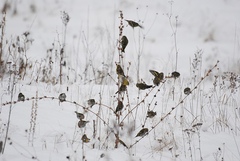
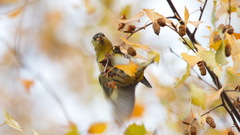
These birds exhibit an unusual migration pattern, migrating southwards in large numbers every few years in winter. The reasons for this behaviour are not known, but they may be related to climatic factors and, above all, the availability of food. This enables overwintering populations to thrive where food is abundant. This small finch is an acrobatic feeder and often hangs upside down like a tit. It will visit garden bird feeding stations. Wikipedia →

Sounds

Call0:38

Sweden · 2026

© Lars Edenius · XC1153986 · CC BY-NC-SA 4.0

Song1:19

Norway · 2022

© Elias A. Ryberg · XC703333 · CC BY-NC-ND 4.0

Alarm call0:44

Sweden · 2021

© Thomas Bergman · XC665065 · CC BY-NC-SA 4.0

Global Distribution

Parks Where Found

# Park Country Daily sighting probability
1 Cairngorms National Park 🇬🇧 United Kingdom
~60%
2 Tatra National Park 🇸🇰 Slovakia
~30%
3 Gauja National Park 🇱🇻 Latvia
~20%
4 Bavarian Forest National Park 🇩🇪 Germany
~20%
5 Białowieża National Park 🇵🇱 Poland
~20%
6 Snowdonia National Park 🇬🇧 United Kingdom
~20%
7 Biebrza National Park 🇵🇱 Poland
~20%
8 Sierra Nevada National Park 🇪🇸 Spain
~10%
9 Triglav National Park 🇸🇮 Slovenia
~10%
10 Vanoise National Park 🇫🇷 France
~10%
11 Kiskunság National Park 🇭🇺 Hungary
~10%
12 Wadden Sea National Park 🇩🇪 Germany
~10%
13 Hohe Tauern National Park 🇦🇹 Austria
~10%
14 Mercantour National Park 🇫🇷 France
~10%
15 Ecrins National Park 🇫🇷 France
~10%
16 Hortobágy National Park 🇭🇺 Hungary
~10%
17 Nikko National Park 🇯🇵 Japan
~10%
18 Doñana National Park 🇪🇸 Spain
~10%
19 Monfragüe National Park 🇪🇸 Spain
~10%
20 Gobi Gurvansaikhan National Park 🇲🇳 Mongolia
~10%
21 Plitvice Lakes National Park 🇭🇷 Croatia
~10%
22 Aigüestortes National Park 🇪🇸 Spain
~10%
23 Pyrénées National Park 🇫🇷 France
<5%
24 Cévennes National Park 🇫🇷 France
<5%
25 Sierra de Guadarrama National Park 🇪🇸 Spain
<5%
26 Fertő-Hanság National Park 🇭🇺 Hungary
<5%
27 Camargue 🇫🇷 France
<5%
28 Ordesa y Monte Perdido National Park 🇪🇸 Spain
<5%
29 Picos de Europa National Park 🇪🇸 Spain
<5%
30 Taroko National Park 🇹🇼 Taiwan
<5%

Cities Where Found

# City Country Daily sighting probability
1 Mashhad 🇮🇷 Iran
~40%
2 Helsinki 🇫🇮 Finland
~30%
3 Minsk 🇧🇾 Belarus
~20%
4 Warsaw 🇵🇱 Poland
~20%
5 Ankara 🇹🇷 Turkey
~20%
6 Kharkiv 🇺🇦 Ukraine
~20%
7 Jerusalem 🇮🇱 Israel
~20%
8 Kyiv 🇺🇦 Ukraine
~20%
9 Sincan 🇹🇷 Turkey
~20%
10 Milan 🇮🇹 Italy
~20%

Zoos & Centres Where Found

# Zoo / Centre Country
1 Beijing Wildlife Park 🇨🇳 China In captivity
2 Ueno Zoo 🇯🇵 Japan In captivity
3 Tierpark Hexentanzplatz 🇩🇪 Germany In captivity
4 Ueno Zoological Gardens (West Garden) 🇯🇵 Japan In captivity
5 Zoopark Limpopo 🇷🇺 Russia In captivity
6 Vogelpark Heiligenkirchen 🇩🇪 Germany In captivity

Before you go

What are the chances of seeing a Eurasian Siskin in Bavarian Forest National Park?

Possible

About 20% of wildlife watchers report a Eurasian Siskin sighting in Bavarian Forest National Park on a given day, based on 198 verified sightings from GBIF citizen-science data from 2019 to 2026. It is the 35th most-seen of the 170 birds we can rate there. Over three days the chance rises to about 50%, and over a week to about 80%, if each day is a fresh chance.

When is the best time to see a Eurasian Siskin in Bavarian Forest National Park?

February and October

In those months about 40% of wildlife watchers report a Eurasian Siskin in Bavarian Forest National Park on a given day, against about 10% in May–August and December, the lowest months.

What time of day is best to see a Eurasian Siskin?

Between 4 and 7 pm

Across all the parks we cover, that three-hour window holds the most Eurasian Siskin sightings with a recorded time, and about 6 in 10 of them come between 6 pm and 6 am: it is most active around dawn and dusk.

Which relatives of the Eurasian Siskin live in Bavarian Forest National Park?

Same family: Fringillidae

The closest relatives of the Eurasian Siskin that you can see in Bavarian Forest National Park (family Fringillidae, Finches, Euphonias, and Allies) are Chaffinch (about 60%), Eurasian Goldfinch (about 30%) and European Greenfinch (about 20%), with each one's daily chance of a sighting.

Where does the Eurasian Siskin sighting chance come from?

GBIF citizen-science records

It is estimated from how often the Eurasian Siskin is recorded against all the birds logged in Bavarian Forest National Park (198 verified sightings from 2019 to 2026), calibrated against known sighting rates. Figures are rounded to the nearest 10% because citizen-science data supports honest approximations, not decimals, and months with records from fewer than five people show "—". How it works.

← Back to Bavarian Forest National Park