Red-crested Pochard

Red-crested Pochard

Netta rufina

Silhouette: Sheatherius · PhyloPic

LCLeast ConcernNTVUENCR
Daily sighting probability <5% · Rare
at Bavarian Forest National Park

In 3 days ~10% in a week ~20%

28 Verified sightings at Bavarian Forest National Park From 2019 to 2026
3,137 In all 15 parks
April Best month
☀️ Diurnal When it's spotted

About the Red-crested Pochard

The red-crested pochard (Netta rufina) is a large diving duck. The scientific name is derived from Greek Netta "duck", and Latin rufina, "golden-red" (from rufus, "ruddy"). Its breeding habitat is lowland marshes and lakes in southern Europe and it extends from the steppe and semi-desert areas on the Black Sea to Central Asia and Mongolia, wintering in the Indian subcontinent and Africa. It is somewhat migratory, and northern birds winter further south into north Africa.

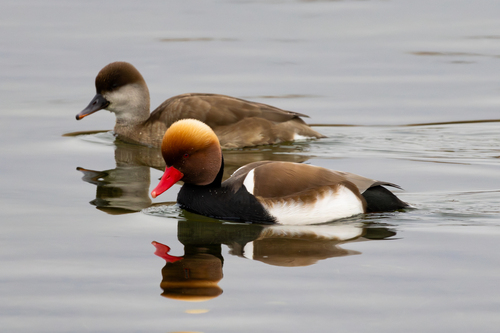
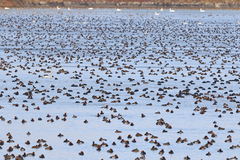
The adult male is unmistakable. It has a rounded orange head, red bill and black breast. The flanks are white, the back brown, and the tail black. The female is mainly a pale brown, with a darker back and crown and a whitish face. Eclipse males are like females but with red bills. They are gregarious birds, forming large flocks in winter, often mixed with other diving ducks, such as common pochards. They feed mainly by diving or dabbling. They eat aquatic plants, and typically upend for food more than most diving ducks.

A wheezing veht call can be given by the male. Series of hoarse vrah-vrah-vrah calls can also be heard from females. Red-crested pochards build nests by the lakeside among vegetation and lay 8–12 pale green eggs. The birds' status in the British Isles is much confused because there have been many escapes and deliberate releases over the years, as well as natural visitors from the continent. However, the majority of individuals in the British Isles are the result of accidental and deliberate introductions. They are most numerous around areas of England including Gloucestershire, Oxfordshire, Northamptonshire and also spotted in Leicestershire.

The red-crested pochard is one of the species to which the Agreement on the Conservation of African-Eurasian Migratory Waterbirds (AEWA) applies. Wikipedia →
Sounds

Call0:46

Poland · 2025

© Jarek Matusiak · XC982110 · CC BY-NC-ND 4.0

Song0:47

Switzerland · 2018

© Pascal Christe · XC404318 · CC BY-NC-SA 4.0

Call1:02

Netherlands · 2020

© Michel Veldt · XC769720 · CC BY-NC-SA 4.0

Global Distribution

Parks Where Found

# Park Country Daily sighting probability
1 Fertő-Hanság National Park 🇭🇺 Hungary
~30%
2 Kiskunság National Park 🇭🇺 Hungary
~30%
3 Doñana National Park 🇪🇸 Spain
~30%
4 Camargue 🇫🇷 France
~20%
5 Keoladeo National Park 🇮🇳 India
~20%
6 Hortobágy National Park 🇭🇺 Hungary
~10%
7 Bavarian Forest National Park 🇩🇪 Germany
<5%
8 Chitwan National Park 🇳🇵 Nepal
<5%
9 Kaziranga National Park 🇮🇳 India
<5%
10 Kanha National Park 🇮🇳 India
<5%
11 Satpura National Park 🇮🇳 India
<5%
12 Pyrénées National Park 🇫🇷 France
<5%
13 Monfragüe National Park 🇪🇸 Spain
<5%
14 Wadden Sea National Park 🇩🇪 Germany
<5%
15 Jim Corbett National Park 🇮🇳 India
<5%

Cities Where Found

# City Country Daily sighting probability
1 Munich 🇩🇪 Germany
~20%
2 Nagpur 🇮🇳 India
~10%
3 Asansol 🇮🇳 India
~10%
4 Valencia 🇪🇸 Spain
~10%
5 Chengdu 🇨🇳 China
~10%
6 London 🇬🇧 United Kingdom
~10%
7 Rotterdam [The Hague] 🇳🇱 Netherlands
<5%
8 Lisbon 🇵🇹 Portugal
<5%
9 Miami 🇺🇸 United States
<5%
10 Antalya 🇹🇷 Turkey
<5%

Zoos & Centres Where Found

# Zoo / Centre Country
1 Disney's Animal Kingdom 🇺🇸 United States In captivity
2 Busch Gardens Tampa 🇺🇸 United States In captivity
3 Moscow Zoo 🇷🇺 Russia In captivity
4 Pairi Daiza 🇧🇪 Belgium In captivity
5 Prague Zoo 🇨🇿 Czechia In captivity
6 Dvůr Králové Zoo 🇨🇿 Czechia In captivity
7 Parc Phœnix 🇫🇷 France In captivity
8 Fota Wildlife Park 🇮🇪 Ireland In captivity
9 Réserve africaine de Sigean 🇫🇷 France In captivity
10 Parc des oiseaux 🇫🇷 France In captivity
11 Zoobotánico Jerez 🇪🇸 Spain In captivity
12 Zoo Miami 🇺🇸 United States In captivity
13 Lusen National Park Centre 🇩🇪 Germany In captivity
14 San Diego Zoo Safari Park 🇺🇸 United States In captivity
15 SeaWorld San Antonio 🇺🇸 United States In captivity
16 Ramat Gan Safari 🇮🇱 Israel In captivity
17 Beijing Zoo 🇨🇳 China In captivity
18 Sedgwick County Zoo 🇺🇸 United States In captivity
19 Chester Zoo 🇬🇧 United Kingdom In captivity
20 Dallas Zoo 🇺🇸 United States In captivity
21 Slimbridge Wetland Centre 🇬🇧 United Kingdom In captivity
22 Phoenix Zoo 🇺🇸 United States In captivity
23 The Maryland Zoo 🇺🇸 United States In captivity
24 Silesian Zoological Garden 🇵🇱 Poland In captivity
25 Wildlife World Zoo 🇺🇸 United States In captivity
26 Parco Natura Viva 🇮🇹 Italy In captivity
27 Wildpark Schwarze Berge 🇩🇪 Germany In captivity
28 Chongqing Zoo 🇨🇳 China In captivity
29 Hellabrunn Zoo 🇩🇪 Germany In captivity
30 Berlin Zoological Garden 🇩🇪 Germany In captivity
31 Diergaarde Blijdorp 🇳🇱 Netherlands In captivity
32 Fort Worth Zoo 🇺🇸 United States In captivity
33 Oregon Zoo 🇺🇸 United States In captivity
34 Memphis Zoo 🇺🇸 United States In captivity
35 Centro Cicogne e Anatidi 🇮🇹 Italy In captivity
36 Dudley Zoo 🇬🇧 United Kingdom In captivity
37 Karlsruhe Zoo 🇩🇪 Germany In captivity
38 Tierpark Hagenbeck 🇩🇪 Germany In captivity
39 Budapest Zoo & Botanical Garden 🇭🇺 Hungary In captivity
40 Faunia 🇪🇸 Spain In captivity
41 Cleres Zoological Park 🇫🇷 France In captivity
42 Valencia Bioparc 🇪🇸 Spain In captivity
43 Bioparque Educativo Quillón 🇨🇱 Chile In captivity
44 Vogelpark Avifauna 🇳🇱 Netherlands In captivity
45 Monkeyland 🇿🇦 South Africa In captivity
46 Van Blanckendaell Park 🇳🇱 Netherlands In captivity
47 Buin Zoo 🇨🇱 Chile In captivity
48 Kuala Lumpur Bird Park 🇲🇾 Malaysia In captivity
49 L'Oceanogràfic 🇪🇸 Spain In captivity
50 Zoopark Limpopo 🇷🇺 Russia In captivity

Before you go

What are the chances of seeing a Red-crested Pochard in Bavarian Forest National Park?

Rare

Under 5% of wildlife watchers report a Red-crested Pochard sighting in Bavarian Forest National Park on a given day, based on 28 verified sightings from GBIF citizen-science data from 2019 to 2026. It is the 110th most-seen of the 170 birds we can rate there. Over three days the chance rises to about 10%, and over a week to about 20%, if each day is a fresh chance.

When is the best time to see a Red-crested Pochard in Bavarian Forest National Park?

April and May

In those months about 10% of wildlife watchers report a Red-crested Pochard in Bavarian Forest National Park on a given day, against under 5% in June to March, the lowest months.

What time of day is best to see a Red-crested Pochard?

Between 9 am and noon

Across all the parks we cover, that three-hour window holds the most Red-crested Pochard sightings with a recorded time, and about 8 in 10 of them come between 6 am and 6 pm: it is a daytime animal.

Is Bavarian Forest National Park the best place to see a Red-crested Pochard?

7th of 15

Of the 15 parks where we can rate Red-crested Pochard sightings, Bavarian Forest National Park ranks 7th at under 5%. The best odds are in Fertő-Hanság National Park (Hungary, about 30%), Kiskunság National Park (Hungary, about 30%) and Doñana National Park (Spain, about 30%).

Which relatives of the Red-crested Pochard live in Bavarian Forest National Park?

Same family: Anatidae

The closest relatives of the Red-crested Pochard that you can see in Bavarian Forest National Park (family Anatidae, Ducks, Geese, and Swans) are Mallard (about 50%), Greylag Goose (about 40%) and Mute Swan (about 30%), with each one's daily chance of a sighting.

Where does the Red-crested Pochard sighting chance come from?

GBIF citizen-science records

It is estimated from how often the Red-crested Pochard is recorded against all the birds logged in Bavarian Forest National Park (28 verified sightings from 2019 to 2026), calibrated against known sighting rates. Figures are rounded to the nearest 10% because citizen-science data supports honest approximations, not decimals, and months with records from fewer than five people show "—". How it works.

← Back to Bavarian Forest National Park

