White-breasted Nuthatch

White-breasted Nuthatch

Sitta carolinensis

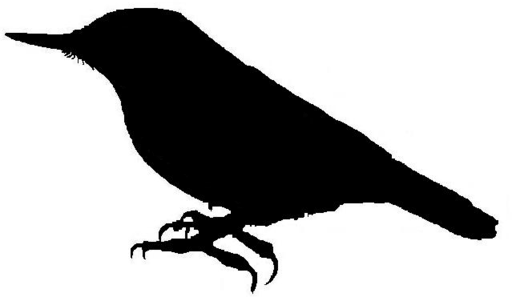
Silhouette: Alan and Elaine Wilson (Modified) · PhyloPic

LCLeast ConcernNTVUENCR
Daily sighting probability ~10% · With luck
at Big Bend National Park

In 3 days ~20% in a week ~40%

279 Verified sightings at Big Bend National Park From 2019 to 2026
20,288 In all 27 parks
June Best month
☀️ Diurnal When it's spotted

About the White-breasted Nuthatch

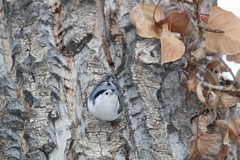
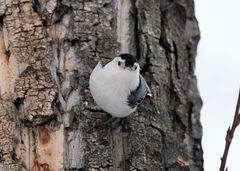
The white-breasted nuthatch (Sitta carolinensis) is a species of bird in the nuthatch family Sittidae. It is a medium-sized nuthatch, measuring approximately 15.5 cm (6.1 in) in length. Coloration varies somewhat along the species' range, but the upperparts are light blue-gray, with a black crown and nape in males, while females have a dark gray crown. The underparts are whitish, with a reddish tinge on the lower abdomen. Despite not being closely related, the white-breasted nuthatch and the white wagtail are very similar in plumage.

The white-breasted nuthatch is a chatty bird. It has a nasal voice and often utters little cries or vocalizations, often composed of repetitions of small invariant whistles. In summer, it is an exclusively insectivorous bird, consuming a wide range of arthropods, but in winter its diet consists mainly of seeds. The nest is located in the cavity of a tree. The clutch consists of five to nine eggs, incubated for two weeks by the female, who is fed by the male. The two adults then feed the young until they fledge, and for a few weeks after that.

The white-breasted nuthatch breeds throughout much of North America, except in the cooler and drier areas. It is mainly found at low elevations, in deciduous forests or in mixed woodlands. Seven to nine subspecies are generally distinguished by their slightly distinct distributions, vocalizations, and coloration. The species was once thought to be related to the white-cheeked nuthatch (S leucopsis) and Przewalski's nuthatch (S. przewalskii), two species from southern Asia, but is actually more closely related to the giant nuthatch (S. magna), also from Southeast Asia. Wikipedia →

Sounds

Song1:23

United States · 2026

© Ed Pandolfino · XC1094766 · CC BY-NC-SA 4.0

Call0:20

United States · 2013

© Tero Linjama · XC942746 · CC BY-NC-SA 4.0

Alarm call0:26

United States · 2021

© David A. Brinkman · XC687224 · CC BY-NC-SA 4.0

Global Distribution

Parks Where Found

# Park Country Daily sighting probability
1 Shenandoah National Park 🇺🇸 United States
~60%
2 Grand Canyon National Park 🇺🇸 United States
~50%
3 Great Smoky Mountains National Park 🇺🇸 United States
~50%
4 Congaree National Park 🇺🇸 United States
~40%
5 Rocky Mountain National Park 🇺🇸 United States
~40%
6 Sequoia and Kings Canyon National Parks 🇺🇸 United States
~30%
7 Guadalupe Mountains National Park 🇺🇸 United States
~20%
8 Zion National Park 🇺🇸 United States
~20%
9 Riding Mountain National Park 🇨🇦 Canada
~20%
10 Elk Island National Park 🇨🇦 Canada
~20%
11 Point Pelee National Park 🇨🇦 Canada
~20%
12 Acadia National Park 🇺🇸 United States
~20%
13 Cumbres de Monterrey National Park 🇲🇽 Mexico
~10%
14 Yosemite National Park 🇺🇸 United States
~10%
15 Voyageurs National Park 🇺🇸 United States
~10%
16 Big Bend National Park 🇺🇸 United States
~10%
17 Isle Royale National Park 🇺🇸 United States
<5%
18 Grand Teton National Park 🇺🇸 United States
<5%
19 Redwood National Park 🇺🇸 United States
<5%
20 Reserva de la Biosfera Mariposa Monarca 🇲🇽 Mexico
<5%
21 Yellowstone National Park 🇺🇸 United States
<5%
22 Banff National Park 🇨🇦 Canada
<5%
23 Saguaro National Park 🇺🇸 United States
<5%
24 Jasper National Park 🇨🇦 Canada
<5%
25 Cape Breton Highlands National Park 🇨🇦 Canada
<5%
26 Glacier National Park 🇺🇸 United States
<5%
27 Channel Islands National Park 🇺🇸 United States
<5%

Cities Where Found

# City Country Daily sighting probability
1 Montreal 🇨🇦 Canada
~60%
2 Sacramento 🇺🇸 United States
~60%
3 Minneapolis [Saint Paul] 🇺🇸 United States
~50%
4 Washington 🇺🇸 United States
~50%
5 Edmonton 🇨🇦 Canada
~50%
6 Calgary 🇨🇦 Canada
~50%
7 Boston 🇺🇸 United States
~40%
8 Detroit 🇺🇸 United States
~40%
9 Philadelphia 🇺🇸 United States
~40%
10 Toronto 🇨🇦 Canada
~30%

Before you go

What are the chances of seeing a White-breasted Nuthatch in Big Bend National Park?

With luck

About 10% of wildlife watchers report a White-breasted Nuthatch sighting in Big Bend National Park on a given day, based on 279 verified sightings from GBIF citizen-science data from 2019 to 2026. It is the 109th most-seen of the 270 birds we can rate there. Over three days the chance rises to about 20%, and over a week to about 40%, if each day is a fresh chance.

When is the best time to see a White-breasted Nuthatch in Big Bend National Park?

June

In that month about 20% of wildlife watchers report a White-breasted Nuthatch in Big Bend National Park on a given day, against under 5% in September and November–March, the lowest months.

What time of day is best to see a White-breasted Nuthatch?

Between 8 and 11 am

Across all the parks we cover, that three-hour window holds the most White-breasted Nuthatch sightings with a recorded time, and about 9 in 10 of them come between 6 am and 6 pm: it is a daytime animal.

Where does the White-breasted Nuthatch sighting chance come from?

GBIF citizen-science records

It is estimated from how often the White-breasted Nuthatch is recorded against all the birds logged in Big Bend National Park (279 verified sightings from 2019 to 2026), calibrated against known sighting rates. Figures are rounded to the nearest 10% because citizen-science data supports honest approximations, not decimals, and months with records from fewer than five people show "—". How it works.

← Back to Big Bend National Park