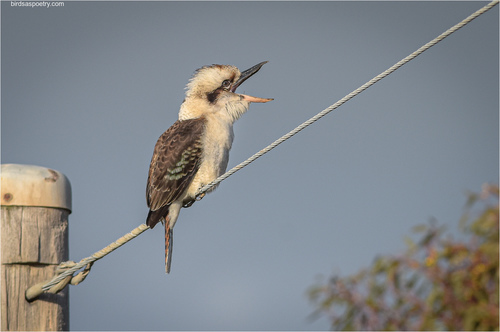
Azure Kingfisher

Azure Kingfisher

Ceyx azureus

Silhouette: Rachael Joakim · PhyloPic

LCLeast ConcernNTVUENCR
Daily sighting probability <5% · Rare
at Blue Mountains National Park

In 3 days <5% in a week ~10%

73 Verified sightings at Blue Mountains National Park From 2019 to 2026
2,218 In all 12 parks
June Best month
☀️ Diurnal When it's spotted

About the Azure Kingfisher

The azure kingfisher (Ceyx azureus) is a small kingfisher in the river kingfisher subfamily, Alcedininae. The azure kingfisher measures 17–19 cm (6.7–7.5 in) in length, and the male weighs 29–32 g (1.0–1.1 oz) while the female is slightly heavier at 31–35 g (1.1–1.2 oz).

It is a very colourful bird, with deep blue to azure back, a large white to buff spot on the side of the neck and throat, rufous-buff with some blue-violet streaks on the breast and flanks. The feet are red with only two forward toes. The lores (the region between the eye and the bill) are white and inconspicuous except in front view, where they stand out as two large white eye-like spots which may have a role in warding off potential predators. Wikipedia →

Sounds

Call0:13

Australia · 2024

© Romuald Mikusek · XC1173647 · CC BY-NC-SA 4.0

Flight call0:32

Australia · 2021

© Eddy Smith · XC669638 · CC BY-NC-SA 4.0

Call0:28

Australia · 2025

© Peter Boesman · XC1066438 · CC BY-NC-ND 4.0

Global Distribution

Parks Where Found

# Park Country Daily sighting probability
1 Daintree National Park 🇦🇺 Australia
~60%
2 Kakadu National Park 🇦🇺 Australia
~30%
3 Royal National Park 🇦🇺 Australia
~10%
4 Springbrook National Park 🇦🇺 Australia
~10%
5 Nitmiluk National Park 🇦🇺 Australia
~10%
6 Booderee National Park 🇦🇺 Australia
<5%
7 Litchfield National Park 🇦🇺 Australia
<5%
8 Lamington National Park 🇦🇺 Australia
<5%
9 Noosa National Park 🇦🇺 Australia
<5%
10 Raja Ampat 🇮🇩 Indonesia
<5%
11 Blue Mountains National Park 🇦🇺 Australia
<5%
12 Great Otway National Park 🇦🇺 Australia
<5%

Cities Where Found

# City Country Daily sighting probability
1 Brisbane 🇦🇺 Australia
<5%
2 Sydney 🇦🇺 Australia
<5%
3 Melbourne 🇦🇺 Australia
<5%

Before you go

What are the chances of seeing an Azure Kingfisher in Blue Mountains National Park?

Rare

Under 5% of wildlife watchers report an Azure Kingfisher sighting in Blue Mountains National Park on a given day, based on 73 verified sightings from GBIF citizen-science data from 2019 to 2026. It is the 121st most-seen of the 196 birds we can rate there. Over three days the chance rises to under 5%, and over a week to about 10%, if each day is a fresh chance.

When is the best time to see an Azure Kingfisher in Blue Mountains National Park?

Any time of year

In every month with enough records, under 5% of wildlife watchers report an Azure Kingfisher in Blue Mountains National Park on a given day, so our monthly data shows no clear season.

What time of day is best to see an Azure Kingfisher?

Between 2 and 5 pm

Across all the parks we cover, that three-hour window holds the most Azure Kingfisher sightings with a recorded time, and about 9 in 10 of them come between 6 am and 6 pm: it is a daytime animal.

Is Blue Mountains National Park the best place to see an Azure Kingfisher?

11th of 12

Of the 12 parks where we can rate Azure Kingfisher sightings, Blue Mountains National Park ranks 11th at under 5%. The best odds are in Daintree National Park (Australia, about 60%), Kakadu National Park (Australia, about 30%) and Royal National Park (Australia, about 10%).

Which relatives of the Azure Kingfisher live in Blue Mountains National Park?

Same family: Alcedinidae

The closest relatives of the Azure Kingfisher that you can see in Blue Mountains National Park (family Alcedinidae, Kingfishers) are Laughing Kookaburra (about 50%) and Sacred Kingfisher (about 10%), with each one's daily chance of a sighting.

Where does the Azure Kingfisher sighting chance come from?

GBIF citizen-science records

It is estimated from how often the Azure Kingfisher is recorded against all the birds logged in Blue Mountains National Park (73 verified sightings from 2019 to 2026), calibrated against known sighting rates. Figures are rounded to the nearest 10% because citizen-science data supports honest approximations, not decimals, and months with records from fewer than five people show "—". How it works.

← Back to Blue Mountains National Park