European Nightjar

European Nightjar

Caprimulgus europaeus

Silhouette: Ferran Sayol · PhyloPic

LCLeast ConcernNTVUENCR
Daily sighting probability <5% · Rare
at Cairngorms National Park

In 3 days <5%

10 Verified sightings at Cairngorms National Park From 2019 to 2026
523 In all 19 parks
June Best month
☀️🌙 Day & Night When it's spotted

About the European Nightjar

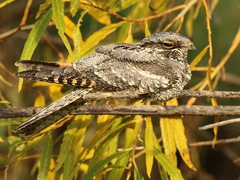
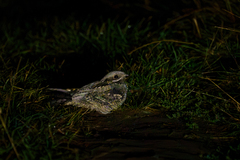
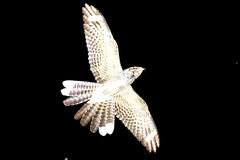
The European nightjar (Caprimulgus europaeus), common goatsucker, Eurasian nightjar or just nightjar is a crepuscular and nocturnal bird in the nightjar family that breeds across most of Europe and the Palearctic to Mongolia and Northwestern China. The Latin generic name refers to the old myth that the nocturnal nightjar suckled from goats, causing them to cease to give milk. The six subspecies differ clinally, the birds becoming smaller and paler towards the east of the range. All populations are migratory, wintering in sub-Saharan Africa. Their densely patterned grey and brown plumage makes individuals difficult to see in the daytime when they rest on the ground or perch motionless along a branch, although the male shows white patches in the wings and tail as he flies at night.

The preferred habitat is dry, open country with some trees and small bushes, such as heaths, forest clearings or newly planted woodland. The male European nightjar occupies a territory in spring and advertises his presence with a distinctive sustained churring trill from a perch. He patrols his territory with wings held in a V and tail fanned, chasing intruders while wing-clapping and calling. Wing clapping also occurs when the male chases the female in a spiralling display flight. The European nightjar does not build a nest, and its two grey and brown blotched eggs are laid directly on the ground; they hatch after about 17–21 days and the downy chicks fledge in another 16–17 days.

The European nightjar feeds on a wide variety of flying insects, which it seizes in flight, often fly-catching from a perch. It hunts by sight, silhouetting its prey against the night sky. Its eyes are relatively large, each with a reflective layer, which improves night vision. It appears not to rely on its hearing to find insects and does not echolocate. Drinking and bathing take place during flight. Although it suffers a degree of predation and parasitism, the main threats to the species are habitat loss, disturbance and a reduction of its insect prey through pesticide use. Despite population decreases, its large numbers and huge breeding range mean that it is classified by the International Union for Conservation of Nature as being of least concern. Wikipedia →

Sounds

Nocturnal flight call0:13

France · 2017

© Marco Mastrorilli · XC1136196 · CC BY-NC-SA 4.0

Song0:18

Sweden · 2022

© Marc Anderson · XC1079561 · CC BY-NC-ND 4.0

Call0:04

France · 2024

© Dorian BELIARDE · XC1041833 · CC BY-NC-SA 4.0

Global Distribution

Parks Where Found

# Park Country Daily sighting probability
1 Tsavo West National Park 🇰🇪 Kenya
<5%
2 Cévennes National Park 🇫🇷 France
<5%
3 Biebrza National Park 🇵🇱 Poland
<5%
4 Białowieża National Park 🇵🇱 Poland
<5%
5 Lake Manyara National Park 🇹🇿 Tanzania
<5%
6 Samburu National Reserve 🇰🇪 Kenya
<5%
7 Tsavo East National Park 🇰🇪 Kenya
<5%
8 Sierra de Guadarrama National Park 🇪🇸 Spain
<5%
9 Ordesa y Monte Perdido National Park 🇪🇸 Spain
<5%
10 Kruger National Park 🇿🇦 South Africa
<5%
11 Kiskunság National Park 🇭🇺 Hungary
<5%
12 Snowdonia National Park 🇬🇧 United Kingdom
<5%
13 Fertő-Hanság National Park 🇭🇺 Hungary
<5%
14 Tarangire National Park 🇹🇿 Tanzania
<5%
15 Nairobi National Park 🇰🇪 Kenya
<5%
16 Pyrénées National Park 🇫🇷 France
<5%
17 Cairngorms National Park 🇬🇧 United Kingdom
<5%
18 Wadden Sea National Park 🇩🇪 Germany
<5%
19 Serengeti National Park 🇹🇿 Tanzania
<5%

Cities Where Found

# City Country Daily sighting probability
1 Jerusalem 🇮🇱 Israel
~10%
2 Mombasa 🇰🇪 Kenya
<5%
3 Ankara 🇹🇷 Turkey
<5%
4 Abu Dhabi 🇦🇪 United Arab Emirates
<5%
5 Kuwait City 🇰🇼 Kuwait
<5%
6 Dubai 🇦🇪 United Arab Emirates
<5%
7 Doha 🇶🇦 Qatar
<5%
8 Porto 🇵🇹 Portugal
<5%
9 Tel Aviv 🇮🇱 Israel
<5%
10 Istanbul 🇹🇷 Turkey
<5%

Before you go

What are the chances of seeing a European Nightjar in Cairngorms National Park?

Rare

Under 5% of wildlife watchers report a European Nightjar sighting in Cairngorms National Park on a given day, based on 10 verified sightings from GBIF citizen-science data from 2019 to 2026. It is the 139th most-seen of the 140 birds we can rate there. Over three days the chance rises to under 5%, if each day is a fresh chance.

When is the best time to see a European Nightjar in Cairngorms National Park?

Any time of year

In every month with enough records, under 5% of wildlife watchers report a European Nightjar in Cairngorms National Park on a given day, so our monthly data shows no clear season.

What time of day is best to see a European Nightjar?

Between 8 and 11 pm

Across all the parks we cover, that three-hour window holds the most European Nightjar sightings with a recorded time, and about 7 in 10 of them come between 6 pm and 6 am: it is seen both by day and at night.

Is Cairngorms National Park the best place to see a European Nightjar?

Among the best

Of the 19 parks where we can rate European Nightjar sightings, Cairngorms National Park ranks 17th at under 5%, level with the leaders once rounded. The best odds are in Tsavo West National Park (Kenya, under 5%), Cévennes National Park (France, under 5%) and Biebrza National Park (Poland, under 5%).

Where does the European Nightjar sighting chance come from?

GBIF citizen-science records

It is estimated from how often the European Nightjar is recorded against all the birds logged in Cairngorms National Park (10 verified sightings from 2019 to 2026), calibrated against known sighting rates. Figures are rounded to the nearest 10% because citizen-science data supports honest approximations, not decimals, and months with records from fewer than five people show "—". How it works.

← Back to Cairngorms National Park