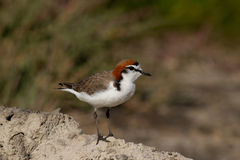
Red-Capped Plover

Red-Capped Plover

Charadrius ruficapillus

LCLeast ConcernNTVUENCR
Daily sighting probability ~40% · Likely
at Cape Range

In 3 days ~80% in a week >90%

78 Verified sightings at Cape Range From 2019 to 2026
701 In all 6 parks
February Best month
☀️ Diurnal When it's spotted

About the Red-Capped Plover

The red-capped plover (Anarhynchus ruficapillus), also known as the red-capped dotterel, is a small species of plover. It breeds in Australia. This species is closely related to (and sometimes considered conspecific with) the Kentish plover, Javan plover, and white-fronted plover.

Red-capped plovers have a white forehead and underparts. Their upperparts are mainly grey-brown. Adult males have a rufous or reddish-brown crown and hindneck. Adult females have a paler rufous and grey-brown crown and hindneck, with a pale loreal stripe. The upperwing of Anarhynchus ruficapillus shows dark brown remiges (flight feathers) and primary covert feathers with a white wingbar in flight. Its length is 14–16 cm (5.5–6.3 in) and its wingspan is 27–34 cm (10.6–13.4 in); it weighs 35–40 g (1.2–1.4 oz).

Breeding plumage shows a red-brown crown and nape with black margins. Non-breeding plumage is duller and lacks the black margins. The red-capped plover is widespread in Australia; it is a vagrant to New Zealand, although it bred there for some time in small numbers from 1950–1980. The species occupies a range of coastal and inland habitats, including estuaries...

Wikipedia →

Sounds

Call0:06

Australia · 2020

© Marc Anderson · XC596003 · CC BY-NC-ND 4.0

Flight call0:13

Australia · 2023

© James Lambert · XC790066 · CC BY-NC-ND 4.0

Call0:24

Australia · 2017

© Greg McLachlan · XC395985 · CC BY-NC-SA 4.0

Global Distribution

Parks Where Found

# Park Country Daily sighting probability
1 Rottnest Island 🇦🇺 Australia
~60%
2 Cape Range 🇦🇺 Australia
~40%
3 Daintree National Park 🇦🇺 Australia
~30%
4 Booderee National Park 🇦🇺 Australia
~20%
5 Phillip Island Nature Park 🇦🇺 Australia
~20%
6 Wilsons Promontory National Park 🇦🇺 Australia
~10%

Cities Where Found

# City Country Daily sighting probability
1 Perth 🇦🇺 Australia
<5%
2 Brisbane 🇦🇺 Australia
<5%
3 Melbourne 🇦🇺 Australia
<5%
4 Sydney 🇦🇺 Australia
<5%

Before you go

What are the chances of seeing a Red-Capped Plover in Cape Range?

Likely

About 40% of wildlife watchers report a Red-Capped Plover sighting in Cape Range on a given day, based on 78 verified sightings from GBIF citizen-science data from 2019 to 2026. It is the 12th most-seen of the 85 birds we can rate there. Over three days the chance rises to about 80%, and over a week to over 90%, if each day is a fresh chance.

When is the best time to see a Red-Capped Plover in Cape Range?

February and December

In those months about 60% of wildlife watchers report a Red-Capped Plover in Cape Range on a given day, against under 5% in March and April, the lowest months.

What time of day is best to see a Red-Capped Plover?

Between 2 and 5 pm

Across all the parks we cover, that three-hour window holds the most Red-Capped Plover sightings with a recorded time, and nearly all of them come between 6 am and 6 pm: it is a daytime animal.

Is Cape Range the best place to see a Red-Capped Plover?

2nd of 6

Of the 6 parks where we can rate Red-Capped Plover sightings, Cape Range ranks 2nd at about 40%. The best odds are in Rottnest Island (Australia, about 60%). All parks ranked.

Where does the Red-Capped Plover sighting chance come from?

GBIF citizen-science records

It is estimated from how often the Red-Capped Plover is recorded against all the birds logged in Cape Range (78 verified sightings from 2019 to 2026), calibrated against known sighting rates. Figures are rounded to the nearest 10% because citizen-science data supports honest approximations, not decimals, and months with records from fewer than five people show "—". How it works.

← Back to Cape Range