Greater Sandplover

Greater Sandplover

Charadrius leschenaultii

Silhouette: Ferran Sayol · PhyloPic

LCLeast ConcernNTVUENCR
Daily sighting probability ~10% · With luck
at Cape Range

In 3 days ~30% in a week ~60%

24 Verified sightings at Cape Range From 2019 to 2026
547 In all 9 parks
September Best month
☀️ Diurnal When it's spotted

About the Greater Sandplover

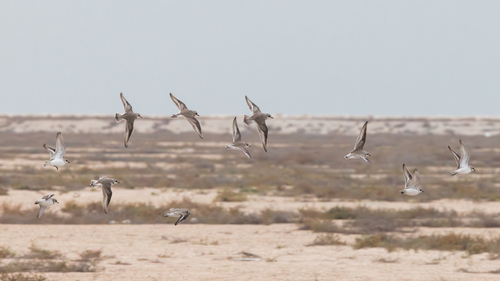
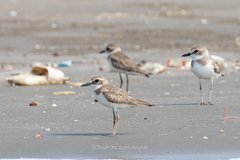
The greater sand plover (Anarhynchus leschenaultii) is a small wader in the plover family of birds. The spelling is often given as "greater sandplover" or "greater sand-plover", but the official IOC and British Ornithologists' Union spelling is "Greater Sand Plover". The specific leschenaultii commemorates the French botanist Jean Baptiste Leschenault de la Tour. Like most other species in the genus Anarhynchus, it was until recently included in the genus Charadrius.

It breeds in the semi-deserts of Turkey and eastwards through Central Asia, where it nests in a bare ground scrape. This species is strongly migratory, wintering on sandy beaches in East Africa, South Asia and Australasia. It is a rare vagrant in western Europe, where it has been recorded as far west as Iceland. It has been recorded three times in North America, the most recent being on 13 April 2025 in Biscay Bay, Newfoundland and Labrador. Last previous sighing in NA,14 May 2009 in Jacksonville, Florida.

There are three subspecies: A. l. leschenaultii, the nominate, in the east of the species' range in Mongolia and NW China. Bill intermediate; summer plumage with a weak orange breast... Wikipedia →

Sounds

Call0:20

Kazakhstan · 2025

© Frank Lambert · XC1029678 · CC BY-NC-ND 4.0

Song and call0:38

Kazakhstan · 2023

© Peter Boesman · XC813307 · CC BY-NC-ND 4.0

Call0:15

United Kingdom · 2025

© Scott Wotherspoon · XC1027789 · CC BY-NC-SA 4.0

Global Distribution

Parks Where Found

# Park Country Daily sighting probability
1 Bali Barat National Park 🇮🇩 Indonesia
~20%
2 Gobi Gurvansaikhan National Park 🇲🇳 Mongolia
~20%
3 Sundarbans National Park 🇮🇳 India
~10%
4 Cape Range 🇦🇺 Australia
~10%
5 Ningaloo Marine Park 🇦🇺 Australia
~10%
6 Yala National Park 🇱🇰 Sri Lanka
~10%
7 Rottnest Island 🇦🇺 Australia
<5%
8 Daintree National Park 🇦🇺 Australia
<5%
9 Raja Ampat 🇮🇩 Indonesia
<5%

Cities Where Found

# City Country Daily sighting probability
1 Kuwait City 🇰🇼 Kuwait
~30%
2 Manama 🇧🇭 Bahrain
~20%
3 Maputo 🇲🇿 Mozambique
~20%
4 Zanzibar City 🇹🇿 Tanzania
~10%
5 Karachi 🇵🇰 Pakistan
~10%
6 Quanzhou 🇨🇳 China
~10%
7 Davao City 🇵🇭 Philippines
~10%
8 Kozhikode 🇮🇳 India
~10%
9 Naha 🇯🇵 Japan
~10%
10 Xiamen City 🇨🇳 China
<5%

Before you go

What are the chances of seeing a Greater Sandplover in Cape Range?

With luck

About 10% of wildlife watchers report a Greater Sandplover sighting in Cape Range on a given day, based on 24 verified sightings from GBIF citizen-science data from 2019 to 2026. It is the 49th most-seen of the 84 birds we can rate there. Over three days the chance rises to about 30%, and over a week to about 60%, if each day is a fresh chance.

When is the best time to see a Greater Sandplover in Cape Range?

September and December

In those months about 20% of wildlife watchers report a Greater Sandplover in Cape Range on a given day, against about 10% in January, March–August and October–November, the lowest months. Those are among Cape Range's driest months, with almost no rain against 55 mm in June. February has too few records to rate.

What time of day is best to see a Greater Sandplover?

Between 10 am and 1 pm

Across all the parks we cover, that three-hour window holds the most Greater Sandplover sightings with a recorded time, and about 9 in 10 of them come between 6 am and 6 pm: it is a daytime animal.

Where does the Greater Sandplover sighting chance come from?

GBIF citizen-science records

It is estimated from how often the Greater Sandplover is recorded against all the birds logged in Cape Range (24 verified sightings from 2019 to 2026), calibrated against known sighting rates. Figures are rounded to the nearest 10% because citizen-science data supports honest approximations, not decimals, and months with records from fewer than five people show "—". How it works.

← Back to Cape Range