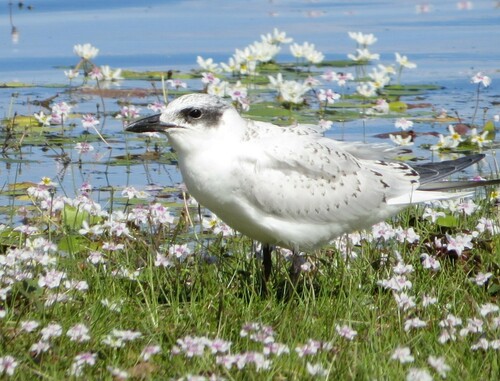
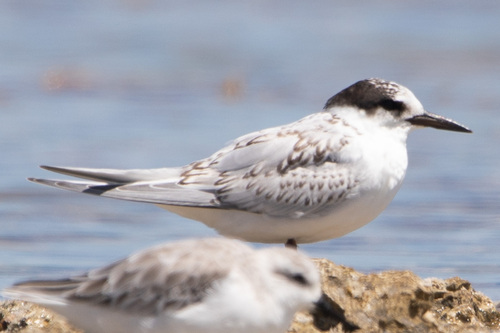
Crested Tern

Crested Tern

Thalasseus bergii

Silhouette: JJ Harrison (vectorized by T. Michael Keesey) · PhyloPic

LCLeast ConcernNTVUENCR
Daily sighting probability ~40% · Likely
at Cape Range

In 3 days ~70% in a week >90%

92 Verified sightings at Cape Range From 2019 to 2026
7,040 In all 25 parks
March Best month
☀️ Diurnal When it's spotted

About the Crested Tern

The greater crested tern (Thalasseus bergii), also called crested tern, swift tern, or great crested tern, is a tern in the family Laridae that nests in dense colonies on coastlines and islands in the tropical and subtropical Old World. Its four or five subspecies breed in the area from South Africa around the Indian Ocean to the central Pacific and Australia, all populations dispersing widely from the breeding range after nesting. This large tern is closely related to other species in its genus, but can be distinguished by its darker, battleship-grey upperparts, white forehead even in full breeding plumage, and greenish-tinged yellow (not orange or black) bill colour.

The greater crested tern has dark grey upperparts, white underparts, a yellow bill, and a shaggy black crest that recedes in winter. Its young have a distinctive appearance, with strongly patterned grey, brown and white plumage, and rely on their parents for food for several months after they have fledged. Like all members of the genus Thalasseus, the greater crested tern feeds by plunge diving for fish, usually in marine environments; the male offers fish to the female as part of the courtship ritual.

This is an adaptable species that has learned to follow fishing boats for jettisoned bycatch, and to use unusual nest sites such as the roofs of buildings and artificial islands in salt pans and sewage works. Its eggs and young are taken by gulls and ibises, and human activities such as fishing, shooting and egg harvesting have caused local population declines. There are no global conservation concerns for this bird, which has a stable total population of more than 500,000 individuals. Wikipedia →

Sounds

Flight call0:04

Australia · 2023

© Romuald Mikusek · XC1169751 · CC BY-NC-SA 4.0

Call0:46

Australia · 2025

© Peter Boesman · XC1067025 · CC BY-NC-ND 4.0

Begging call0:16

Oman · 2023

© Alain Malengreau · XC862846 · CC BY-NC-SA 4.0

Global Distribution

Parks Where Found

# Park Country Daily sighting probability
1 Rottnest Island 🇦🇺 Australia
~90%
2 Komodo National Park 🇮🇩 Indonesia
~60%
3 Ningaloo Marine Park 🇦🇺 Australia
~50%
4 Noosa National Park 🇦🇺 Australia
~40%
5 West Coast National Park 🇿🇦 South Africa
~40%
6 Freycinet National Park 🇦🇺 Australia
~40%
7 Cape Range 🇦🇺 Australia
~40%
8 Wilsons Promontory National Park 🇦🇺 Australia
~30%
9 iSimangaliso Wetland Park 🇿🇦 South Africa
~30%
10 Maria Island National Park 🇦🇺 Australia
~30%
11 Table Mountain National Park 🇿🇦 South Africa
~20%
12 Raja Ampat 🇮🇩 Indonesia
~20%
13 Bali Barat National Park 🇮🇩 Indonesia
~20%
14 Booderee National Park 🇦🇺 Australia
~20%
15 Bako National Park 🇲🇾 Malaysia
~10%
16 Royal National Park 🇦🇺 Australia
~10%
17 Great Otway National Park 🇦🇺 Australia
~10%
18 De Hoop Nature Reserve 🇿🇦 South Africa
~10%
19 Flinders Chase 🇦🇺 Australia
~10%
20 Garden Route National Park 🇿🇦 South Africa
~10%
21 Yala National Park 🇱🇰 Sri Lanka
~10%
22 Namib-Naukluft National Park 🇳🇦 Namibia
<5%
23 Addo Elephant National Park 🇿🇦 South Africa
<5%
24 Daintree National Park 🇦🇺 Australia
<5%
25 Tangkoko Nature Reserve 🇮🇩 Indonesia
<5%

Cities Where Found

# City Country Daily sighting probability
1 Zanzibar City 🇹🇿 Tanzania
~30%
2 Kozhikode 🇮🇳 India
~20%
3 Durban 🇿🇦 South Africa
~10%
4 Denpasar 🇮🇩 Indonesia
~10%
5 Kuwait City 🇰🇼 Kuwait
~10%
6 Perth 🇦🇺 Australia
~10%
7 Sydney 🇦🇺 Australia
~10%
8 Kollam 🇮🇳 India
~10%
9 Melbourne 🇦🇺 Australia
~10%
10 Davao City 🇵🇭 Philippines
~10%

Zoos & Centres Where Found

# Zoo / Centre Country
1 Currumbin Wildlife Sanctuary 🇦🇺 Australia In captivity
2 Southern African Foundation for the Conservation of Coastal Birds 🇿🇦 South Africa In captivity

Before you go

What are the chances of seeing a Crested Tern in Cape Range?

Likely

About 40% of wildlife watchers report a Crested Tern sighting in Cape Range on a given day, based on 92 verified sightings from GBIF citizen-science data from 2019 to 2026. It is the 16th most-seen of the 84 birds we can rate there. Over three days the chance rises to about 70%, and over a week to over 90%, if each day is a fresh chance.

When is the best time to see a Crested Tern in Cape Range?

March

In that month about 50% of wildlife watchers report a Crested Tern in Cape Range on a given day, against about 30% in August–October and December–January, the lowest months. That is one of Cape Range's wettest months, with about 40 mm of rain against almost none in October. February has too few records to rate.

What time of day is best to see a Crested Tern?

Between 8 and 11 am

Across all the parks we cover, that three-hour window holds the most Crested Tern sightings with a recorded time, and nearly all of them come between 6 am and 6 pm: it is a daytime animal.

Where does the Crested Tern sighting chance come from?

GBIF citizen-science records

It is estimated from how often the Crested Tern is recorded against all the birds logged in Cape Range (92 verified sightings from 2019 to 2026), calibrated against known sighting rates. Figures are rounded to the nearest 10% because citizen-science data supports honest approximations, not decimals, and months with records from fewer than five people show "—". How it works.

← Back to Cape Range