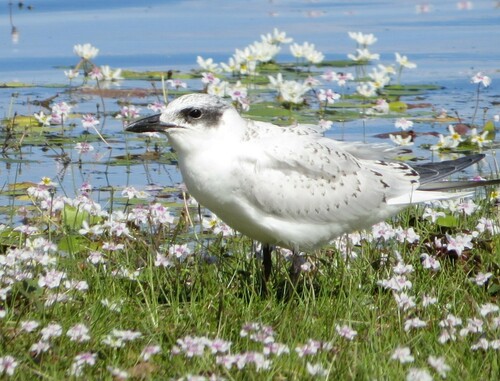
White-headed Stilt

White-headed Stilt

Himantopus leucocephalus

Silhouette: Edwin Price · PhyloPic

Daily sighting probability ~40% · Likely
at Cape Range

In 3 days ~80% in a week >90%

100 Verified sightings at Cape Range From 2019 to 2026
1,605 In all 12 parks
September Best month
☀️ Diurnal When it's spotted

About the White-headed Stilt

The pied stilt (Himantopus leucocephalus), also known as the white-headed stilt, is a shorebird in the family Recurvirostridae. It is widely distributed with a large total population size and apparently stable population trend, occurring in Malaysia, Japan, the Philippines, Brunei, Christmas Island, Indonesia, Palau, Papua New Guinea, Australia, and New Zealand. It is listed as Least Concern on the IUCN Red List. It is sometimes considered a subspecies of the black-winged stilt (H. himantopus).

Himantopus leucocephalus was the scientific name proposed by John Gould in 1837 who described a pied stilt from Australia. The pied stilt grows to a length of about 14 in (36 cm) with a wingspan of about 26.5 in (67 cm). The back of the head and neck, the back and the upper surfaces of the wings are glossy greenish-black. The undersides of the wings are plain black and the remainder of the plumage is white, apart from the tail feathers which are tinged with grey. The long, thin legs are pink and the toes have black claws. The long slender beak is black and the irises and the eyelids are red.

The pied stilt is resident in southern... Wikipedia →

Sounds

Flight call0:54

Australia · 2025

© Drew Davison · XC961153 · CC BY-NC-ND 4.0

Alarm call0:43

New Zealand · 2024

© Ken George · XC955587 · CC BY-NC-SA 4.0

Call0:05

Australia · 2023

© Sreekar · XC838767 · CC BY-NC-SA 4.0

Global Distribution

Parks Where Found

# Park Country Daily sighting probability
1 Rottnest Island 🇦🇺 Australia
~70%
2 Cape Range 🇦🇺 Australia
~40%
3 Bali Barat National Park 🇮🇩 Indonesia
~30%
4 Ningaloo Marine Park 🇦🇺 Australia
~30%
5 Litchfield National Park 🇦🇺 Australia
~20%
6 Abel Tasman National Park 🇳🇿 New Zealand
~20%
7 Fiordland National Park 🇳🇿 New Zealand
~10%
8 Kakadu National Park 🇦🇺 Australia
~10%
9 Daintree National Park 🇦🇺 Australia
<5%
10 Noosa National Park 🇦🇺 Australia
<5%
11 Hattah-Kulkyne National Park 🇦🇺 Australia
<5%
12 Blue Mountains National Park 🇦🇺 Australia
<5%

Cities Where Found

# City Country Daily sighting probability
1 Auckland 🇳🇿 New Zealand
~30%
2 Makassar 🇮🇩 Indonesia
~30%
3 Perth 🇦🇺 Australia
~20%
4 Sydney 🇦🇺 Australia
~10%
5 Davao City 🇵🇭 Philippines
~10%
6 Brisbane 🇦🇺 Australia
~10%
7 Cebu City 🇵🇭 Philippines
~10%
8 Jakarta 🇮🇩 Indonesia
<5%
9 Melbourne 🇦🇺 Australia
<5%
10 Singapore 🇸🇬 Singapore
<5%

Zoos & Centres Where Found

# Zoo / Centre Country
1 Territory Wildlife Park 🇦🇺 Australia In captivity
2 Alice Springs Desert Park 🇦🇺 Australia In captivity
3 Taronga Zoo 🇦🇺 Australia In captivity
4 Currumbin Wildlife Sanctuary 🇦🇺 Australia In captivity
5 Melbourne Zoo 🇦🇺 Australia In captivity
6 Gembira Loka Zoo 🇮🇩 Indonesia In captivity
7 Perth Zoo 🇦🇺 Australia In captivity
8 Auckland Zoo 🇳🇿 New Zealand In captivity
9 Adelaide Zoo 🇦🇺 Australia In captivity
10 Australian Reptile Park 🇦🇺 Australia In captivity
11 Featherdale Sydney Wildlife Park 🇦🇺 Australia In captivity
12 Bali Bird Park 🇮🇩 Indonesia In captivity
13 Ipswich Nature Centre 🇦🇺 Australia In captivity
14 Ōtorohanga Kiwi House 🇳🇿 New Zealand In captivity
15 Ranger Red’s Zoo & Conservation Park 🇦🇺 Australia In captivity
16 The Lair 🇦🇺 Australia In captivity

Before you go

What are the chances of seeing a White-headed Stilt in Cape Range?

Likely

About 40% of wildlife watchers report a White-headed Stilt sighting in Cape Range on a given day, based on 100 verified sightings from GBIF citizen-science data from 2019 to 2026. It is the 12th most-seen of the 84 birds we can rate there. Over three days the chance rises to about 80%, and over a week to over 90%, if each day is a fresh chance.

When is the best time to see a White-headed Stilt in Cape Range?

January, April–June and September

In those months about 50% of wildlife watchers report a White-headed Stilt in Cape Range on a given day, against about 20% in March, the lowest month. February has too few records to rate.

What time of day is best to see a White-headed Stilt?

Between 10 am and 1 pm

Across all the parks we cover, that three-hour window holds the most White-headed Stilt sightings with a recorded time, and about 9 in 10 of them come between 6 am and 6 pm: it is a daytime animal.

Is Cape Range the best place to see a White-headed Stilt?

2nd of 12

Of the 12 parks where we can rate White-headed Stilt sightings, Cape Range ranks 2nd at about 40%. The best odds are in Rottnest Island (Australia, about 70%). All parks ranked.

Which relatives of the White-headed Stilt live in Cape Range?

Same order: Charadriiformes

The closest relatives of the White-headed Stilt that you can see in Cape Range (order Charadriiformes, Shorebirds and Allies) are Silver Gull (about 70%), Pied Oystercatcher (about 40%) and Crested Tern (about 40%), with each one's daily chance of a sighting.

Where does the White-headed Stilt sighting chance come from?

GBIF citizen-science records

It is estimated from how often the White-headed Stilt is recorded against all the birds logged in Cape Range (100 verified sightings from 2019 to 2026), calibrated against known sighting rates. Figures are rounded to the nearest 10% because citizen-science data supports honest approximations, not decimals, and months with records from fewer than five people show "—". How it works.

← Back to Cape Range