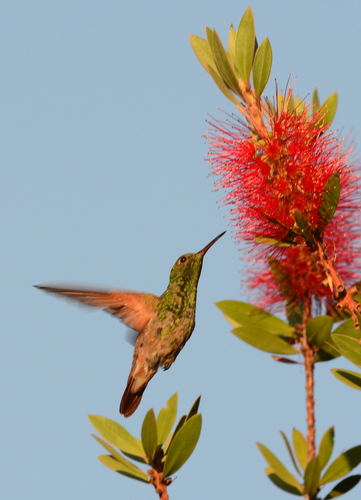
Brown Violetear

Brown Violetear

Colibri delphinae

Silhouette: Ferran Sayol · PhyloPic

LCLeast ConcernNTVUENCR
Daily sighting probability <5% · Rare
at Cerro Azul Meámbar National Park

In 3 days <5% in a week ~10%

12 Verified sightings at Cerro Azul Meámbar National Park From 2019 to 2026
5,912 In all 18 parks
June Best month
☀️ Diurnal When it's spotted

About the Brown Violetear

The brown violetear (Colibri delphinae) is a large hummingbird that breeds at middle elevations in the mountains in Central America, and western and northern South America (primarily the Andes and the tepuis) with isolated populations on Trinidad and in the Brazilian state Bahia.

The breeding habitat is forest at altitudes between 400 and 1600 m, but the brown Violet-ear will spread widely into the lowlands when not nesting. It is replaced at higher altitudes by its relative, the lesser violetear (C. cyanotus), but their ranges overlap widely.

The brown violetear is typically found high in the canopy of the rainforest, tall second growth and coffee plantations, but it will feed at lower levels at edges and clearings. The nest is a small cup of plant down saddled on a twig 1–3 m. high in a bush, into which two white eggs are laid.

The 11.5 cm long, 6.5-7 g weight brown violetear is unmistakable; it is mainly dull brown, with a rufous rump and greyer underparts. There is a violet patch running back and down from the eye, a hermit-like malar stripe, and a glittering green and blue throat stripe. The bill is relatively short and almost straight.

The female is similar to the male, but has a smaller throat patch. Immature bird have rufous fringes to the upperpart plumage, and little or no violet behind the eyes. The song is a vigorous repetition of the chit call, and is delivered by up to several dozen breeding males in loose leks.

The brown violetear feeds on nectar from small flowers of trees, shrubs and epiphytes. It also takes insects, often caught in flight (hawking), as an essential source of protein. Although not particularly territorial, this species is highly aggressive, and at feeders seems to spend far more time attacking other hummingbirds than actually feeding. Wikipedia →

Sounds

Call0:27

Ecuador · 2024

© Sue Riffe · XC931236 · CC BY-NC-SA 4.0

Song1:21

Ecuador · 2023

© rudy gelis · XC822932 · CC BY-NC-SA 4.0

Song?1:30

Ecuador · 2012

© Manuel Sanchez · XC107071 · CC BY-NC-ND 2.5

Global Distribution

Parks Where Found

# Park Country Daily sighting probability
1 Farallones de Cali National Natural Park 🇨🇴 Colombia
~60%
2 Poás Volcano National Park 🇨🇷 Costa Rica
~20%
3 Chirripó National Park 🇨🇷 Costa Rica
~10%
4 Tenorio Volcano National Park 🇨🇷 Costa Rica
~10%
5 Chapada Diamantina National Park 🇧🇷 Brazil
~10%
6 Tapantí-Macizo de la Muerte National Park 🇨🇷 Costa Rica
~10%
7 Arenal Volcano National Park 🇨🇷 Costa Rica
~10%
8 Darién National Park 🇵🇦 Panama
<5%
9 Pico Bonito National Park 🇭🇳 Honduras
<5%
10 Podocarpus National Park 🇪🇨 Ecuador
<5%
11 Braulio Carrillo National Park 🇨🇷 Costa Rica
<5%
12 La Amistad International Park (Panama) 🇵🇦 Panama
<5%
13 Chagres National Park 🇵🇦 Panama
<5%
14 Monteverde Cloud Forest Reserve 🇨🇷 Costa Rica
<5%
15 Cerro Azul Meámbar National Park 🇭🇳 Honduras
<5%
16 Volcán Barú National Park 🇵🇦 Panama
<5%
17 Manu National Park 🇵🇪 Peru
<5%
18 Los Quetzales National Park 🇨🇷 Costa Rica
<5%

Cities Where Found

# City Country Daily sighting probability
1 Caracas 🇻🇪 Venezuela
<5%
2 Quito 🇪🇨 Ecuador
<5%

Before you go

What are the chances of seeing a Brown Violetear in Cerro Azul Meámbar National Park?

Rare

Under 5% of wildlife watchers report a Brown Violetear sighting in Cerro Azul Meámbar National Park on a given day, based on 12 verified sightings from GBIF citizen-science data from 2019 to 2026. It is the 257th most-seen of the 293 birds we can rate there. Over three days the chance rises to under 5%, and over a week to about 10%, if each day is a fresh chance.

When is the best time to see a Brown Violetear in Cerro Azul Meámbar National Park?

June and July

In those months about 10% of wildlife watchers report a Brown Violetear in Cerro Azul Meámbar National Park on a given day, against under 5% in August to May, the lowest months.

What time of day is best to see a Brown Violetear?

Between 9 am and noon

Across all the parks we cover, that three-hour window holds the most Brown Violetear sightings with a recorded time, and nearly all of them come between 6 am and 6 pm: it is a daytime animal.

Which relatives of the Brown Violetear live in Cerro Azul Meámbar National Park?

Same family: Trochilidae

The closest relatives of the Brown Violetear that you can see in Cerro Azul Meámbar National Park (family Trochilidae, Hummingbirds) are Rufous-tailed Hummingbird (about 70%), White-bellied Emerald (about 30%) and Violet Sabrewing (about 30%), with each one's daily chance of a sighting.

Where does the Brown Violetear sighting chance come from?

GBIF citizen-science records

It is estimated from how often the Brown Violetear is recorded against all the birds logged in Cerro Azul Meámbar National Park (12 verified sightings from 2019 to 2026), calibrated against known sighting rates. Figures are rounded to the nearest 10% because citizen-science data supports honest approximations, not decimals, and months with records from fewer than five people show "—". How it works.

← Back to Cerro Azul Meámbar National Park