White-eyed Vireo

White-eyed Vireo

Vireo griseus

Silhouette: Caleb Gordon · PhyloPic

LCLeast ConcernNTVUENCR
Daily sighting probability ~30% · Possible
at Biotopo Cerro Cahuí

In 3 days ~60% in a week ~90%

276 Verified sightings at Biotopo Cerro Cahuí From 2019 to 2026
15,799 In all 26 parks
October Best month
☀️ Diurnal When it's spotted

About the White-eyed Vireo

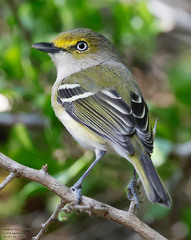
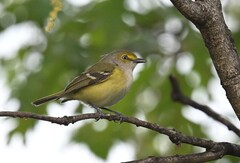
The white-eyed vireo (Vireo griseus) is a small songbird of the family Vireonidae. It breeds in the eastern United States from New England west to northern Missouri and south to Texas and Florida, and also in eastern Mexico, northern Central America, Cuba and the Bahamas. Populations on the US Gulf Coast and further south are resident, but most North American birds migrate south in winter. This vireo frequents bushes and shrubs in abandoned cultivation or overgrown pastures.

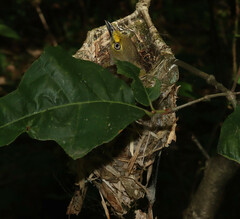
They nest near the ground in tangled thickets. Nests are made of weeds, leaves, grass, bark or bits of trash. The grass-lined nest is a neat cup shape, attached to a fork in a tree branch by spider webs. It lays 3–5 dark-spotted white eggs. Both the male and female incubate the eggs for 12–16 days. The young leave the nest 9–11 days after hatching.

Measurements: Length: 4.3–5.1 in (11–13 cm) Weight: 0.3–0.5 oz (10–14 g) Wingspan: 6.7 in (17 cm) Its head and back are a greyish olive, and the underparts are white with yellow flanks. The wings and tail are dark, and there are two white wing bars on each wing. The eyes have white irises, and are surrounded... Wikipedia →

Sounds

Song0:37

United States · 2026

© Sue Riffe · XC1091756 · CC BY-NC-SA 4.0

Call0:37

Mexico · 2024

© Rodolfo Salinas-Villarreal · XC896910 · CC BY-NC-SA 4.0

Duet0:18

United States · 2021

© Keith Corliss · XC660444 · CC BY-NC-SA 4.0

Global Distribution

Parks Where Found

# Park Country Daily sighting probability
1 Congaree National Park 🇺🇸 United States
~50%
2 Everglades National Park 🇺🇸 United States
~50%
3 Calakmul Biosphere Reserve 🇲🇽 Mexico
~50%
4 Big Cypress National Preserve 🇺🇸 United States
~40%
5 Tikal National Park 🇬🇹 Guatemala
~30%
6 Sian Ka'an Biosphere Reserve 🇲🇽 Mexico
~30%
7 Biotopo Cerro Cahuí 🇬🇹 Guatemala
~30%
8 Arrecifes de Cozumel National Park 🇲🇽 Mexico
~20%
9 Cañón del Sumidero National Park 🇲🇽 Mexico
~20%
10 Pico Bonito National Park 🇭🇳 Honduras
~20%
11 Cumbres de Monterrey National Park 🇲🇽 Mexico
~10%
12 Celestún Biosphere Reserve 🇲🇽 Mexico
~10%
13 Merritt Island National Wildlife Refuge 🇺🇸 United States
~10%
14 Cockscomb Basin Wildlife Sanctuary 🇧🇿 Belize
~10%
15 Montes Azules Biosphere Reserve 🇲🇽 Mexico
~10%
16 Great Smoky Mountains National Park 🇺🇸 United States
~10%
17 Point Pelee National Park 🇨🇦 Canada
~10%
18 Cusuco National Park 🇭🇳 Honduras
~10%
19 Lago de Yojoa 🇭🇳 Honduras
~10%
20 Ría Lagartos Biosphere Reserve 🇲🇽 Mexico
<5%
21 Shenandoah National Park 🇺🇸 United States
<5%
22 Cerro Azul Meámbar National Park 🇭🇳 Honduras
<5%
23 Celaque National Park 🇭🇳 Honduras
<5%
24 Ciénaga de Zapata 🇨🇺 Cuba
<5%
25 La Amistad International Park (Panama) 🇵🇦 Panama
<5%
26 Acadia National Park 🇺🇸 United States
<5%

Cities Where Found

# City Country Daily sighting probability
1 Austin 🇺🇸 United States
~30%
2 San Antonio 🇺🇸 United States
~30%
3 Dallas 🇺🇸 United States
~20%
4 Houston 🇺🇸 United States
~10%
5 Orlando 🇺🇸 United States
~10%
6 Miami 🇺🇸 United States
~10%
7 Havana 🇨🇺 Cuba
~10%
8 Monterrey 🇲🇽 México
<5%
9 Baltimore 🇺🇸 United States
<5%
10 Washington 🇺🇸 United States
<5%

Before you go

What are the chances of seeing a White-eyed Vireo in Biotopo Cerro Cahuí?

Possible

About 30% of wildlife watchers report a White-eyed Vireo sighting in Biotopo Cerro Cahuí on a given day, based on 276 verified sightings from GBIF citizen-science data from 2019 to 2026. It is the 28th most-seen of the 191 birds we can rate there. Over three days the chance rises to about 60%, and over a week to about 90%, if each day is a fresh chance.

When is the best time to see a White-eyed Vireo in Biotopo Cerro Cahuí?

February–March and October

In those months about 40% of wildlife watchers report a White-eyed Vireo in Biotopo Cerro Cahuí on a given day, against about 10% in January, May–August and November, the lowest months.

What time of day is best to see a White-eyed Vireo?

Between 8 and 11 am

Across all the parks we cover, that three-hour window holds the most White-eyed Vireo sightings with a recorded time, and about 9 in 10 of them come between 6 am and 6 pm: it is a daytime animal.

Which relatives of the White-eyed Vireo live in Biotopo Cerro Cahuí?

Same genus: Vireo

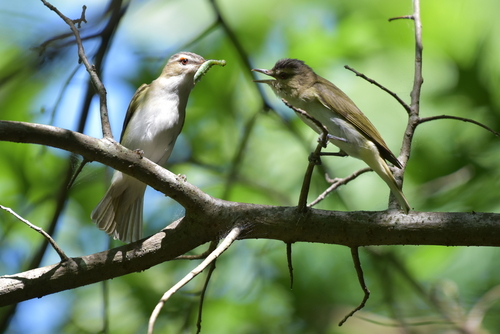
The closest relatives of the White-eyed Vireo that you can see in Biotopo Cerro Cahuí (genus Vireo, Vireos) are Yellow-throated Vireo (about 20%), Red-eyed Vireo (about 20%) and Yellow-green Vireo (about 20%), with each one's daily chance of a sighting.

Where does the White-eyed Vireo sighting chance come from?

GBIF citizen-science records

It is estimated from how often the White-eyed Vireo is recorded against all the birds logged in Biotopo Cerro Cahuí (276 verified sightings from 2019 to 2026), calibrated against known sighting rates. Figures are rounded to the nearest 10% because citizen-science data supports honest approximations, not decimals, and months with records from fewer than five people show "—". How it works.

← Back to Biotopo Cerro Cahuí