Ring-necked Pheasant

Ring-necked Pheasant

Phasianus colchicus

Silhouette: Mattia Menchetti · PhyloPic

LCLeast ConcernNTVUENCR
Daily sighting probability ~10% · With luck
at Barcelona

In 3 days ~20% in a week ~40%

434 Verified sightings at Barcelona
6,370 In all 16 parks From 2019 to 2026
April Best month
☀️ Diurnal When it's spotted

About the Ring-necked Pheasant

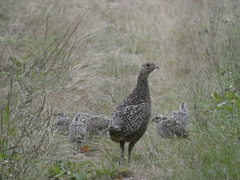
The common pheasant (Phasianus colchicus), ring-necked pheasant, or blue-headed pheasant, is a bird in the pheasant family (Phasianidae). The genus name comes from Latin phasianus 'pheasant'. The species name colchicus is Latin for 'of Colchis' (modern day Georgia), a country on the Black Sea where pheasants became known to Europeans. Although Phasianus was previously thought to be closely related to the genus Gallus, the genus of junglefowl and domesticated chickens, recent studies show that they are in different subfamilies, having diverged over 20 million years ago.

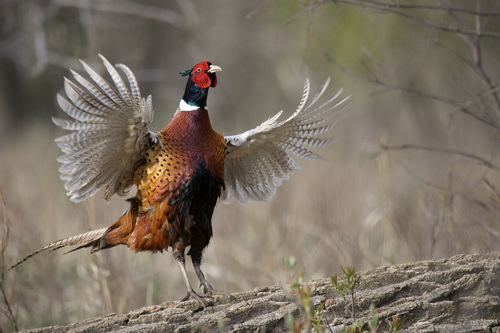
It is native to Asia, where it is widespread, and also to the extreme southeast of Europe in the northern foothills of the Caucasus Mountains. It has been widely introduced elsewhere as a game bird. In parts of its range, mainly in places where none of its relatives occurs such as in Europe, where it is naturalised, it is simply known as the pheasant. Ring-necked pheasant is both the collective name for a number of subspecies and their intergrades that have white neck rings and the name used for the species as a whole in North America.

It is a well-known gamebird, among those of more than regional importance perhaps the most widespread and ancient one in the whole world. The common pheasant is one of the world's most hunted birds; it has been introduced for that purpose to many regions and is also common on game farms, where it is commercially bred. The ring-necked subspecies group in particular are commonly bred and were introduced to many parts of the world; the game farm stock, though no distinct breeds have been developed yet, can be considered semi-domesticated. The ring-necked pheasant is the state bird of South Dakota, one of only two US state birds that is not a species native to the United States.

The green pheasant (P. versicolor) of Japan is sometimes considered a subspecies of the common pheasant. Though the species produce fertile hybrids wherever they coexist, this is simply a typical feature among fowl (Galloanseres), in which postzygotic isolating mechanisms are slight compared to most other birds. The species apparently have somewhat different ecological requirements and at least in its typical habitat, the green pheasant outcompetes the common pheasant. The introduction of the latter to Japan has therefore largely failed. Wikipedia →
Sounds

Song0:15

France · 2026

© Grégoire Chauvot · XC1157852 · CC BY-NC-SA 4.0

Alarm call0:16

Sweden · 2025

© Lennart Jeppsson · XC1067618 · CC BY-NC-SA 4.0

Call0:27

China · 2024

© Bo Shunqi 薄顺奇 · XC992620 · CC BY-NC-SA 4.0

Global Distribution

Parks Where Found

# Park Country Daily sighting probability
1 Kiskunság National Park 🇭🇺 Hungary
~60%
2 Fertő-Hanság National Park 🇭🇺 Hungary
~60%
3 Hortobágy National Park 🇭🇺 Hungary
~50%
4 Cairngorms National Park 🇬🇧 United Kingdom
~30%
5 Camargue 🇫🇷 France
~20%
6 Wadden Sea National Park 🇩🇪 Germany
~20%
7 Egmont National Park 🇳🇿 New Zealand
~20%
8 Snowdonia National Park 🇬🇧 United Kingdom
~20%
9 Bavarian Forest National Park 🇩🇪 Germany
~20%
10 Jiuzhaigou National Park 🇨🇳 China
~10%
11 Biebrza National Park 🇵🇱 Poland
~10%
12 Rottnest Island 🇦🇺 Australia
<5%
13 Badlands National Park 🇺🇸 United States
<5%
14 Taroko National Park 🇹🇼 Taiwan
<5%
15 Monfragüe National Park 🇪🇸 Spain
<5%
16 Pyrénées National Park 🇫🇷 France
<5%

Cities Where Found

# City Country Daily sighting probability
1 Tashkent 🇺🇿 Uzbekistan
~50%
2 Almaty 🇰🇿 Kazakhstan
~50%
3 Bishkek 🇰🇬 Kyrgyzstan
~40%
4 Lanzhou 🇨🇳 China
~30%
5 Ürümqi 🇨🇳 China
~30%
6 Milan 🇮🇹 Italy
~20%
7 Manchester 🇬🇧 United Kingdom
~20%
8 Daejeon 🇰🇷 South Korea
~20%
9 Shymkent 🇰🇿 Kazakhstan
~20%
10 Busan 🇰🇷 South Korea
~20%

Zoos & Centres Where Found

# Zoo / Centre Country
1 Moscow Zoo 🇷🇺 Russia In captivity
2 Korkeasaari Zoo 🇫🇮 Finland In captivity
3 Zoo Pilsen 🇨🇿 Czechia In captivity
4 Yekaterinburg Zoo 🇷🇺 Russia In captivity
5 Parque Zoológico Nacional de Cuba 🇨🇺 Cuba In captivity
6 Sri Venkateswara Zoological Park 🇮🇳 India In captivity
7 Wildpark Schloss Tambach 🇩🇪 Germany In captivity
8 Safaripark Beekse Bergen 🇳🇱 Netherlands In captivity
9 Bondla Zoo 🇮🇳 India In captivity
10 Nehru Zoological Park 🇮🇳 India In captivity
11 Tierpark Sababurg 🇩🇪 Germany In captivity
12 Columbus Zoo and Aquarium 🇺🇸 United States In captivity
13 Wildpark Alte Fasanerie 🇩🇪 Germany In captivity
14 Ecological Center of Sonora 🇲🇽 Mexico In captivity
15 Shanghai Zoo 🇨🇳 China In captivity
16 Naturwildpark Granat 🇩🇪 Germany In captivity
17 Parque Zoológico de León - Zooleón 🇲🇽 Mexico In captivity
18 Wildpark Poing 🇩🇪 Germany In captivity
19 Sanjay Gandhi Biological Park 🇮🇳 India In captivity
20 Antalya Zoo 🇹🇷 Türkiye In captivity
21 Guadalajara Zoo 🇲🇽 Mexico In captivity
22 Parque Zoologico Guátika 🇨🇴 Colombia In captivity
23 Wildpark Hundshaupten 🇩🇪 Germany In captivity
24 Joya Grande 🇭🇳 Honduras In captivity
25 Zoológico de San Juan de Aragón 🇲🇽 Mexico In captivity
26 Yerevan Zoo 🇦🇲 Armenia In captivity
27 Oklahoma City Zoo and Botanical Garden 🇺🇸 United States In captivity
28 Olympic Game Farm 🇺🇸 United States In captivity
29 Kyiv Zoo 🇺🇦 Ukraine In captivity
30 Fonghuanggu Bird and Ecology Park 🇹🇼 Taiwan In captivity
31 West Virginia State Wildlife Center 🇺🇸 United States In captivity
32 Wildpark Gersfeld 🇩🇪 Germany In captivity
33 Wildgehege Moritzburg 🇩🇪 Germany In captivity
34 Wildpark im Grafenberger Wald 🇩🇪 Germany In captivity
35 Saigon Zoo and Botanical Gardens 🇻🇳 Vietnam In captivity
36 Chapultepec Zoo 🇲🇽 Mexico In captivity
37 Soğanlı Zoo 🇹🇷 Türkiye In captivity
38 Asahiyama Zoo 🇯🇵 Japan In captivity
39 Faunia 🇪🇸 Spain In captivity
40 Thiruvananthapuram Zoo 🇮🇳 India In captivity
41 Център за защита на природата и животните 🇧🇬 Bulgaria In captivity
42 Municipal Zoological Park Quinzinho de Barros 🇧🇷 Brazil In captivity
43 Wildgehege Uelzen Stadtwald 🇩🇪 Germany In captivity
44 Himalayan Zoological Park 🇮🇳 India In captivity
45 Bioparque Educativo Quillón 🇨🇱 Chile In captivity
46 La Paz Waterfall Gardens 🇨🇷 Costa Rica In captivity
47 Bluebird Gap Farm 🇺🇸 United States In captivity
48 Paphos Zoo 🇨🇾 Cyprus In captivity
49 Rahim Yar Khan Wildlife Park 🇵🇰 Pakistan In captivity
50 Tierpark Hexentanzplatz 🇩🇪 Germany In captivity

Before you go

What are the chances of seeing a Ring-necked Pheasant in Barcelona?

With luck

About 10% of wildlife watchers report a Ring-necked Pheasant sighting in Barcelona on a given day, based on 434 verified sightings from GBIF citizen-science data. It is the 61st most-seen of the 215 birds we can rate there. Over three days the chance rises to about 20%, and over a week to about 40%, if each day is a fresh chance.

When is the best time to see a Ring-necked Pheasant in Barcelona?

January and March–September

In those months about 10% of wildlife watchers report a Ring-necked Pheasant in Barcelona on a given day, against under 5% in February and October–December, the lowest months.

What time of day is best to see a Ring-necked Pheasant?

Between noon and 3 pm

Across all the parks we cover, that three-hour window holds the most Ring-necked Pheasant sightings with a recorded time, and about 8 in 10 of them come between 6 am and 6 pm: it is a daytime animal.

Is Barcelona the best place to see a Ring-necked Pheasant?

36th of 71

Of the 71 cities where we can rate Ring-necked Pheasant sightings, Barcelona ranks 36th at about 10%. The best odds are in Tashkent (Uzbekistan, about 50%), Almaty (Kazakhstan, about 50%) and Bishkek (Kyrgyzstan, about 40%).

Where does the Ring-necked Pheasant sighting chance come from?

GBIF citizen-science records

It is estimated from how often the Ring-necked Pheasant is recorded against all the birds logged in Barcelona (434 verified sightings), calibrated against known sighting rates. Figures are rounded to the nearest 10% because citizen-science data supports honest approximations, not decimals, and months with records from fewer than five people show "—". How it works.

← Back to Barcelona