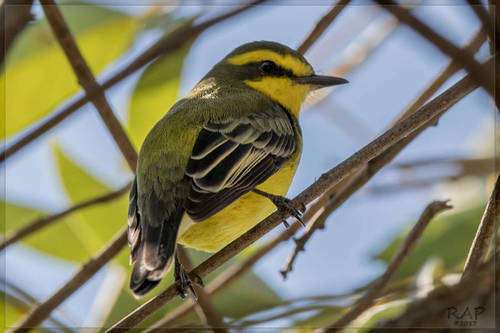
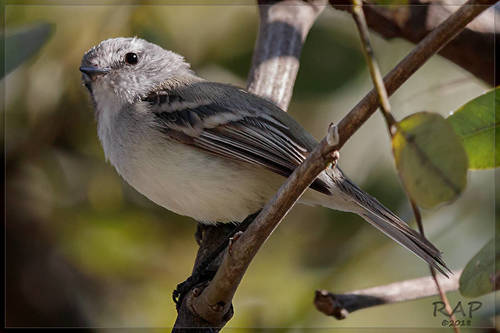
Large Elaenia

Large Elaenia

Elaenia spectabilis

Silhouette: Edwin Price · PhyloPic

LCLeast ConcernNTVUENCR
Daily sighting probability <5% · Rare
at Buenos Aires

In 3 days <5%

25 Verified sightings at Buenos Aires
1,058 In all 12 parks From 2019 to 2026
November Best month
☀️ Diurnal When it's spotted

About the Large Elaenia

The large elaenia (Elaenia spectabilis) is a species of bird in subfamily Elaeniinae of family Tyrannidae, the tyrant flycatchers. It is found in Argentina, Bolivia, Brazil, Colombia, Ecuador, Paraguay, Peru, and Uruguay.

The large elaenia is monotypic. In the mid twentieth century at least one author treated the large elaenia and the yellow-bellied elaenia (E. flavogaster) as conspecific. During the period several authors suggested that the Noronha elaenia (E. ridleyana) should be treated as a subspecies of the large elaenia. That suggestion did not gain wide acceptance and by the 1990s had been shown to be wrong.

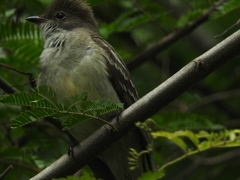
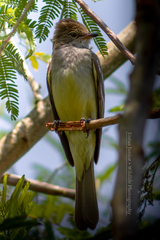
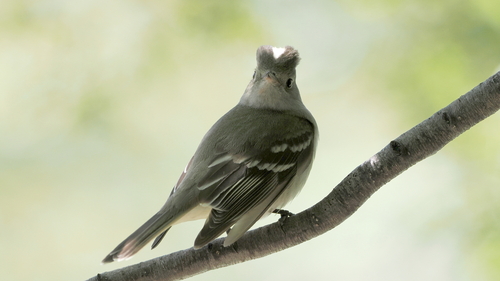
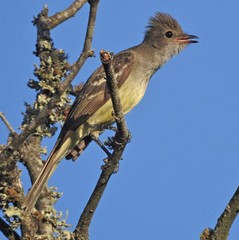
The large elaenia is 16.5 to 18 cm (6.5 to 7.1 in) long and weighs 20 to 35 g (0.71 to 1.2 oz). It is a large elaenia with a small crest. The sexes have the same plumage. Adults have a mostly olive-brown head with a minimal or no white stripe in the middle of the crest. Their upperparts are dark grayish olive. Their wings are dusky with white tips on the coverts that show as three wing bars. Their tail is dusky. Their throat is grayish, their breast dark olive-gray, and their belly and undertail undertail coverts yellow. Both... Wikipedia →

Sounds

Song0:43

Argentina · 2026

© Marcos E. Sosa · XC1100147 · CC BY-NC-SA 4.0

Call0:44

Brazil · 2025

© JAYRSON ARAUJO DE OLIVEIRA · XC1070606 · CC BY-NC-SA 4.0

Recording0:09

Argentina · 2024

© Sabrina Andrea Rendon Anaya · XC947278 · CC BY-NC-SA 4.0

Global Distribution

Parks Where Found

# Park Country Daily sighting probability
1 Iberá National Park 🇦🇷 Argentina
~20%
2 El Impenetrable National Park 🇦🇷 Argentina
~10%
3 Iguazú National Park 🇦🇷 Argentina
~10%
4 Chapada dos Guimarães National Park 🇧🇷 Brazil
~10%
5 Parque Estadual Encontro das Águas 🇧🇷 Brazil
<5%
6 Iguaçu National Park 🇧🇷 Brazil
<5%
7 Anavilhanas National Park 🇧🇷 Brazil
<5%
8 Chapada Diamantina National Park 🇧🇷 Brazil
<5%
9 Amacayacu National Natural Park 🇨🇴 Colombia
<5%
10 Serra da Canastra National Park 🇧🇷 Brazil
<5%
11 Manu National Park 🇵🇪 Peru
<5%
12 Tambopata National Reserve 🇵🇪 Peru
<5%

Cities Where Found

# City Country Daily sighting probability
1 Campo Grande 🇧🇷 Brazil
~20%
2 Asuncion 🇵🇾 Paraguay
~10%
3 São Paulo 🇧🇷 Brazil
<5%
4 Goiânia 🇧🇷 Brazil
<5%
5 Belo Horizonte 🇧🇷 Brazil
<5%
6 Manaus 🇧🇷 Brazil
<5%
7 Buenos Aires 🇦🇷 Argentina
<5%

Before you go

What are the chances of seeing a Large Elaenia in Buenos Aires?

Rare

Under 5% of wildlife watchers report a Large Elaenia sighting in Buenos Aires on a given day, based on 25 verified sightings from GBIF citizen-science data. It is the 240th most-seen of the 274 birds we can rate there. Over three days the chance rises to under 5%, if each day is a fresh chance.

When is the best time to see a Large Elaenia in Buenos Aires?

Any time of year

In every month with enough records, under 5% of wildlife watchers report a Large Elaenia in Buenos Aires on a given day, so our monthly data shows no clear season.

What time of day is best to see a Large Elaenia?

Between 8 and 11 am

Across all the parks we cover, that three-hour window holds the most Large Elaenia sightings with a recorded time, and about 9 in 10 of them come between 6 am and 6 pm: it is a daytime animal.

Is Buenos Aires the best place to see a Large Elaenia?

7th of 7

Of the 7 cities where we can rate Large Elaenia sightings, Buenos Aires ranks 7th at under 5%. The best odds are in Campo Grande (Brazil, about 20%), Asuncion (Paraguay, about 10%) and São Paulo (Brazil, under 5%).

Where does the Large Elaenia sighting chance come from?

GBIF citizen-science records

It is estimated from how often the Large Elaenia is recorded against all the birds logged in Buenos Aires (25 verified sightings), calibrated against known sighting rates. Figures are rounded to the nearest 10% because citizen-science data supports honest approximations, not decimals, and months with records from fewer than five people show "—". How it works.

← Back to Buenos Aires