


Completed

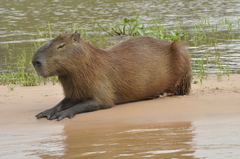


Capybara
Hydrochoerus hydrochaeris
Silhouette: Steven Traver · PhyloPic
- KingdomAnimalia (Animals)
- PhylumChordata (Chordates)
- ClassMammalia (Mammals)
- OrderRodentia (Rodents)
- FamilyCaviidae (Cavies)
- GenusHydrochoerus (Capybaras)
- SpeciesHydrochoerus hydrochaeris (Capybara)
In 3 days ~80% in a week >90%
136 Verified sightings at Campinas
1,322 In all 11 parks From 2019 to 2026
February Best month
☀️ Diurnal When it's spotted

Completed
About the Capybara
The capybara (/kæp.ɪˈbɑːr.ə, -băr′ə/ kap-uh-BAR-uh) or greater capybara (Hydrochoerus hydrochaeris) is the largest living rodent, native to all countries in South America except Chile. It is a semiaquatic herbivore that inhabits savannas and dense forests, living near and in bodies of freshwater and feeding mainly on grasses and aquatic plants.
Together with the lesser capybara, it constitutes the genus Hydrochoerus. Its other close relatives include guinea pigs and rock cavies, and it is more distantly related to the agouti, the chinchilla, and the nutria. The capybara is a highly social species that usually lives in groups of 10–20 individuals, but can be found in groups as large as 100. It is hunted for its meat and hide and for grease from its thick fatty skin.
Its common name is derived from Tupi ka'apiûara, a complex agglutination of kaá (leaf) + píi (slender) + ú (eat) + ara (a suffix for agent nouns), meaning "one who eats slender leaves", or "grass-eater". The genus name, hydrochoerus, comes from Greek ὕδωρ (hýdor "water") and χοῖρος (choíros "pig, hog") and the species name, hydrochaeris, comes from Greek ὕδωρ (hýdor "water") and χαίρω (chairo "feel happy... Wikipedia →
Sounds
Call0:05
Argentina · 2023
© Bernard BOUSQUET · XC1059461 · CC BY-NC-SA 4.0
Recording0:04
Uruguay · 2023
© Santiago Ramos · iNaturalist · CC BY-NC 4.0
Recording0:20
Argentina · 2024
© catachan · iNaturalist · CC BY-NC 4.0
Recent sightings of Capybara in Campinas
LIVEiNaturalistGlobal Distribution
Parks Where Found
| # | Park | Country | Daily sighting probability |
|---|---|---|---|
| 1 | El Palmar National Park | 🇦🇷 Argentina | |
| 2 | Iberá National Park | 🇦🇷 Argentina | |
| 3 | Parque Estadual Encontro das Águas | 🇧🇷 Brazil | |
| 4 | Tambopata National Reserve | 🇵🇪 Peru | |
| 5 | El Impenetrable National Park | 🇦🇷 Argentina | |
| 6 | Manu National Park | 🇵🇪 Peru | |
| 7 | Yasuní National Park | 🇪🇨 Ecuador | |
| 8 | Cuyabeno Wildlife Reserve | 🇪🇨 Ecuador | |
| 9 | Iguazú National Park | 🇦🇷 Argentina | |
| 10 | Tijuca National Park | 🇧🇷 Brazil | |
| 11 | Iguaçu National Park | 🇧🇷 Brazil |
Cities Where Found
| # | City | Country | Daily sighting probability |
|---|---|---|---|
| 1 | Campo Grande | 🇧🇷 Brazil | |
| 2 | Curitiba | 🇧🇷 Brazil | |
| 3 | Recife | 🇧🇷 Brazil | |
| 4 | João Pessoa | 🇧🇷 Brazil | |
| 5 | Campinas | 🇧🇷 Brazil | |
| 6 | Santa Cruz de la Sierra | 🇧🇴 Bolivia | |
| 7 | Brasilia | 🇧🇷 Brazil | |
| 8 | Belém | 🇧🇷 Brazil | |
| 9 | Rio de Janeiro | 🇧🇷 Brazil | |
| 10 | São Paulo | 🇧🇷 Brazil |
Zoos & Centres Where Found




Before you go
What are the chances of seeing a Capybara in Campinas?
Likely
About 40% of wildlife watchers report a Capybara sighting in Campinas on a given day, based on 136 verified sightings from GBIF citizen-science data. It is the most-seen of the 5 mammals we can rate there. Over three days the chance rises to about 80%, and over a week to over 90%, if each day is a fresh chance.
When is the best time to see a Capybara in Campinas?
January–February and May
In those months about 50% of wildlife watchers report a Capybara in Campinas on a given day, against about 30% in June–July and November–December, the lowest months. Those are among Campinas's wettest months, with about 160 mm of rain a month against 30 mm in August.
What time of day is best to see a Capybara?
Between 3 and 6 pm
Across all the parks we cover, that three-hour window holds the most Capybara sightings with a recorded time, and about 9 in 10 of them come between 6 am and 6 pm: it is a daytime animal.
Is Campinas the best place to see a Capybara?
5th of 16
Of the 16 cities where we can rate Capybara sightings, Campinas ranks 5th at about 40%. The best odds are in Campo Grande (Brazil, about 70%), Curitiba (Brazil, about 70%) and Recife (Brazil, about 50%).
Where does the Capybara sighting chance come from?
GBIF citizen-science records
It is estimated from how often the Capybara is recorded against all the mammals logged in Campinas (136 verified sightings), calibrated against known sighting rates. Figures are rounded to the nearest 10% because citizen-science data supports honest approximations, not decimals, and months with records from fewer than five people show "—". How it works.
