


Completed

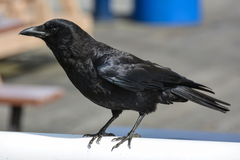


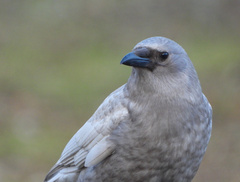
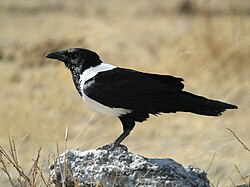
American Crow
Corvus brachyrhynchos
Silhouette: Peileppe · PhyloPic
- KingdomAnimalia (Animals)
- PhylumChordata (Chordates)
- ClassAves (Birds)
- OrderPasseriformes (Perching Birds)
- FamilyCorvidae (Crows, Jays, and Magpies)
- GenusCorvus (Crows and Ravens)
- SpeciesCorvus brachyrhynchos (American Crow)
In 3 days ~80% in a week >90%
31,586 Verified sightings at Chicago
83,716 In all 35 parks From 2019 to 2026
January Best month
☀️ Diurnal When it's spotted





Completed
About the American Crow
The American crow (Corvus brachyrhynchos) is a large passerine bird species of the family Corvidae. It is a common bird found throughout much of North America, only absent from the tundra biome. The American crow is the New World counterpart to the carrion crow and the hooded crow of Eurasia, occupying similar ecological niches.
The American crow has all-black plumage, with iridescent feathers. It looks similar to other all-black corvids. It is highly intelligent, similar to other Corvidae, and is adaptable to human environments. The American crow can be distinguished from the common raven by its smaller size and a slightly less pronounced beak, and from the carrion crow by its size, as the carrion crow is larger and of a stockier build. The American crow can be difficult to distinguish from the fish crow; however, the fish crow tends to fluff its throat feathers when calling. The American crow is an omnivore, feeding on insects, seeds, and nuts while also preying on small animals. It also rarely feeds on carrion, leading to associations with death, thieves, and bad luck in some cultures; however, in Native American and some Gaelic cultures, crows are considered good luck due to their intelligence.
The American crow is common, widespread, and susceptible to the West Nile virus, making it a useful bioindicator for tracking the virus's spread. Direct transmission of the virus from crows to humans is impossible. According to BirdLife International, there are 31 million American crows as of 2012. Wikipedia →
Recent sightings of American Crow in Chicago
LIVEiNaturalistGlobal Distribution
Parks Where Found
Cities Where Found
| # | City | Country | Daily sighting probability |
|---|---|---|---|
| 1 | Seattle | 🇺🇸 United States | |
| 2 | Vancouver | 🇨🇦 Canada | |
| 3 | Portland | 🇺🇸 United States | |
| 4 | San Diego | 🇺🇸 United States | |
| 5 | Montreal | 🇨🇦 Canada | |
| 6 | San Francisco | 🇺🇸 United States | |
| 7 | Dallas | 🇺🇸 United States | |
| 8 | Los Angeles | 🇺🇸 United States | |
| 9 | Edmonton | 🇨🇦 Canada | |
| 10 | Washington | 🇺🇸 United States |
Zoos & Centres Where Found
| # | Zoo / Centre | Country | |
|---|---|---|---|
| 1 | San Diego Zoo | 🇺🇸 United States | |
| 2 | Ecomuseum Zoo | 🇨🇦 Canada | |
| 3 | Bronx Zoo | 🇺🇸 United States | |
| 4 | Cape May County Park & Zoo | 🇺🇸 United States | |
| 5 | Oklahoma City Zoo and Botanical Garden | 🇺🇸 United States | |
| 6 | Saint Louis Zoo | 🇺🇸 United States | |
| 7 | Zoo Knoxville | 🇺🇸 United States | |
| 8 | Salisbury Zoo | 🇺🇸 United States | |
| 9 | Chattanooga Zoo at Warner Park | 🇺🇸 United States | |
| 10 | Tracy Aviary | 🇺🇸 United States | |
| 11 | Ralph Perkins II Wildlife Center and Woods Garden | 🇺🇸 United States | |
| 12 | Virginia Aquarium | 🇺🇸 United States | |
| 13 | Carolina Raptor Center | 🇺🇸 United States | |
| 14 | Mountainaire Avian Rescue Society | 🇨🇦 Canada | |
| 15 | Wild Bird Fund | 🇺🇸 United States |
Closest Relatives at Chicago







Before you go
What are the chances of seeing an American Crow in Chicago?
Likely
About 40% of wildlife watchers report an American Crow sighting in Chicago on a given day, based on 31,586 verified sightings from GBIF citizen-science data. It is the 16th most-seen of the 314 birds we can rate there. Over three days the chance rises to about 80%, and over a week to over 90%, if each day is a fresh chance.
When is the best time to see an American Crow in Chicago?
January and February
In those months about 60% of wildlife watchers report an American Crow in Chicago on a given day, against about 30% in June to August, the lowest months.
What time of day is best to see an American Crow?
Between 8 and 11 am
Across all the parks we cover, that three-hour window holds the most American Crow sightings with a recorded time, and about 8 in 10 of them come between 6 am and 6 pm: it is a daytime animal.
Is Chicago the best place to see an American Crow?
21st of 29
Of the 29 cities where we can rate American Crow sightings, Chicago ranks 21st at about 40%. The best odds are in Seattle (United States, about 90%), Vancouver (Canada, about 90%) and Portland (United States, about 90%).
Where does the American Crow sighting chance come from?
GBIF citizen-science records
It is estimated from how often the American Crow is recorded against all the birds logged in Chicago (31,586 verified sightings), calibrated against known sighting rates. Figures are rounded to the nearest 10% because citizen-science data supports honest approximations, not decimals, and months with records from fewer than five people show "—". How it works.
