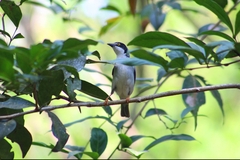
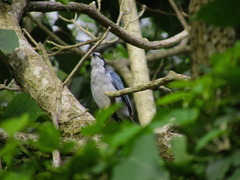
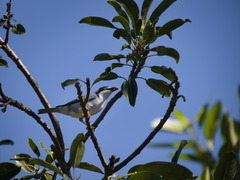
Hooded Tanager

Hooded Tanager

Nemosia pileata

Silhouette: Sheatherius · PhyloPic

LCLeast ConcernNTVUENCR
Daily sighting probability ~10% · With luck
at Goiânia

In 3 days ~30% in a week ~60%

74 Verified sightings at Goiânia
301 In all 10 parks From 2019 to 2026
April Best month
☀️ Diurnal When it's spotted

About the Hooded Tanager

The hooded tanager (Nemosia pileata) is a species of bird in the family Thraupidae, the tanagers and allies. It is found in every mainland South American country except Chile, Ecuador, and Uruguay. The hooded tanager was described by the French polymath Georges-Louis Leclerc, Comte de Buffon in 1779 in his Histoire Naturelle des Oiseaux from a specimen collected in Cayenne, French Guiana. The bird was also illustrated in a hand-colored plate engraved by François-Nicolas Martinet in the Planches Enluminées D'Histoire Naturelle which was produced under the supervision of Edme-Louis Daubenton to accompany Buffon's text. Neither the plate caption nor Buffon's description included a scientific name but in 1783 the Dutch naturalist Pieter Boddaert coined the binomial Tanagra pileata in his catalogue of the Planches Enluminées.

The hooded tanager is now placed in the genus Nemosia that was introduced by the French ornithologist Louis Pierre Vieillot in 1816 with the hooded tanager as the type species. The genus name is from the Ancient Greek nemos meaning "glade" or "dell". The specific epithet pileata is from the Latin pileatus meaning "-capped". The hooded... Wikipedia →

Sounds

Call0:22

Brazil · 2026

© JAYRSON ARAUJO DE OLIVEIRA · XC1136833 · CC BY-NC-SA 4.0

Song1:20

Bolivia · 2021

© Richard E. Webster · XC708154 · CC BY-NC-SA 4.0

Song0:42

Brazil · 2019

© Crizanto B. De-Carvalho · XC464937 · CC BY-NC-SA 4.0

Global Distribution

Parks Where Found

# Park Country Daily sighting probability
1 Chapada Diamantina National Park 🇧🇷 Brazil
~10%
2 Serra da Canastra National Park 🇧🇷 Brazil
<5%
3 Amacayacu National Natural Park 🇨🇴 Colombia
<5%
4 Parque Estadual Encontro das Águas 🇧🇷 Brazil
<5%
5 Chapada dos Guimarães National Park 🇧🇷 Brazil
<5%
6 Iguazú National Park 🇦🇷 Argentina
<5%
7 Itatiaia National Park 🇧🇷 Brazil
<5%
8 Iguaçu National Park 🇧🇷 Brazil
<5%
9 Manu National Park 🇵🇪 Peru
<5%
10 Tambopata National Reserve 🇵🇪 Peru
<5%

Cities Where Found

# City Country Daily sighting probability
1 Goiânia 🇧🇷 Brazil
~10%
2 Campo Grande 🇧🇷 Brazil
~10%
3 Fortaleza 🇧🇷 Brazil
~10%
4 Asuncion 🇵🇾 Paraguay
<5%
5 Campinas 🇧🇷 Brazil
<5%
6 Belo Horizonte 🇧🇷 Brazil
<5%
7 Brasilia 🇧🇷 Brazil
<5%
8 Valencia 🇻🇪 Venezuela
<5%
9 Vitória 🇧🇷 Brazil
<5%
10 São Paulo 🇧🇷 Brazil
<5%

Before you go

What are the chances of seeing a Hooded Tanager in Goiânia?

With luck

About 10% of wildlife watchers report a Hooded Tanager sighting in Goiânia on a given day, based on 74 verified sightings from GBIF citizen-science data. It is the 72nd most-seen of the 174 birds we can rate there. Over three days the chance rises to about 30%, and over a week to about 60%, if each day is a fresh chance.

When is the best time to see a Hooded Tanager in Goiânia?

January, April–May and September

In those months about 20% of wildlife watchers report a Hooded Tanager in Goiânia on a given day, against under 5% in July, the lowest month.

What time of day is best to see a Hooded Tanager?

Between 7 and 10 am

Across all the parks we cover, that three-hour window holds the most Hooded Tanager sightings with a recorded time, and about 9 in 10 of them come between 6 am and 6 pm: it is a daytime animal.

Is Goiânia the best place to see a Hooded Tanager?

Yes

Of the 13 cities where we can rate Hooded Tanager sightings, Goiânia has the highest daily chance: about 10%. Next come Campo Grande (Brazil, about 10%) and Fortaleza (Brazil, about 10%).

Which relatives of the Hooded Tanager live in Goiânia?

Same family: Thraupidae

The closest relatives of the Hooded Tanager that you can see in Goiânia (family Thraupidae, Tanagers and Allies) are Saffron Finch (about 60%), Bananaquit (about 50%) and Yellow-bellied Seedeater (about 30%), with each one's daily chance of a sighting.

Where does the Hooded Tanager sighting chance come from?

GBIF citizen-science records

It is estimated from how often the Hooded Tanager is recorded against all the birds logged in Goiânia (74 verified sightings), calibrated against known sighting rates. Figures are rounded to the nearest 10% because citizen-science data supports honest approximations, not decimals, and months with records from fewer than five people show "—". How it works.

← Back to Goiânia