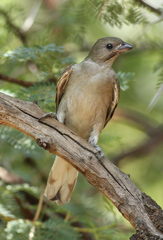
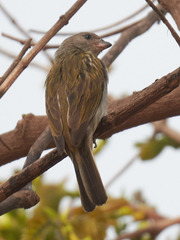
Lesser Honeyguide

Lesser Honeyguide

Indicator minor

Silhouette: Sheatherius · PhyloPic

LCLeast ConcernNTVUENCR
Daily sighting probability <5% · Rare
at Johannesburg

In 3 days ~10% in a week ~30%

162 Verified sightings at Johannesburg
1,762 In all 44 parks From 2019 to 2026
November Best month
☀️ Diurnal When it's spotted

About the Lesser Honeyguide

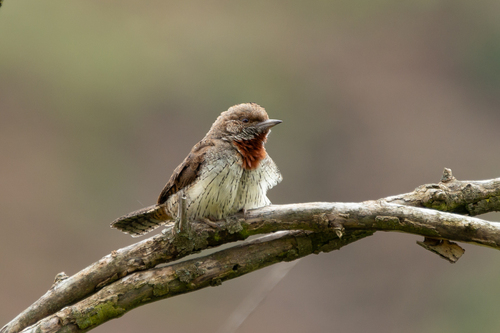
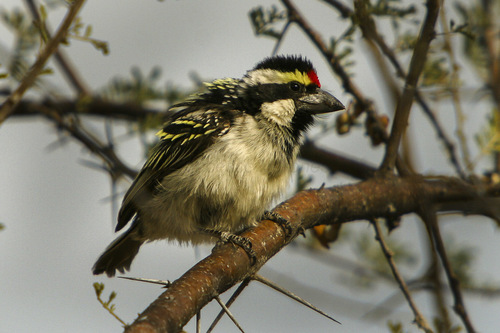
The lesser honeyguide (Indicator minor) is a species of bird in the family Indicatoridae that is widely distributed across sub-Saharan Africa. Like other honeyguides, it is a brood parasite that lays eggs most commonly in the nests of African barbets, but will also occasionally use the nests of other birds as well, such as starlings and woodpeckers.

The lesser honeyguide was formally described in 1815 by the English naturalist James Francis Stephens under the binomial name Indicator minor. Stephens based his account on "Le petit indicator" that had been described and illustrated in 1806 by the French naturalist François Levaillant based on specimens collected near the Swartkops River in the Eastern Cape province of South Africa.

Eight subspecies are recognised: Wikipedia →

Sounds

Song0:17

Burkina Faso · 2026

© Marc Languy · XC1088005 · CC BY-NC-SA 4.0

Call0:07

South Africa · 2021

© Ian-Malcolm Rijsdijk · XC1041085 · CC BY-NC-SA 4.0

Call0:20

Ivory Coast · 2024

© Étienne Leroy · XC957587 · CC BY-NC-SA 4.0

Global Distribution

Parks Where Found

# Park Country Daily sighting probability
1 Mkomazi National Park 🇹🇿 Tanzania
~20%
2 Meru National Park 🇰🇪 Kenya
~20%
3 De Hoop Nature Reserve 🇿🇦 South Africa
~10%
4 Kafue National Park 🇿🇲 Zambia
~10%
5 Gonarezhou National Park 🇿🇼 Zimbabwe
~10%
6 uMkhuze Game Reserve 🇿🇦 South Africa
~10%
7 Lake Manyara National Park 🇹🇿 Tanzania
~10%
8 Arusha National Park 🇹🇿 Tanzania
~10%
9 iSimangaliso Wetland Park 🇿🇦 South Africa
~10%
10 Kibale National Park 🇺🇬 Uganda
~10%
11 Tsavo West National Park 🇰🇪 Kenya
~10%
12 Nairobi National Park 🇰🇪 Kenya
~10%
13 Kidepo Valley National Park 🇺🇬 Uganda
~10%
14 Mikumi National Park 🇹🇿 Tanzania
~10%
15 Niokolo-Koba National Park 🇸🇳 Senegal
<5%
16 Masai Mara National Reserve 🇰🇪 Kenya
<5%
17 Lake Mburo National Park 🇺🇬 Uganda
<5%
18 Samburu National Reserve 🇰🇪 Kenya
<5%
19 Kruger National Park 🇿🇦 South Africa
<5%
20 Lake Nakuru National Park 🇰🇪 Kenya
<5%
21 Semuliki National Park 🇺🇬 Uganda
<5%
22 Virunga National Park 🇨🇩 Democratic Republic of the Congo
<5%
23 Mana Pools National Park 🇿🇼 Zimbabwe
<5%
24 Addo Elephant National Park 🇿🇦 South Africa
<5%
25 Tarangire National Park 🇹🇿 Tanzania
<5%
26 South Luangwa National Park 🇿🇲 Zambia
<5%
27 Lower Zambezi National Park 🇿🇲 Zambia
<5%
28 Pilanesberg National Park 🇿🇦 South Africa
<5%
29 Queen Elizabeth National Park 🇺🇬 Uganda
<5%
30 Gorongosa National Park 🇲🇿 Mozambique
<5%
31 Ngorongoro Conservation Area 🇹🇿 Tanzania
<5%
32 Bwindi Impenetrable National Park 🇺🇬 Uganda
<5%
33 Akagera National Park 🇷🇼 Rwanda
<5%
34 Chobe National Park 🇧🇼 Botswana
<5%
35 Aberdare National Park 🇰🇪 Kenya
<5%
36 Murchison Falls National Park 🇺🇬 Uganda
<5%
37 Hwange National Park 🇿🇼 Zimbabwe
<5%
38 Nyungwe National Park 🇷🇼 Rwanda
<5%
39 Garden Route National Park 🇿🇦 South Africa
<5%
40 Moremi Game Reserve 🇧🇼 Botswana
<5%
41 Amboseli National Park 🇰🇪 Kenya
<5%
42 Table Mountain National Park 🇿🇦 South Africa
<5%
43 Serengeti National Park 🇹🇿 Tanzania
<5%
44 West Coast National Park 🇿🇦 South Africa
<5%

Cities Where Found

# City Country Daily sighting probability
1 Harare 🇿🇼 Zimbabwe
~10%
2 Pretoria 🇿🇦 South Africa
~10%
3 Lusaka 🇿🇲 Zambia
<5%
4 Johannesburg 🇿🇦 South Africa
<5%
5 Kigali 🇷🇼 Rwanda
<5%
6 Durban 🇿🇦 South Africa
<5%
7 Serrekunda 🇬🇲 Gambia
<5%
8 Nairobi 🇰🇪 Kenya
<5%
9 Kampala 🇺🇬 Uganda
<5%
10 Cape Town 🇿🇦 South Africa
<5%

Before you go

What are the chances of seeing a Lesser Honeyguide in Johannesburg?

Rare

Under 5% of wildlife watchers report a Lesser Honeyguide sighting in Johannesburg on a given day, based on 162 verified sightings from GBIF citizen-science data. It is the 89th most-seen of the 219 birds we can rate there. Over three days the chance rises to about 10%, and over a week to about 30%, if each day is a fresh chance.

When is the best time to see a Lesser Honeyguide in Johannesburg?

October to January

In those months about 10% of wildlife watchers report a Lesser Honeyguide in Johannesburg on a given day, against under 5% in February to September, the lowest months. Those are among Johannesburg's wettest months, with about 100 mm of rain a month against almost none in July.

What time of day is best to see a Lesser Honeyguide?

Between 7 and 10 am

Across all the parks we cover, that three-hour window holds the most Lesser Honeyguide sightings with a recorded time, and about 9 in 10 of them come between 6 am and 6 pm: it is a daytime animal.

Is Johannesburg the best place to see a Lesser Honeyguide?

4th of 10

Of the 10 cities where we can rate Lesser Honeyguide sightings, Johannesburg ranks 4th at under 5%. The best odds are in Harare (Zimbabwe, about 10%), Pretoria (South Africa, about 10%) and Lusaka (Zambia, under 5%).

Where does the Lesser Honeyguide sighting chance come from?

GBIF citizen-science records

It is estimated from how often the Lesser Honeyguide is recorded against all the birds logged in Johannesburg (162 verified sightings), calibrated against known sighting rates. Figures are rounded to the nearest 10% because citizen-science data supports honest approximations, not decimals, and months with records from fewer than five people show "—". How it works.

← Back to Johannesburg