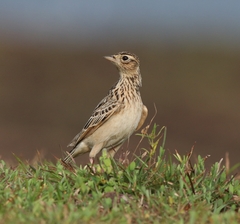
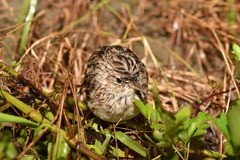
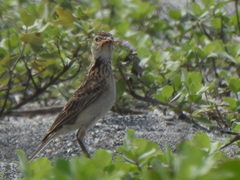
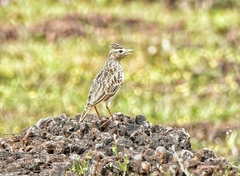

Oriental Skylark

Oriental Skylark

Alauda gulgula

Silhouette: Gossipguy and T. Michael Keesey · PhyloPic

LCLeast ConcernNTVUENCR
Daily sighting probability ~10% · With luck
at Kathmandu

In 3 days ~20% in a week ~40%

388 Verified sightings at Kathmandu
569 In all 19 parks From 2019 to 2026
March Best month
☀️ Diurnal When it's spotted

About the Oriental Skylark

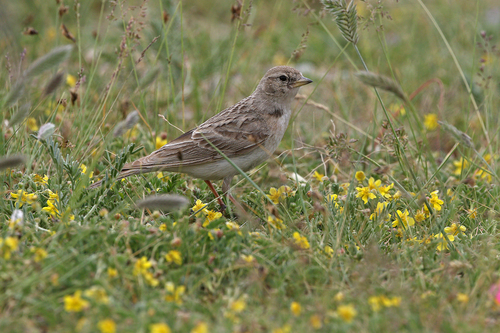
The Oriental skylark (Alauda gulgula) is a species of skylark found in the Sino-Indian region and parts of central Asia. Like other skylarks, it is found in open grassland where it feeds on seeds and insects. The Oriental skylark was described by the English soldier and naturalist James Franklin in 1831 and given the binomial name Alauda gulgula. The meaning of the specific epithet gulgula is uncertain but is perhaps a reference to the song as gula is Latin for "throat", or maybe the colour of a gulgula, a sweet which looks like doughnut, made in many parts of Central India.

Other alternate names for the Oriental skylark include small skylark, eastern skylark, Indian skylark and lesser skylark. A. g... Wikipedia →

Sounds

Song0:55

China · 2026

© Bo Shunqi 薄顺奇 · XC1174621 · CC BY-NC-SA 4.0

Flight song0:52

Uzbekistan · 2025

© Frank Lambert · XC1029428 · CC BY-NC-ND 4.0

Call0:14

China · 2024

© He Wenjin/文进 · XC913946 · CC BY-NC-SA 4.0

Global Distribution

Parks Where Found

# Park Country Daily sighting probability
1 Udawalawe National Park 🇱🇰 Sri Lanka
~10%
2 Yala National Park 🇱🇰 Sri Lanka
~10%
3 Wilpattu National Park 🇱🇰 Sri Lanka
~10%
4 Satpura National Park 🇮🇳 India
<5%
5 Nagarhole National Park 🇮🇳 India
<5%
6 Chitwan National Park 🇳🇵 Nepal
<5%
7 Minneriya National Park 🇱🇰 Sri Lanka
<5%
8 Kaziranga National Park 🇮🇳 India
<5%
9 Bandipur National Park 🇮🇳 India
<5%
10 Ranthambore National Park 🇮🇳 India
<5%
11 Jim Corbett National Park 🇮🇳 India
<5%
12 Mudumalai National Park 🇮🇳 India
<5%
13 Periyar National Park 🇮🇳 India
<5%
14 Horton Plains National Park 🇱🇰 Sri Lanka
<5%
15 Sundarbans National Park 🇮🇳 India
<5%
16 Manas National Park 🇮🇳 India
<5%
17 Taroko National Park 🇹🇼 Taiwan
<5%
18 Kanha National Park 🇮🇳 India
<5%
19 Kaeng Krachan National Park 🇹🇭 Thailand
<5%

Cities Where Found

# City Country Daily sighting probability
1 Vasai-Virar 🇮🇳 India
~20%
2 Kaohsiung 🇹🇼 Taiwan
~10%
3 Lahore 🇵🇰 Pakistan
~10%
4 Ranchi 🇮🇳 India
~10%
5 Kathmandu 🇳🇵 Nepal
~10%
6 Suzhou 🇨🇳 China
~10%
7 Tamluk 🇮🇳 India
<5%
8 Kolkata 🇮🇳 India
<5%
9 Taichung 🇹🇼 Taiwan
<5%
10 Thrissur 🇮🇳 India
<5%

Before you go

What are the chances of seeing an Oriental Skylark in Kathmandu?

With luck

About 10% of wildlife watchers report an Oriental Skylark sighting in Kathmandu on a given day, based on 388 verified sightings from GBIF citizen-science data. It is the 69th most-seen of the 312 birds we can rate there. Over three days the chance rises to about 20%, and over a week to about 40%, if each day is a fresh chance.

When is the best time to see an Oriental Skylark in Kathmandu?

March and October–November

In those months about 20% of wildlife watchers report an Oriental Skylark in Kathmandu on a given day, against under 5% in April to September, the lowest months. Those are among Kathmandu's driest months, with about 25 mm of rain a month against 280 mm in July.

What time of day is best to see an Oriental Skylark?

Between 8 and 11 am

Across all the parks we cover, that three-hour window holds the most Oriental Skylark sightings with a recorded time, and nearly all of them come between 6 am and 6 pm: it is a daytime animal.

Is Kathmandu the best place to see an Oriental Skylark?

5th of 29

Of the 29 cities where we can rate Oriental Skylark sightings, Kathmandu ranks 5th at about 10%. The best odds are in Vasai-Virar (India, about 20%), Kaohsiung (Taiwan, about 10%) and Lahore (Pakistan, about 10%).

Where does the Oriental Skylark sighting chance come from?

GBIF citizen-science records

It is estimated from how often the Oriental Skylark is recorded against all the birds logged in Kathmandu (388 verified sightings), calibrated against known sighting rates. Figures are rounded to the nearest 10% because citizen-science data supports honest approximations, not decimals, and months with records from fewer than five people show "—". How it works.

← Back to Kathmandu