




Completed






Great Tit
Parus major
Silhouette: Ferran Sayol · PhyloPic
- KingdomAnimalia (Animals)
- PhylumChordata (Chordates)
- ClassAves (Birds)
- OrderPasseriformes (Perching Birds)
- FamilyParidae (Tits, Chickadees, and Titmice)
- GenusParus (Great Tits and Allies)
- SpeciesParus major (Great Tit)
1,430 Verified sightings at Kyiv
24,216 In all 27 parks From 2019 to 2026
December Best month
☀️ Diurnal When it's spotted
About the Great Tit
The great tit (Parus major) is a small passerine bird in the tit family Paridae. It is widespread and common throughout Europe, the Middle East, Central Asia and as far east as the Amur River. It also occurs in parts of North Africa where it is generally resident in any sort of woodland. Most great tits do not migrate, except in extremely harsh winters. Until 2005 this species was lumped with numerous other subspecies. However, DNA studies have revealed that these subspecies are distinct from the great tit, and they have now been classified as two distinct species, the cinereous tit (Parus cinereus) of southern Asia, and the Japanese tit (Parus minor) of East Asia. The great tit remains the most widespread species in the genus Parus.
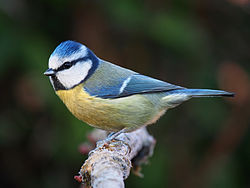
The great tit is a distinctive bird with a black head and neck, prominent white cheeks, olive-coloured upperparts and yellow underparts. There is some variation amongst the numerous subspecies. Predominantly insectivorous in the summer, the species consumes a wider range of food items in the winter months, including small hibernating bats. Like all tits, it is a cavity nester, usually nesting in a tree hole. The female lays around 12 eggs and incubates them alone, although both parents raise the chicks. In most years, the pair will raise two broods. However, the nests may be raided by woodpeckers, squirrels and weasels and may become infested with fleas, and adults may be hunted by sparrowhawks. The great tit has adapted well to human-induced environmental changes and is a common and familiar bird in urban parks and gardens. The great tit is also an important study species in ornithology. Wikipedia →
Recent sightings of Great Tit in Kyiv
LIVEiNaturalistGlobal Distribution
Parks Where Found
Zoos & Centres Where Found
| # | Zoo / Centre | Country | |
|---|---|---|---|
| 1 | Aquarium du palais de la Porte Dorée | 🇫🇷 France | |
| 2 | Ogród Zoologiczny w Katowicach | 🇵🇱 Poland | |
| 3 | Remstecken | 🇩🇪 Germany |
Closest Relatives at Kyiv


Before you go
What are the chances of seeing a Great Tit in Kyiv?
Very likely
About 90% of wildlife watchers report a Great Tit sighting in Kyiv on a given day, based on 1,430 verified sightings from GBIF citizen-science data. It is the 2nd most-seen of the 164 birds we can rate there.
When is the best time to see a Great Tit in Kyiv?
February–March and October–December
In those months over 90% of wildlife watchers report a Great Tit in Kyiv on a given day, against about 70% in June and August, the lowest months.
What time of day is best to see a Great Tit?
Between 8 and 11 am
Across all the parks we cover, that three-hour window holds the most Great Tit sightings with a recorded time, and about 9 in 10 of them come between 6 am and 6 pm: it is a daytime animal.
Is Kyiv the best place to see a Great Tit?
10th of 76
Of the 76 cities where we can rate Great Tit sightings, Kyiv ranks 10th at about 90%. The best odds are in Bishkek (Kyrgyzstan, over 90%), Kharkiv (Ukraine, over 90%) and Yekaterinburg (Russia, about 90%).
Which relatives of the Great Tit live in Kyiv?
Same family: Paridae
The closest relatives of the Great Tit that you can see in Kyiv (family Paridae, Tits, Chickadees, and Titmice) are Blue Tit (about 60%), Coal Tit (about 10%) and Crested Tit (about 10%), with each one's daily chance of a sighting.
Where does the Great Tit sighting chance come from?
GBIF citizen-science records
It is estimated from how often the Great Tit is recorded against all the birds logged in Kyiv (1,430 verified sightings), calibrated against known sighting rates. Figures are rounded to the nearest 10% because citizen-science data supports honest approximations, not decimals, and months with records from fewer than five people show "—". How it works.
