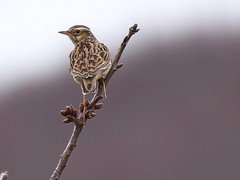
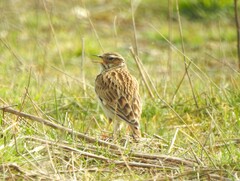

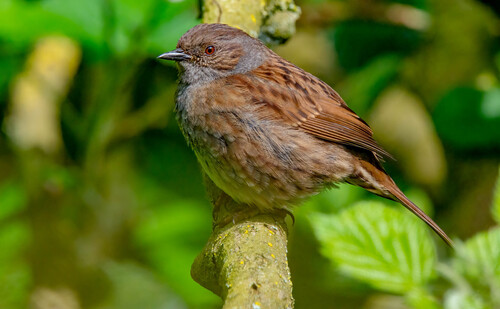
Woodlark

Woodlark

Lullula arborea

Silhouette: Ján Svetlík · PhyloPic

LCLeast ConcernNTVUENCR
Daily sighting probability <5% · Rare
at London

In 3 days <5%

12 Verified sightings at London
2,993 In all 17 parks From 2019 to 2026
October Best month
☀️ Diurnal When it's spotted

About the Woodlark

The woodlark or wood lark (Lullula arborea) is the only extant species in the lark genus Lullula. It is found across most of Europe, the Middle East, western Asia and the mountains of north Africa. It is mainly resident (non-migratory) in the west of its range, but eastern populations of this passerine bird are more migratory, moving further south in winter.

The former is native to northern regions of Europe, while the latter can be found in the south of the woodlark's range. Their diet is mostly composed of seeds but also includes insects during the breeding period. A comparatively small bird, the woodlark is between 13.5 and 15 centimetres (5.3 and 5.9 in) long and roughly 20% shorter than the skylark. It is a brown bird with a pale underside and has a white-tipped tail.

The woodlark was described by the Swedish naturalist Carl Linnaeus in 1758 in the tenth edition of his Systema Naturae and given the binomial name Alauda arborea. This binomial name is identical to the Latin name used in 1676 by English ornithologist Francis Willughby in his Ornithologiae libri tres. The woodlark... Wikipedia →

Sounds

Call0:33

Sweden · 2026

© Lars Edenius · XC1096720 · CC BY-NC-SA 4.0

Song0:45

Sweden · 2026

© Mikael Calner · XC1086158 · CC BY-NC-SA 4.0

Flight song0:54

France · 2023

© Dominique Guillerme · XC798301 · CC BY-NC-SA 4.0

Global Distribution

Parks Where Found

# Park Country Daily sighting probability
1 Sierra de Guadarrama National Park 🇪🇸 Spain
~20%
2 Monfragüe National Park 🇪🇸 Spain
~20%
3 Cévennes National Park 🇫🇷 France
~20%
4 Biebrza National Park 🇵🇱 Poland
~10%
5 Sierra Nevada National Park 🇪🇸 Spain
~10%
6 Białowieża National Park 🇵🇱 Poland
~10%
7 Kiskunság National Park 🇭🇺 Hungary
<5%
8 Doñana National Park 🇪🇸 Spain
<5%
9 Pyrénées National Park 🇫🇷 France
<5%
10 Ordesa y Monte Perdido National Park 🇪🇸 Spain
<5%
11 Aigüestortes National Park 🇪🇸 Spain
<5%
12 Picos de Europa National Park 🇪🇸 Spain
<5%
13 Wadden Sea National Park 🇩🇪 Germany
<5%
14 Bavarian Forest National Park 🇩🇪 Germany
<5%
15 Gauja National Park 🇱🇻 Latvia
<5%
16 Fertő-Hanság National Park 🇭🇺 Hungary
<5%
17 Camargue 🇫🇷 France
<5%

Cities Where Found

# City Country Daily sighting probability
1 Ramallah 🇵🇸 Palestine
~10%
2 Antalya 🇹🇷 Turkey
<5%
3 Berlin 🇩🇪 Germany
<5%
4 Rotterdam [The Hague] 🇳🇱 Netherlands
<5%
5 Madrid 🇪🇸 Spain
<5%
6 Valencia 🇪🇸 Spain
<5%
7 Jerusalem 🇮🇱 Israel
<5%
8 Barcelona 🇪🇸 Spain
<5%
9 Warsaw 🇵🇱 Poland
<5%
10 Belgrade 🇷🇸 Serbia
<5%

Before you go

What are the chances of seeing a Woodlark in London?

Rare

Under 5% of wildlife watchers report a Woodlark sighting in London on a given day, based on 12 verified sightings from GBIF citizen-science data. It is the 186th most-seen of the 203 birds we can rate there. Over three days the chance rises to under 5%, if each day is a fresh chance.

When is the best time to see a Woodlark in London?

Any time of year

In every month with enough records, under 5% of wildlife watchers report a Woodlark in London on a given day, so our monthly data shows no clear season.

What time of day is best to see a Woodlark?

Between 8 and 11 am

Across all the parks we cover, that three-hour window holds the most Woodlark sightings with a recorded time, and about 8 in 10 of them come between 6 am and 6 pm: it is a daytime animal.

Is London the best place to see a Woodlark?

17th of 17

Of the 17 cities where we can rate Woodlark sightings, London ranks 17th at under 5%. The best odds are in Ramallah (Palestine, about 10%), Antalya (Turkey, under 5%) and Berlin (Germany, under 5%).

Where does the Woodlark sighting chance come from?

GBIF citizen-science records

It is estimated from how often the Woodlark is recorded against all the birds logged in London (12 verified sightings), calibrated against known sighting rates. Figures are rounded to the nearest 10% because citizen-science data supports honest approximations, not decimals, and months with records from fewer than five people show "—". How it works.

← Back to London