Olivaceous Piculet

Olivaceous Piculet

Picumnus olivaceus

Silhouette: Pepe Reigada · PhyloPic

LCLeast ConcernNTVUENCR
Daily sighting probability ~10% · With luck
at Medellín

In 3 days ~30% in a week ~50%

381 Verified sightings at Medellín
1,792 In all 17 parks From 2019 to 2026
October Best month
☀️ Diurnal When it's spotted

About the Olivaceous Piculet

The olivaceous piculet (Picumnus olivaceus) is a species of bird in subfamily Picumninae of the woodpecker family Picidae. It is found from Guatemala south through Central America and western South America to Peru. The olivaceous piculet has these six subspecies:

The olivaceous piculet and the grayish piculet (P. granadensis) were at one time considered to be conspecific and are now treated as sister species. The "evidence for treatment as separate species is weak". Some authors have proposed splitting each of subspecies flavotinctus and olivaceous into two subspecies but those changes have not been accepted.

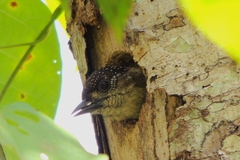
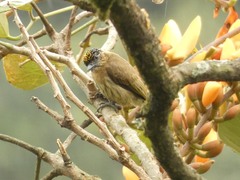
The olivaceous piculet is 8.5 to 10 cm (3.3 to 3.9 in) long and weighs 10 to 15 g (0.35 to 0.53 oz). Adult males of the nominate subspecies P. o. olivaceus have a black crown and nape with red tips on the feathers of the front and top and white spots on the rest. Their face is mostly brown with white feather tips... Wikipedia →

Sounds

Song0:13

Ecuador · 2023

© Manuel Sánchez-Nivicela · XC1176104 · CC BY-NC-ND 4.0

Recording0:31

Ecuador · 2020

© José María Loaiza B. · XC583501 · CC BY-NC-SA 4.0

Call0:23

Colombia · 2020

© Jerome Fischer · XC561647 · CC BY-NC-SA 4.0

Global Distribution

Parks Where Found

# Park Country Daily sighting probability
1 Cerro Azul Meámbar National Park 🇭🇳 Honduras
~20%
2 Chirripó National Park 🇨🇷 Costa Rica
~10%
3 Piedras Blancas National Park 🇨🇷 Costa Rica
~10%
4 Lago de Yojoa 🇭🇳 Honduras
~10%
5 Marino Ballena National Park 🇨🇷 Costa Rica
<5%
6 Tenorio Volcano National Park 🇨🇷 Costa Rica
<5%
7 Pico Bonito National Park 🇭🇳 Honduras
<5%
8 La Amistad International Park (Panama) 🇵🇦 Panama
<5%
9 Darién National Park 🇵🇦 Panama
<5%
10 Corcovado National Park 🇨🇷 Costa Rica
<5%
11 Arenal Volcano National Park 🇨🇷 Costa Rica
<5%
12 Carara National Park 🇨🇷 Costa Rica
<5%
13 Manuel Antonio National Park 🇨🇷 Costa Rica
<5%
14 Soberanía National Park 🇵🇦 Panama
<5%
15 Volcán Barú National Park 🇵🇦 Panama
<5%
16 Parque Natural Metropolitano 🇵🇦 Panama
<5%
17 Los Nevados National Natural Park 🇨🇴 Colombia
<5%

Cities Where Found

# City Country Daily sighting probability
1 Medellín 🇨🇴 Colombia
~10%

Before you go

What are the chances of seeing an Olivaceous Piculet in Medellín?

With luck

About 10% of wildlife watchers report an Olivaceous Piculet sighting in Medellín on a given day, based on 381 verified sightings from GBIF citizen-science data. It is the 59th most-seen of the 244 birds we can rate there. Over three days the chance rises to about 30%, and over a week to about 50%, if each day is a fresh chance.

When is the best time to see an Olivaceous Piculet in Medellín?

Any time of year

In every month with enough records, about 10% of wildlife watchers report an Olivaceous Piculet in Medellín on a given day, so our monthly data shows no clear season.

What time of day is best to see an Olivaceous Piculet?

Between 7 and 10 am

Across all the parks we cover, that three-hour window holds the most Olivaceous Piculet sightings with a recorded time, and nearly all of them come between 6 am and 6 pm: it is a daytime animal.

Where else can you see an Olivaceous Piculet?

Only Medellín, in our data

Medellín is the only city on Wallace's Line with enough records to rate Olivaceous Piculet sightings: about 10% of wildlife watchers there report one on a given day.

Which relatives of the Olivaceous Piculet live in Medellín?

Same family: Picidae

The closest relatives of the Olivaceous Piculet that you can see in Medellín (family Picidae, Woodpeckers) are Red-crowned Woodpecker (about 50%), Lineated Woodpecker (about 10%) and Acorn Woodpecker (about 10%), with each one's daily chance of a sighting.

Where does the Olivaceous Piculet sighting chance come from?

GBIF citizen-science records

It is estimated from how often the Olivaceous Piculet is recorded against all the birds logged in Medellín (381 verified sightings), calibrated against known sighting rates. Figures are rounded to the nearest 10% because citizen-science data supports honest approximations, not decimals, and months with records from fewer than five people show "—". How it works.

← Back to Medellín