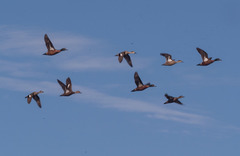
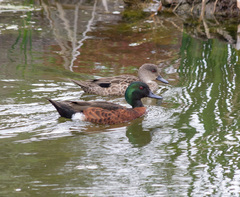
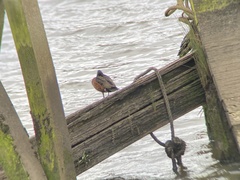

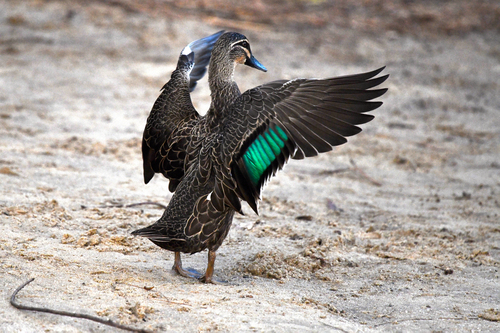
Chestnut Teal

Chestnut Teal

Anas castanea

Silhouette: Sheatherius · PhyloPic

LCLeast ConcernNTVUENCR Endemic
Daily sighting probability ~50% · Likely
at Melbourne

In 3 days ~80% in a week >90%

15,712 Verified sightings at Melbourne
1,506 In all 9 parks From 2019 to 2026
February Best month
☀️ Diurnal When it's spotted

About the Chestnut Teal

The chestnut teal (Anas castanea) is a dabbling duck found in Australia. It is protected under the National Parks and Wildlife Act 1974. The chestnut teal was described by the English naturalist Thomas Campbell Eyton in 1838 under the binomial name Mareca castanea. The specific epithet castanea is from the Latin castaneus for "chestnut-coloured" or "chestnut-brown".

A large molecular phylogentic study that compared mitochondrial DNA sequences from ducks, geese and swans in the family Anatidae found that the chestnut teal is a sister species to the Sunda teal (Anas gibberifrons) that is endemic to Indonesia.

The chestnut teal is darker and a slightly bigger bird than the grey teal. The male has a distinctive green coloured head and mottled brown body. The female has a brown head and mottled brown body. The female is almost identical in appearance to the grey teal.

The female chestnut teal has a loud penetrating "laughing" quack repeated rapidly nine times or more. The chestnut teal is commonly distributed in south-eastern and south-western Australia, while vagrants may occur elsewhere. Tasmania and southern Victoria are... Wikipedia →

Sounds

Song0:16

Australia · 2016

© Marc Anderson · XC340216 · CC BY-NC-ND 4.0

Call0:20

Australia · 2025

© Nick Talbot · XC1068770 · CC BY-NC-SA 4.0

Recording0:05

Australia · 2021

© nick talbot · XC654677 · CC BY-NC-SA 4.0

Global Distribution

Parks Where Found

# Park Country Daily sighting probability
1 Maria Island National Park 🇦🇺 Australia
~70%
2 Booderee National Park 🇦🇺 Australia
~20%
3 Great Otway National Park 🇦🇺 Australia
~20%
4 Royal National Park 🇦🇺 Australia
~10%
5 Freycinet National Park 🇦🇺 Australia
~10%
6 Wilsons Promontory National Park 🇦🇺 Australia
~10%
7 Grampians National Park 🇦🇺 Australia
~10%
8 Hattah-Kulkyne National Park 🇦🇺 Australia
<5%
9 Blue Mountains National Park 🇦🇺 Australia
<5%

Cities Where Found

# City Country Daily sighting probability
1 Melbourne 🇦🇺 Australia
~50%
2 Sydney 🇦🇺 Australia
~30%
3 Hobart 🇦🇺 Australia
<5%
4 Brisbane 🇦🇺 Australia
<5%
5 Perth 🇦🇺 Australia
<5%

Zoos & Centres Where Found

# Zoo / Centre Country
1 Parc des oiseaux 🇫🇷 France In captivity
2 Zoo Miami 🇺🇸 United States In captivity
3 Minnesota Zoo 🇺🇸 United States In captivity
4 Columbus Zoo and Aquarium 🇺🇸 United States In captivity
5 Sedgwick County Zoo 🇺🇸 United States In captivity
6 Omaha’s Henry Doorly Zoo and Aquarium 🇺🇸 United States In captivity
7 Cleland Wildlife Park 🇦🇺 Australia In captivity
8 Cologne Zoological Garden 🇩🇪 Germany In captivity
9 Henry Vilas Zoo 🇺🇸 United States In captivity
10 Ménagerie du Jardin des Plantes 🇫🇷 France In captivity
11 Australian Reptile Park 🇦🇺 Australia In captivity
12 Santillana Zoo 🇪🇸 Spain In captivity
13 Featherdale Sydney Wildlife Park 🇦🇺 Australia In captivity
14 Zoo Lagos 🇵🇹 Portugal In captivity
15 Ipswich Nature Centre 🇦🇺 Australia In captivity
16 Caversham Wildlife Park 🇦🇺 Australia In captivity
17 Cologne Zoo Aquarium 🇩🇪 Germany In captivity
18 Montreal Biodome 🇨🇦 Canada In captivity

Before you go

What are the chances of seeing a Chestnut Teal in Melbourne?

Likely

About 50% of wildlife watchers report a Chestnut Teal sighting in Melbourne on a given day, based on 15,712 verified sightings from GBIF citizen-science data. It is the 18th most-seen of the 236 birds we can rate there. Over three days the chance rises to about 80%, and over a week to over 90%, if each day is a fresh chance.

When is the best time to see a Chestnut Teal in Melbourne?

September to March

In those months about 50% of wildlife watchers report a Chestnut Teal in Melbourne on a given day, against about 40% in April to August, the lowest months.

What time of day is best to see a Chestnut Teal?

Between 2 and 5 pm

Across all the parks we cover, that three-hour window holds the most Chestnut Teal sightings with a recorded time, and nearly all of them come between 6 am and 6 pm: it is a daytime animal.

Is Melbourne the best place to see a Chestnut Teal?

Yes

Of the 5 cities where we can rate Chestnut Teal sightings, Melbourne has the highest daily chance: about 50%. Next come Sydney (Australia, about 30%) and Hobart (Australia, under 5%).

Which relatives of the Chestnut Teal live in Melbourne?

Same genus: Anas

The closest relatives of the Chestnut Teal that you can see in Melbourne (genus Anas, Mallards, Pintails, and Allies) are Pacific Black Duck (about 60%) and Grey Teal (about 30%), with each one's daily chance of a sighting.

Where does the Chestnut Teal sighting chance come from?

GBIF citizen-science records

It is estimated from how often the Chestnut Teal is recorded against all the birds logged in Melbourne (15,712 verified sightings), calibrated against known sighting rates. Figures are rounded to the nearest 10% because citizen-science data supports honest approximations, not decimals, and months with records from fewer than five people show "—". How it works.

← Back to Melbourne