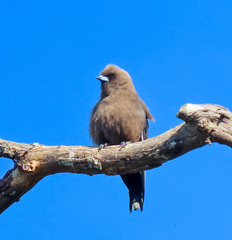
Dusky Woodswallow

Dusky Woodswallow

Artamus cyanopterus

Silhouette: Sheatherius · PhyloPic

LCLeast ConcernNTVUENCR Endemic
Daily sighting probability <5% · Rare
at Melbourne

In 3 days ~10%

597 Verified sightings at Melbourne
794 In all 13 parks From 2019 to 2026
November Best month
☀️ Diurnal When it's spotted

About the Dusky Woodswallow

The dusky woodswallow (Artamus cyanopterus) is a bird species of forests and woodlands in temperate and subtropical regions, extending into tropical areas around the Atherton Tableland, in eastern and southern Australia.

The global population of the species has as yet not been formally confirmed, but it has been officially rated in the range of 'Least Concern', according to the BirdLife International in 2004. As such, the bird could be described as common in its local habitat.

The name "woodswallow" is a misnomer as they are not closely related to true swallows. Instead, they belong to the family Artamidae, which also includes butcherbirds, currawongs and the Australian magpie. The dusky woodswallow was first described by the English ornithologist John Latham in 1801 with the binomial name Loxia cyanoptera. Its specific epithet is derived from the Ancient Greek words cyanos 'blue' and pteron 'wing'.

The dusky woodswallow is medium-sized and swallow-like, with a dark brown hue, but there have been instances where the bird has appeared grey. The birds have a black patch in front of the eyes, and grey (sometimes also black) wings with white streaks on... Wikipedia →

Sounds

Call0:41

Australia · 2019

© Marc Anderson · XC674052 · CC BY-NC-ND 4.0

Song0:26

Australia · 2016

© Greg McLachlan · XC354593 · CC BY-NC-SA 4.0

Recording0:11

Australia · 2025

© Clare Jacobson · iNaturalist · CC BY-NC 4.0

Global Distribution

Parks Where Found

# Park Country Daily sighting probability
1 Kosciuszko National Park 🇦🇺 Australia
~20%
2 Flinders Chase 🇦🇺 Australia
~20%
3 Maria Island National Park 🇦🇺 Australia
~10%
4 Flinders Ranges National Park 🇦🇺 Australia
~10%
5 Great Otway National Park 🇦🇺 Australia
~10%
6 Grampians National Park 🇦🇺 Australia
~10%
7 Booderee National Park 🇦🇺 Australia
<5%
8 Rakiura National Park 🇳🇿 New Zealand
<5%
9 Blue Mountains National Park 🇦🇺 Australia
<5%
10 Hattah-Kulkyne National Park 🇦🇺 Australia
<5%
11 Wilsons Promontory National Park 🇦🇺 Australia
<5%
12 Royal National Park 🇦🇺 Australia
<5%
13 Lamington National Park 🇦🇺 Australia
<5%

Cities Where Found

# City Country Daily sighting probability
1 Melbourne 🇦🇺 Australia
<5%
2 Sydney 🇦🇺 Australia
<5%

Zoos & Centres Where Found

# Zoo / Centre Country
1 Currumbin Wildlife Sanctuary 🇦🇺 Australia In captivity
2 Adelaide Zoo 🇦🇺 Australia In captivity
3 Gorge Wildlife Park 🇦🇺 Australia In captivity

Before you go

What are the chances of seeing a Dusky Woodswallow in Melbourne?

Rare

Under 5% of wildlife watchers report a Dusky Woodswallow sighting in Melbourne on a given day, based on 597 verified sightings from GBIF citizen-science data. It is the 114th most-seen of the 236 birds we can rate there. Over three days the chance rises to about 10%, if each day is a fresh chance.

When is the best time to see a Dusky Woodswallow in Melbourne?

Any time of year

In every month with enough records, under 5% of wildlife watchers report a Dusky Woodswallow in Melbourne on a given day, so our monthly data shows no clear season.

What time of day is best to see a Dusky Woodswallow?

Between 11 am and 2 pm

Across all the parks we cover, that three-hour window holds the most Dusky Woodswallow sightings with a recorded time, and nearly all of them come between 6 am and 6 pm: it is a daytime animal.

Is Melbourne the best place to see a Dusky Woodswallow?

Yes

Of the 2 cities where we can rate Dusky Woodswallow sightings, Melbourne has the highest daily chance: under 5%. Next come Sydney (Australia, under 5%).

Where does the Dusky Woodswallow sighting chance come from?

GBIF citizen-science records

It is estimated from how often the Dusky Woodswallow is recorded against all the birds logged in Melbourne (597 verified sightings), calibrated against known sighting rates. Figures are rounded to the nearest 10% because citizen-science data supports honest approximations, not decimals, and months with records from fewer than five people show "—". How it works.

← Back to Melbourne