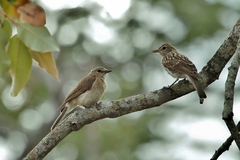
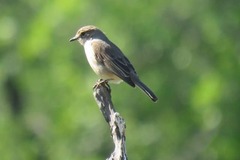
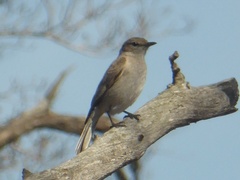
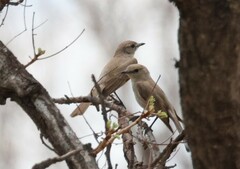

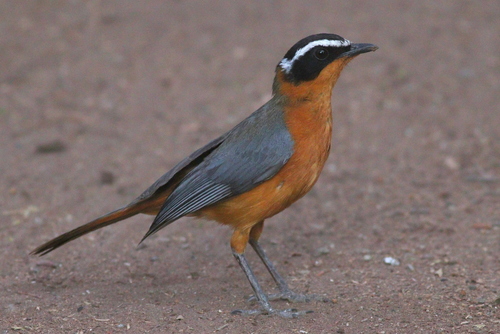
Pale Flycatcher

Pale Flycatcher

Bradornis pallidus

Silhouette: Martin Bulla, based on François Desbordes' illustration · PhyloPic

LCLeast ConcernNTVUENCR
Daily sighting probability ~40% · Likely
at Mombasa

In 3 days ~80% in a week >90%

90 Verified sightings at Mombasa
1,471 In all 32 parks From 2019 to 2026
May Best month
☀️ Diurnal When it's spotted

About the Pale Flycatcher

The pale flycatcher (Agricola pallidus) is a passerine bird of the Old World flycatcher family Muscicapidae, native to Sub-Saharan Africa. The pale flycatcher was previously placed in the genus Bradornis but was moved to Melaenornis based on the results of a molecular phylogenetic study published in 2010. It was subsequently moved to the genus Agricola based on a study published in 2023.

It is widely present across Sub-Saharan Africa, although absent in the Congo Basin and Southern Africa. Its natural habitats are subtropical or tropical dry forests, dry savanna, and subtropical or tropical dry shrubland.

Pale flycatcher - Species text in The Atlas of Southern African Birds. Wikipedia →

Global Distribution

Parks Where Found

# Park Country Daily sighting probability
1 Kidepo Valley National Park 🇺🇬 Uganda
~30%
2 uMkhuze Game Reserve 🇿🇦 South Africa
~20%
3 Akagera National Park 🇷🇼 Rwanda
~20%
4 Mikumi National Park 🇹🇿 Tanzania
~10%
5 Lake Nakuru National Park 🇰🇪 Kenya
~10%
6 Hluhluwe-Imfolozi Park 🇿🇦 South Africa
~10%
7 Murchison Falls National Park 🇺🇬 Uganda
~10%
8 Kafue National Park 🇿🇲 Zambia
~10%
9 Lake Manyara National Park 🇹🇿 Tanzania
~10%
10 Samburu National Reserve 🇰🇪 Kenya
~10%
11 Awash National Park 🇪🇹 Ethiopia
~10%
12 Meru National Park 🇰🇪 Kenya
~10%
13 Ruaha National Park 🇹🇿 Tanzania
~10%
14 Lake Mburo National Park 🇺🇬 Uganda
<5%
15 Masai Mara National Reserve 🇰🇪 Kenya
<5%
16 Virunga National Park 🇨🇩 Democratic Republic of the Congo
<5%
17 Tarangire National Park 🇹🇿 Tanzania
<5%
18 Volcanoes National Park 🇷🇼 Rwanda
<5%
19 Nairobi National Park 🇰🇪 Kenya
<5%
20 Gorongosa National Park 🇲🇿 Mozambique
<5%
21 iSimangaliso Wetland Park 🇿🇦 South Africa
<5%
22 Niokolo-Koba National Park 🇸🇳 Senegal
<5%
23 Serengeti National Park 🇹🇿 Tanzania
<5%
24 Kruger National Park 🇿🇦 South Africa
<5%
25 Pilanesberg National Park 🇿🇦 South Africa
<5%
26 Hwange National Park 🇿🇼 Zimbabwe
<5%
27 Nyungwe National Park 🇷🇼 Rwanda
<5%
28 Chobe National Park 🇧🇼 Botswana
<5%
29 Tsavo East National Park 🇰🇪 Kenya
<5%
30 Queen Elizabeth National Park 🇺🇬 Uganda
<5%
31 Bwindi Impenetrable National Park 🇺🇬 Uganda
<5%
32 Ngorongoro Conservation Area 🇹🇿 Tanzania
<5%

Cities Where Found

# City Country Daily sighting probability
1 Mombasa 🇰🇪 Kenya
~40%
2 Kigali 🇷🇼 Rwanda
~10%
3 Kampala 🇺🇬 Uganda
<5%
4 Nairobi 🇰🇪 Kenya
<5%

Before you go

What are the chances of seeing a Pale Flycatcher in Mombasa?

Likely

About 40% of wildlife watchers report a Pale Flycatcher sighting in Mombasa on a given day, based on 90 verified sightings from GBIF citizen-science data. It is the 39th most-seen of the 146 birds we can rate there. Over three days the chance rises to about 80%, and over a week to over 90%, if each day is a fresh chance.

When is the best time to see a Pale Flycatcher in Mombasa?

April–May and October

In those months about 60% of wildlife watchers report a Pale Flycatcher in Mombasa on a given day, against about 30% in June and November–February, the lowest months. Those are among Mombasa's wettest months, with about 150 mm of rain a month against 15 mm in February.

What time of day is best to see a Pale Flycatcher?

Between 7 and 10 am

Across all the parks we cover, that three-hour window holds the most Pale Flycatcher sightings with a recorded time, and about 9 in 10 of them come between 6 am and 6 pm: it is a daytime animal.

Is Mombasa the best place to see a Pale Flycatcher?

Yes

Of the 4 cities where we can rate Pale Flycatcher sightings, Mombasa has the highest daily chance: about 40%. Next come Kigali (Rwanda, about 10%) and Kampala (Uganda, under 5%).

Where does the Pale Flycatcher sighting chance come from?

GBIF citizen-science records

It is estimated from how often the Pale Flycatcher is recorded against all the birds logged in Mombasa (90 verified sightings), calibrated against known sighting rates. Figures are rounded to the nearest 10% because citizen-science data supports honest approximations, not decimals, and months with records from fewer than five people show "—". How it works.

← Back to Mombasa