About the American Pipit
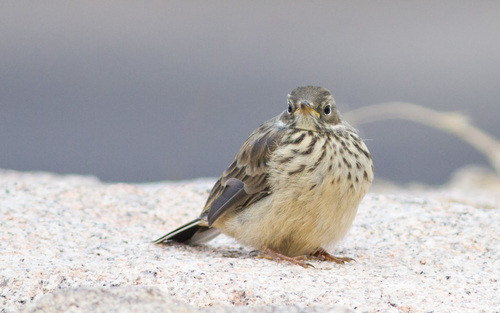
The American pipit (Anthus rubescens), formerly known as the buff-bellied pipit, is a small songbird native to North America. It was first described by Marmaduke Tunstall in his 1771 Ornithologia Britannica. It was formerly classified as a form of the water pipit. The former subspecies, Siberian pipit, is now considered a distinct species.
Like most other pipits, the American pipit is an undistinguished-looking species which usually can be seen to run around on the ground. It has lightly streaked grey-brown upperparts and is diffusely streaked below on the buff breast and flanks. The belly is whitish, the bill and legs are dark. The related Siberian pipit is darker above and has bolder black streaking on its whiter underparts; its legs have a reddish hue. The call is a squeaky sip.
Measurements: Length: 16 cm Weight: 22 g Wingspan: 24 cm The scientific name is from Latin. Anthus is the name for a small bird of grasslands, and the specific rubescens means "reddish", from ruber, "ruddy". Three subspecies are currently recognized: Wikipedia →