
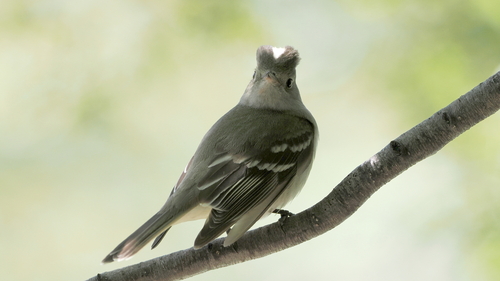
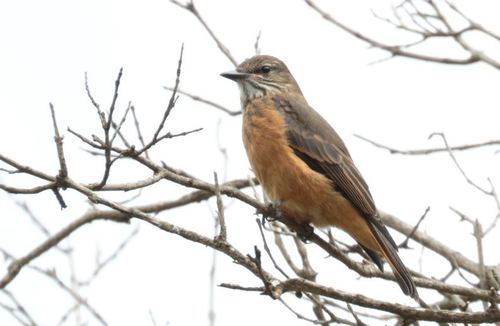

Torrent Tyrannulet

Torrent Tyrannulet

Serpophaga cinerea

Silhouette: Emily Willoughby · PhyloPic

LCLeast ConcernNTVUENCR
Daily sighting probability <5% · Rare
at Quito

In 3 days ~10% in a week ~20%

35 Verified sightings at Quito
4,779 In all 14 parks From 2019 to 2026
May Best month
☀️ Diurnal When it's spotted

About the Torrent Tyrannulet

The torrent tyrannulet (Serpophaga cinerea) is a small bird in the family Tyrannidae, the tyrant flycatchers. It is found in Bolivia, Colombia, Costa Rica, Ecuador, Panama, Peru, and Venezuela. The torrent tyrannulet is 9.5 to 12 cm (3.7 to 4.7 in) long; eight individuals weighed an average of 8.3 g (0.29 oz). Adults of the nominate subspecies have a mostly black head with a partially hidden white patch in the center of the crown. Their back, rump, and uppertail coverts are gray. Their wings are mostly black with gray or grayish white edges on the coverts. Their tail is black and sometimes has indistinct grayish white tips on the feathers. Their chin and throat are grayish white. The center of their breast and their belly are white and their undertail coverts slightly grayish. Adult females have a slightly duller black crown and nape than males and a smaller white crown patch or none at all. Juveniles have a dusky crown with some dull gray mixed in and brownish gray upperparts that are darker on the uppertail coverts... Wikipedia →

Sounds

Song0:40

Colombia · 2020

© Mauricio Cuellar Ramirez (@Birding.travel) · XC589687 · CC BY-NC-SA 4.0

Call0:07

Colombia · 2020

© Jerome Fischer · XC577139 · CC BY-NC-SA 4.0

Dawn song0:22

Colombia · 1995

© Paul Coopmans · XC264679 · CC BY-NC-SA 4.0

Global Distribution

Parks Where Found

# Park Country Daily sighting probability
1 Los Quetzales National Park 🇨🇷 Costa Rica
~30%
2 Farallones de Cali National Natural Park 🇨🇴 Colombia
~20%
3 Volcán Barú National Park 🇵🇦 Panama
~10%
4 Los Nevados National Natural Park 🇨🇴 Colombia
~10%
5 Tapantí-Macizo de la Muerte National Park 🇨🇷 Costa Rica
~10%
6 Chirripó National Park 🇨🇷 Costa Rica
~10%
7 La Amistad International Park (Panama) 🇵🇦 Panama
<5%
8 Braulio Carrillo National Park 🇨🇷 Costa Rica
<5%
9 Poás Volcano National Park 🇨🇷 Costa Rica
<5%
10 Chingaza National Natural Park 🇨🇴 Colombia
<5%
11 Arenal Volcano National Park 🇨🇷 Costa Rica
<5%
12 Podocarpus National Park 🇪🇨 Ecuador
<5%
13 Manu National Park 🇵🇪 Peru
<5%
14 Monteverde Cloud Forest Reserve 🇨🇷 Costa Rica
<5%

Cities Where Found

# City Country Daily sighting probability
1 Quito 🇪🇨 Ecuador
<5%
2 Bogota 🇨🇴 Colombia
<5%
3 Medellín 🇨🇴 Colombia
<5%
4 Cali 🇨🇴 Colombia
<5%

Before you go

What are the chances of seeing a Torrent Tyrannulet in Quito?

Rare

Under 5% of wildlife watchers report a Torrent Tyrannulet sighting in Quito on a given day, based on 35 verified sightings from GBIF citizen-science data. It is the 89th most-seen of the 167 birds we can rate there. Over three days the chance rises to about 10%, and over a week to about 20%, if each day is a fresh chance.

When is the best time to see a Torrent Tyrannulet in Quito?

February, May and September–October

In those months about 10% of wildlife watchers report a Torrent Tyrannulet in Quito on a given day, against under 5% in March–April, June–August and November–January, the lowest months.

What time of day is best to see a Torrent Tyrannulet?

Between 1 and 4 pm

Across all the parks we cover, that three-hour window holds the most Torrent Tyrannulet sightings with a recorded time, and about 9 in 10 of them come between 6 am and 6 pm: it is a daytime animal.

Is Quito the best place to see a Torrent Tyrannulet?

Yes

Of the 4 cities where we can rate Torrent Tyrannulet sightings, Quito has the highest daily chance: under 5%. Next come Bogota (Colombia, under 5%) and Medellín (Colombia, under 5%).

Where does the Torrent Tyrannulet sighting chance come from?

GBIF citizen-science records

It is estimated from how often the Torrent Tyrannulet is recorded against all the birds logged in Quito (35 verified sightings), calibrated against known sighting rates. Figures are rounded to the nearest 10% because citizen-science data supports honest approximations, not decimals, and months with records from fewer than five people show "—". How it works.

← Back to Quito