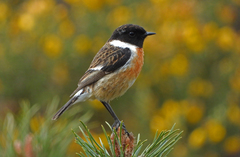
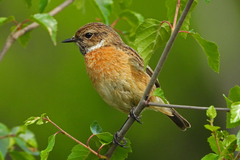
European Stonechat

European Stonechat

Saxicola rubicola

Silhouette: PhyloPic

Daily sighting probability ~20% · Possible
at Rabat

In 3 days ~50% in a week ~80%

38 Verified sightings at Rabat
10,706 In all 22 parks From 2019 to 2026
December Best month
☀️ Diurnal When it's spotted

About the European Stonechat

The European stonechat (Saxicola rubicola) is a small passerine bird that was formerly classed as a subspecies of the common stonechat. Long considered a member of the thrush family, Turdidae, genetic evidence has placed it and its relatives in the Old World flycatcher family, Muscicapidae. It is found across Europe, as far east as Ukraine and the South Caucasus, and in parts of North Africa.

The European stonechat was formally described by the Swedish naturalist Carl Linnaeus in 1766 in the twelfth edition of his Systema Naturae under the binomial name Motacilla rubicola. This species is now placed in the genus Saxicola that was introduced by the German naturalist Johann Matthäus Bechstein in 1802. The English name derives from its call, sounding like two stones knocked together. The scientific name Saxicola means "rock-dweller", from Latin saxum meaning "a rock" and incola meaning "dwelling in". The specific epithet combines the Latin rubus meaning "brambles" with incola. The subspecies name hibernans refers to Ireland (Latin, Hibernia).

In the past, the European stonechat was generally considered conspecific with the Siberian stonechat and African stonechat... Wikipedia →

Sounds

Call0:51

France · 2026

© Louis-Marie Gourmelon · XC1153625 · CC BY-NC-SA 4.0

Song0:49

Belgium · 2026

© Thijs Calu · XC1090404 · CC BY-NC-SA 4.0

Alarm call0:26

Spain · 2025

© Jacobo Ramil Millarengo · XC989130 · CC BY-NC-SA 4.0

Global Distribution

Parks Where Found

# Park Country Daily sighting probability
1 Kiskunság National Park 🇭🇺 Hungary
~60%
2 Doñana National Park 🇪🇸 Spain
~60%
3 Monfragüe National Park 🇪🇸 Spain
~40%
4 Hortobágy National Park 🇭🇺 Hungary
~40%
5 Sierra Nevada National Park 🇪🇸 Spain
~30%
6 Fertő-Hanság National Park 🇭🇺 Hungary
~30%
7 Picos de Europa National Park 🇪🇸 Spain
~30%
8 Snowdonia National Park 🇬🇧 United Kingdom
~30%
9 Sierra de Guadarrama National Park 🇪🇸 Spain
~20%
10 Ordesa y Monte Perdido National Park 🇪🇸 Spain
~20%
11 Camargue 🇫🇷 France
~10%
12 Pyrénées National Park 🇫🇷 France
~10%
13 Wadden Sea National Park 🇩🇪 Germany
~10%
14 Cévennes National Park 🇫🇷 France
~10%
15 Białowieża National Park 🇵🇱 Poland
~10%
16 Cairngorms National Park 🇬🇧 United Kingdom
~10%
17 Aigüestortes National Park 🇪🇸 Spain
~10%
18 Ecrins National Park 🇫🇷 France
~10%
19 Tatra National Park 🇸🇰 Slovakia
<5%
20 Triglav National Park 🇸🇮 Slovenia
<5%
21 Bavarian Forest National Park 🇩🇪 Germany
<5%
22 Biebrza National Park 🇵🇱 Poland
<5%

Cities Where Found

# City Country Daily sighting probability
1 Ramallah 🇵🇸 Palestine
~30%
2 Porto 🇵🇹 Portugal
~30%
3 Antalya 🇹🇷 Turkey
~20%
4 Rabat 🇲🇦 Morocco
~20%
5 Tel Aviv 🇮🇱 Israel
~20%
6 Sincan 🇹🇷 Turkey
~20%
7 Jerusalem 🇮🇱 Israel
~10%
8 Beirut 🇱🇧 Lebanon
~10%
9 Casablanca 🇲🇦 Morocco
~10%
10 Barcelona 🇪🇸 Spain
~10%

Before you go

What are the chances of seeing a European Stonechat in Rabat?

Possible

About 20% of wildlife watchers report a European Stonechat sighting in Rabat on a given day, based on 38 verified sightings from GBIF citizen-science data. It is the 36th most-seen of the 100 birds we can rate there. Over three days the chance rises to about 50%, and over a week to about 80%, if each day is a fresh chance.

When is the best time to see a European Stonechat in Rabat?

December

In that month about 40% of wildlife watchers report a European Stonechat in Rabat on a given day, against about 10% in March to September, the lowest months. That is one of Rabat's wettest months, with about 65 mm of rain against almost none in July.

What time of day is best to see a European Stonechat?

Between 8 and 11 am

Across all the parks we cover, that three-hour window holds the most European Stonechat sightings with a recorded time, and about 8 in 10 of them come between 6 am and 6 pm: it is a daytime animal.

Is Rabat the best place to see a European Stonechat?

4th of 39

Of the 39 cities where we can rate European Stonechat sightings, Rabat ranks 4th at about 20%. The best odds are in Ramallah (Palestine, about 30%), Porto (Portugal, about 30%) and Antalya (Turkey, about 20%).

Which relatives of the European Stonechat live in Rabat?

Same family: Muscicapidae

The closest relatives of the European Stonechat that you can see in Rabat (family Muscicapidae, Old World Flycatchers, Robins, and Chats) are European Robin (about 30%), European Pied Flycatcher (about 10%) and Spotted Flycatcher (about 10%), with each one's daily chance of a sighting.

Where does the European Stonechat sighting chance come from?

GBIF citizen-science records

It is estimated from how often the European Stonechat is recorded against all the birds logged in Rabat (38 verified sightings), calibrated against known sighting rates. Figures are rounded to the nearest 10% because citizen-science data supports honest approximations, not decimals, and months with records from fewer than five people show "—". How it works.
← Back to Rabat