Brown Creeper

Brown Creeper

Certhia americana

Silhouette: Andy Wilson · PhyloPic

LCLeast ConcernNTVUENCR
Daily sighting probability ~10% · With luck
at San Francisco

In 3 days ~30% in a week ~60%

13,263 Verified sightings at San Francisco
15,825 In all 32 parks From 2019 to 2026
September Best month
☀️ Diurnal When it's spotted

About the Brown Creeper

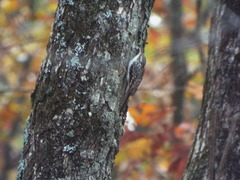
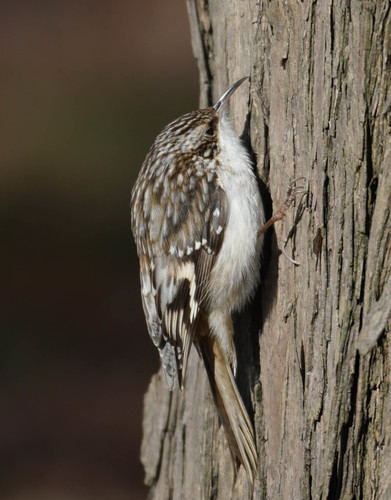
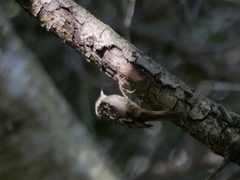
The brown creeper (Certhia americana), also known as the American treecreeper, is a small songbird, the only North American member of the treecreeper family Certhiidae. Adults are brown on the upper parts with light spotting, resembling a piece of tree bark, with white underparts. They have a long thin bill with a slight downward curve and a long stiff tail used for support as the bird creeps upwards. The male creeper has a slightly larger bill than the female. Brown creepers are smaller than white-breasted nuthatches but larger than golden-crowned kinglets.

Measurements: Length: 4.7–5.5 in (12–14 cm) Weight: 0.2–0.3 oz (5.7–8.5 g) Wingspan: 6.7–7.9 in (17–20 cm) Its voice includes single very high pitched, short, often insistent, piercing calls; see, or swee. The song often has a cadence like; pee pee willow wee or see tidle swee, with notes similar to the calls. Creepers in California have songs of four to nine syllables, except in the San Bernardino Mountains, where there are as many as nine to thirteen syllables per song, but within the same two second time frame.

This species's avoidance of edges, cryptic plumage, and high-pitched vocalizations contribute to... Wikipedia →
Sounds

Song0:41

United States · 2026

© Rachel Hudson · XC1091318 · CC BY-NC-SA 4.0

Call0:19

United States · 2026

© Greg Irving · XC1077858 · CC BY-NC-SA 4.0

Call0:10

Mexico · 2024

© Matthew L. Brady · XC978333 · CC BY-NC-SA 4.0

Global Distribution

Parks Where Found

# Park Country Daily sighting probability
1 Yosemite National Park 🇺🇸 United States
~50%
2 Sequoia and Kings Canyon National Parks 🇺🇸 United States
~40%
3 Reserva de la Biosfera Mariposa Monarca 🇲🇽 Mexico
~40%
4 Redwood National Park 🇺🇸 United States
~20%
5 Acadia National Park 🇺🇸 United States
~20%
6 Olympic National Park 🇺🇸 United States
~20%
7 Pacific Rim National Park Reserve 🇨🇦 Canada
~20%
8 Point Pelee National Park 🇨🇦 Canada
~20%
9 Great Bear Rainforest 🇨🇦 Canada
~10%
10 Banff National Park 🇨🇦 Canada
~10%
11 Voyageurs National Park 🇺🇸 United States
~10%
12 Cumbres de Monterrey National Park 🇲🇽 Mexico
~10%
13 Glacier National Park 🇺🇸 United States
~10%
14 Rocky Mountain National Park 🇺🇸 United States
~10%
15 La Tigra National Park 🇭🇳 Honduras
~10%
16 Riding Mountain National Park 🇨🇦 Canada
~10%
17 Great Smoky Mountains National Park 🇺🇸 United States
~10%
18 Congaree National Park 🇺🇸 United States
~10%
19 Isle Royale National Park 🇺🇸 United States
~10%
20 Grand Canyon National Park 🇺🇸 United States
~10%
21 Grand Teton National Park 🇺🇸 United States
~10%
22 Celaque National Park 🇭🇳 Honduras
~10%
23 Guadalupe Mountains National Park 🇺🇸 United States
<5%
24 Katmai National Park 🇺🇸 United States
<5%
25 Cape Breton Highlands National Park 🇨🇦 Canada
<5%
26 Yellowstone National Park 🇺🇸 United States
<5%
27 Shenandoah National Park 🇺🇸 United States
<5%
28 Jasper National Park 🇨🇦 Canada
<5%
29 Zion National Park 🇺🇸 United States
<5%
30 Kenai Fjords National Park 🇺🇸 United States
<5%
31 Elk Island National Park 🇨🇦 Canada
<5%
32 Big Bend National Park 🇺🇸 United States
<5%

Cities Where Found

# City Country Daily sighting probability
1 Portland 🇺🇸 United States
~30%
2 Seattle 🇺🇸 United States
~30%
3 Vancouver 🇨🇦 Canada
~20%
4 Montreal 🇨🇦 Canada
~20%
5 San Francisco 🇺🇸 United States
~10%
6 Chicago 🇺🇸 United States
~10%
7 Toronto 🇨🇦 Canada
~10%
8 New York City 🇺🇸 United States
~10%
9 Minneapolis [Saint Paul] 🇺🇸 United States
~10%
10 Detroit 🇺🇸 United States
~10%

Before you go

What are the chances of seeing a Brown Creeper in San Francisco?

With luck

About 10% of wildlife watchers report a Brown Creeper sighting in San Francisco on a given day, based on 13,263 verified sightings from GBIF citizen-science data. It is the 66th most-seen of the 375 birds we can rate there. Over three days the chance rises to about 30%, and over a week to about 60%, if each day is a fresh chance.

When is the best time to see a Brown Creeper in San Francisco?

September and October

In those months about 20% of wildlife watchers report a Brown Creeper in San Francisco on a given day, against about 10% in November to August, the lowest months. Those are among San Francisco's driest months, with about 15 mm of rain a month against 110 mm in December.

What time of day is best to see a Brown Creeper?

Between 9 am and noon

Across all the parks we cover, that three-hour window holds the most Brown Creeper sightings with a recorded time, and nearly all of them come between 6 am and 6 pm: it is a daytime animal.

Is San Francisco the best place to see a Brown Creeper?

5th of 27

Of the 27 cities where we can rate Brown Creeper sightings, San Francisco ranks 5th at about 10%. The best odds are in Portland (United States, about 30%), Seattle (United States, about 30%) and Vancouver (Canada, about 20%).

Which relatives of the Brown Creeper live in San Francisco?

Same order: Passeriformes

The closest relatives of the Brown Creeper that you can see in San Francisco (order Passeriformes, Perching Birds) are American Crow (about 80%), House Finch (about 70%) and Black Phoebe (about 70%), with each one's daily chance of a sighting.

Where does the Brown Creeper sighting chance come from?

GBIF citizen-science records

It is estimated from how often the Brown Creeper is recorded against all the birds logged in San Francisco (13,263 verified sightings), calibrated against known sighting rates. Figures are rounded to the nearest 10% because citizen-science data supports honest approximations, not decimals, and months with records from fewer than five people show "—". How it works.

← Back to San Francisco