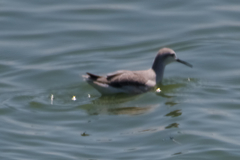
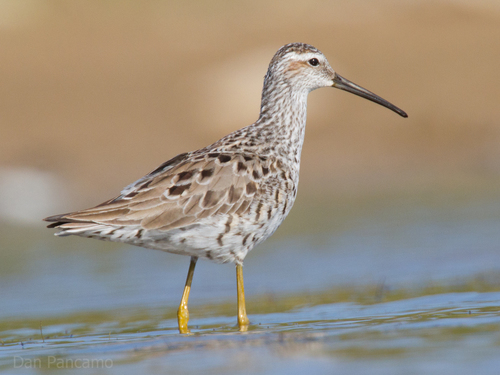
Wilson's Phalarope

Wilson's Phalarope

Phalaropus tricolor

Silhouette: Oscar G. Miranda · PhyloPic

LCLeast ConcernNTVUENCR
Daily sighting probability <5% · Rare
at Santa Cruz de la Sierra

In 3 days ~10% in a week ~20%

10 Verified sightings at Santa Cruz de la Sierra
880 In all 24 parks From 2019 to 2026
September Best month
☀️ Diurnal When it's spotted

About the Wilson's Phalarope

Wilson's phalarope (Phalaropus tricolor) is a small wader. This bird, the largest of the phalaropes, breeds in the prairies of North America in western Canada and the western United States. It is migratory, wintering in inland salt lakes near the Andes in Argentina. They are passage migrants through Central America around March/April and again during September/October. The species is a rare vagrant to western Europe.

This species is often very tame and approachable. Sometimes it is placed in a monotypic genus Steganopus. This bird is named after Scottish-American ornithologist Alexander Wilson. The English and genus names for phalaropes come through French phalarope and scientific Latin Phalaropus from Ancient Greek phalaris, "coot", and pous, "foot". Coots and phalaropes both have lobed toes. The specific tricolor is from Latin tri-, "three-", and color, coloris "colour".

Wilson's phalarope is slightly larger than the red phalarope at about 23 cm (9.1 in) in length. It is a dainty shorebird with lobed toes and a straight fine black bill. The breeding female is predominantly grey and brown above, with white underparts, a reddish neck and reddish flank... Wikipedia →


Sounds

Call0:40

Brazil · 2023

© Aluisio Ribeiro · XC836128 · CC BY-NC-SA 4.0

Alarm call0:11

Mexico · 2020

© Isain Contreras Rodríguez · XC583613 · CC BY-NC-SA 4.0

Flight call0:06

United States · 2015

© Paul Marvin · XC294840 · CC BY-NC-SA 4.0

Global Distribution

Parks Where Found

# Park Country Daily sighting probability
1 Isla del Coco National Park 🇨🇷 Costa Rica
~20%
2 Lauca National Park 🇨🇱 Chile
~10%
3 Celestún Biosphere Reserve 🇲🇽 Mexico
<5%
4 Torres del Paine National Park 🇨🇱 Chile
<5%
5 El Vizcaíno Biosphere Reserve 🇲🇽 Mexico
<5%
6 Padre Island National Seashore 🇺🇸 United States
<5%
7 Channel Islands National Park 🇺🇸 United States
<5%
8 Ría Lagartos Biosphere Reserve 🇲🇽 Mexico
<5%
9 Yellowstone National Park 🇺🇸 United States
<5%
10 Badlands National Park 🇺🇸 United States
<5%
11 Machalilla National Park 🇪🇨 Ecuador
<5%
12 Big Bend National Park 🇺🇸 United States
<5%
13 Galápagos Islands 🇪🇨 Ecuador
<5%
14 Death Valley National Park 🇺🇸 United States
<5%
15 Grand Teton National Park 🇺🇸 United States
<5%
16 Palo Verde National Park 🇨🇷 Costa Rica
<5%
17 Manu National Park 🇵🇪 Peru
<5%
18 Bastimentos Island National Marine Park 🇵🇦 Panama
<5%
19 Saguaro National Park 🇺🇸 United States
<5%
20 Grand Canyon National Park 🇺🇸 United States
<5%
21 Tambopata National Reserve 🇵🇪 Peru
<5%
22 La Amistad International Park (Panama) 🇵🇦 Panama
<5%
23 Rocky Mountain National Park 🇺🇸 United States
<5%
24 Point Pelee National Park 🇨🇦 Canada
<5%

Cities Where Found

# City Country Daily sighting probability
1 Cochabamba 🇧🇴 Bolivia
~10%
2 Lima 🇵🇪 Peru
~10%
3 Rotterdam [The Hague] 🇳🇱 Netherlands
~10%
4 Santa Cruz de la Sierra 🇧🇴 Bolivia
<5%
5 Mexico City 🇲🇽 México
<5%
6 Los Angeles 🇺🇸 United States
<5%
7 Mesa 🇺🇸 United States
<5%
8 Denver 🇺🇸 United States
<5%
9 Montevideo 🇺🇾 Uruguay
<5%
10 San Diego 🇺🇸 United States
<5%

Before you go

What are the chances of seeing a Wilson's Phalarope in Santa Cruz de la Sierra?

Rare

Under 5% of wildlife watchers report a Wilson's Phalarope sighting in Santa Cruz de la Sierra on a given day, based on 10 verified sightings from GBIF citizen-science data. It is the 153rd most-seen of the 208 birds we can rate there. Over three days the chance rises to about 10%, and over a week to about 20%, if each day is a fresh chance.

When is the best time to see a Wilson's Phalarope in Santa Cruz de la Sierra?

September

In that month about 20% of wildlife watchers report a Wilson's Phalarope in Santa Cruz de la Sierra on a given day, against under 5% in October to August, the lowest months. That is one of Santa Cruz de la Sierra's driest months, with about 50 mm of rain against 170 mm in January.

What time of day is best to see a Wilson's Phalarope?

Between 8 and 11 am

Across all the parks we cover, that three-hour window holds the most Wilson's Phalarope sightings with a recorded time, and about 9 in 10 of them come between 6 am and 6 pm: it is a daytime animal.

Is Santa Cruz de la Sierra the best place to see a Wilson's Phalarope?

4th of 28

Of the 28 cities where we can rate Wilson's Phalarope sightings, Santa Cruz de la Sierra ranks 4th at under 5%. The best odds are in Cochabamba (Bolivia, about 10%), Lima (Peru, about 10%) and Rotterdam [The Hague] (Netherlands, about 10%).

Which relatives of the Wilson's Phalarope live in Santa Cruz de la Sierra?

Same family: Scolopacidae

The closest relatives of the Wilson's Phalarope that you can see in Santa Cruz de la Sierra (family Scolopacidae, Sandpipers and Allies) are Lesser Yellowlegs (about 10%), Solitary Sandpiper (about 10%) and Greater Yellowlegs (about 10%), with each one's daily chance of a sighting.

Where does the Wilson's Phalarope sighting chance come from?

GBIF citizen-science records

It is estimated from how often the Wilson's Phalarope is recorded against all the birds logged in Santa Cruz de la Sierra (10 verified sightings), calibrated against known sighting rates. Figures are rounded to the nearest 10% because citizen-science data supports honest approximations, not decimals, and months with records from fewer than five people show "—". How it works.

← Back to Santa Cruz de la Sierra