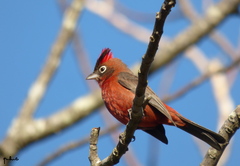
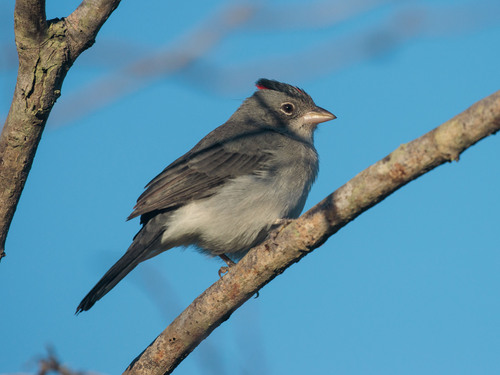
Red-crested Finch

Red-crested Finch

Coryphospingus cucullatus

Silhouette: Sheatherius · PhyloPic

LCLeast ConcernNTVUENCR
Daily sighting probability <5% · Rare
at São Paulo

In 3 days <5%

7 Verified sightings at São Paulo
2,429 In all 9 parks From 2019 to 2026
February Best month
☀️ Diurnal When it's spotted

About the Red-crested Finch

The red pileated finch (Coryphospingus cucullatus), also known as the red-crested finch, is a species of bird in the family Thraupidae, the tanagers and allies. It is found in Argentina, Bolivia, Brazil, Colombia, Ecuador, Paraguay, Peru, Uruguay, and possibly Guyana and Suriname.

The red pileated finch was first described in 1776 by the German zoologist Philipp Ludwig Statius Müller with the binomial Fringilla cucullata. In 1851 Jean Cabanis erected the genus Coryphospingus for cuculatus and what is now the grey pileated finch (C. pileatus). The old and new genera were in the finch family Fringillidae but several early twentieth century studies showed that Coryphospingus belonged in its present tanager family. The two pileated "finches" form a superspecies and hybridize where their ranges overlap. The genera Coryphospingus, Lanio, Eucometis, and Tachyphonus are closely related.

The red pileated finch has these three subspecies: It has a shortish... Wikipedia →

Sounds

Song0:08

Argentina · 2024

© Faustino Hollmann · XC1176841 · CC BY-NC-SA 4.0

Call0:26

Brazil · 2023

© JAYRSON ARAUJO DE OLIVEIRA · XC811910 · CC BY-NC-SA 4.0

Subsong0:17

Brazil · 2020

© Marcelo da Rocha · XC592935 · CC BY-NC-SA 4.0

Global Distribution

Parks Where Found

# Park Country Daily sighting probability
1 Chapada dos Guimarães National Park 🇧🇷 Brazil
~40%
2 El Impenetrable National Park 🇦🇷 Argentina
~20%
3 Podocarpus National Park 🇪🇨 Ecuador
~20%
4 Iguazú National Park 🇦🇷 Argentina
~20%
5 Iguaçu National Park 🇧🇷 Brazil
~20%
6 El Palmar National Park 🇦🇷 Argentina
~10%
7 Iberá National Park 🇦🇷 Argentina
~10%
8 Serra da Canastra National Park 🇧🇷 Brazil
<5%
9 Parque Estadual Encontro das Águas 🇧🇷 Brazil
<5%

Cities Where Found

# City Country Daily sighting probability
1 Asuncion 🇵🇾 Paraguay
~20%
2 Cordoba 🇦🇷 Argentina
~10%
3 Campo Grande 🇧🇷 Brazil
<5%
4 Santa Cruz de la Sierra 🇧🇴 Bolivia
<5%
5 Goiânia 🇧🇷 Brazil
<5%
6 Brasilia 🇧🇷 Brazil
<5%
7 Buenos Aires 🇦🇷 Argentina
<5%
8 Curitiba 🇧🇷 Brazil
<5%
9 São Paulo 🇧🇷 Brazil
<5%

Zoos & Centres Where Found

# Zoo / Centre Country
1 Zürich Zoo 🇨🇭 Switzerland In captivity
2 San Diego Zoo Safari Park 🇺🇸 United States In captivity
3 Toledo Zoo 🇺🇸 United States In captivity
4 Bloedel Conservatory 🇨🇦 Canada In captivity

Before you go

What are the chances of seeing a Red-crested Finch in São Paulo?

Rare

Under 5% of wildlife watchers report a Red-crested Finch sighting in São Paulo on a given day, based on 7 verified sightings from GBIF citizen-science data. It is the 319th most-seen of the 353 birds we can rate there. Over three days the chance rises to under 5%, if each day is a fresh chance.

When is the best time to see a Red-crested Finch in São Paulo?

Any time of year

In every month with enough records, under 5% of wildlife watchers report a Red-crested Finch in São Paulo on a given day, so our monthly data shows no clear season.

What time of day is best to see a Red-crested Finch?

Between 8 and 11 am

Across all the parks we cover, that three-hour window holds the most Red-crested Finch sightings with a recorded time, and about 9 in 10 of them come between 6 am and 6 pm: it is a daytime animal.

Is São Paulo the best place to see a Red-crested Finch?

9th of 9

Of the 9 cities where we can rate Red-crested Finch sightings, São Paulo ranks 9th at under 5%. The best odds are in Asuncion (Paraguay, about 20%), Cordoba (Argentina, about 10%) and Campo Grande (Brazil, under 5%).

Where does the Red-crested Finch sighting chance come from?

GBIF citizen-science records

It is estimated from how often the Red-crested Finch is recorded against all the birds logged in São Paulo (7 verified sightings), calibrated against known sighting rates. Figures are rounded to the nearest 10% because citizen-science data supports honest approximations, not decimals, and months with records from fewer than five people show "—". How it works.

← Back to São Paulo