Pacific Reef Heron

Pacific Reef Heron

Egretta sacra

Silhouette: L. Shyamal · PhyloPic

LCLeast ConcernNTVUENCR
Daily sighting probability <5% · Rare
at Sydney

In 3 days <5%

55 Verified sightings at Sydney
2,121 In all 14 parks From 2019 to 2026
July Best month
☀️ Diurnal When it's spotted

About the Pacific Reef Heron

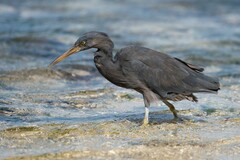
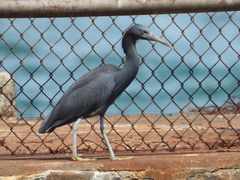
The Pacific reef heron (Egretta sacra), also known as the eastern reef heron or eastern reef egret, is a species of heron found throughout southern Asia and Oceania. It occurs in two colour morphs with either slaty grey or pure white plumage. The sexes are similar in appearance.

The Pacific reef heron was formally described in 1789 by the German naturalist Johann Friedrich Gmelin in his revised and expanded edition of Carl Linnaeus's Systema Naturae. He placed it with the herons, cranes and egrets in the genus Ardea and coined the binomial name Ardea sacra. Gmelin based his description on the "Sacred heron" that had been described in 1785 by the English ornithologist John Latham in his multi-volume work A General Synopsis of Birds. The naturalist Joseph Banks had provided Latham with a specimen of a white morph that had been collected on Tahiti. The Pacific reef heron is now placed with 12 other species in the genus Egretta that was introduced in 1817 by the German naturalist Johann Reinhold Forster. The genus name comes from the Provençal French for the little egret, aigrette, a diminutive of aigron, "heron". The specific epithet sacra is from Latin sacer meaning "sacred... Wikipedia →

Sounds

Call0:23

Fiji · 2012

© Matthias Feuersenger · XC108895 · CC BY-NC-ND 2.5

Alarm call0:04

Japan · 2014

© Ross Gallardy · XC193903 · CC BY-NC-SA 4.0

Global Distribution

Parks Where Found

# Park Country Daily sighting probability
1 Cape Range 🇦🇺 Australia
~70%
2 Komodo National Park 🇮🇩 Indonesia
~60%
3 Ningaloo Marine Park 🇦🇺 Australia
~60%
4 Raja Ampat 🇮🇩 Indonesia
~30%
5 Tangkoko Nature Reserve 🇮🇩 Indonesia
~20%
6 Noosa National Park 🇦🇺 Australia
~10%
7 Rottnest Island 🇦🇺 Australia
~10%
8 Daintree National Park 🇦🇺 Australia
~10%
9 Abel Tasman National Park 🇳🇿 New Zealand
~10%
10 Bali Barat National Park 🇮🇩 Indonesia
~10%
11 Booderee National Park 🇦🇺 Australia
<5%
12 Royal National Park 🇦🇺 Australia
<5%
13 Fiordland National Park 🇳🇿 New Zealand
<5%
14 Taroko National Park 🇹🇼 Taiwan
<5%

Cities Where Found

# City Country Daily sighting probability
1 Naha 🇯🇵 Japan
~20%
2 Denpasar 🇮🇩 Indonesia
~20%
3 Đà Nẵng 🇻🇳 Vietnam
~20%
4 Kitakyushu 🇯🇵 Japan
~10%
5 Davao City 🇵🇭 Philippines
~10%
6 Singapore 🇸🇬 Singapore
<5%
7 Hong Kong 🇨🇳 China
<5%
8 Busan 🇰🇷 South Korea
<5%
9 Auckland 🇳🇿 New Zealand
<5%
10 Taipei 🇹🇼 Taiwan
<5%

Before you go

What are the chances of seeing a Pacific Reef Heron in Sydney?

Rare

Under 5% of wildlife watchers report a Pacific Reef Heron sighting in Sydney on a given day, based on 55 verified sightings from GBIF citizen-science data. It is the 175th most-seen of the 243 birds we can rate there. Over three days the chance rises to under 5%, if each day is a fresh chance.

When is the best time to see a Pacific Reef Heron in Sydney?

Any time of year

In every month with enough records, under 5% of wildlife watchers report a Pacific Reef Heron in Sydney on a given day, so our monthly data shows no clear season.

What time of day is best to see a Pacific Reef Heron?

Between 11 am and 2 pm

Across all the parks we cover, that three-hour window holds the most Pacific Reef Heron sightings with a recorded time, and about 9 in 10 of them come between 6 am and 6 pm: it is a daytime animal.

Is Sydney the best place to see a Pacific Reef Heron?

15th of 17

Of the 17 cities where we can rate Pacific Reef Heron sightings, Sydney ranks 15th at under 5%. The best odds are in Naha (Japan, about 20%), Denpasar (Indonesia, about 20%) and Đà Nẵng (Vietnam, about 20%).

Where does the Pacific Reef Heron sighting chance come from?

GBIF citizen-science records

It is estimated from how often the Pacific Reef Heron is recorded against all the birds logged in Sydney (55 verified sightings), calibrated against known sighting rates. Figures are rounded to the nearest 10% because citizen-science data supports honest approximations, not decimals, and months with records from fewer than five people show "—". How it works.

← Back to Sydney